Editorial illustration about discovering unknown online. AI image by WP AI.
Part II: Finding the Unknown Online
Part II: Finding the Unknown Online
The Methodology of the Hunt: Pearl Spinning, Diamonds in the Rough, and the Analog Lifeline
In Part I of Behind the Curtain, we laid bare the digital engine—the software, agentic browsers, and capture suites that keep DrWeb’s Domain running at velocity. But hardware and apps are only the skeleton; they are the heavy machinery waiting for a spark. The real work—the investigative artisan’s craft—begins when you turn that machinery toward the fog of the open web and attempt to pull structure from chaos.
For decades, commercial search engines have trained the public to accept the first page of algorithmic convenience as the final word. Corporate consolidation, SEO optimization, and political scrubbing have turned standard search into a high-gloss shopping mall. But true citizen journalism doesn’t shop; it hunts. Here, we share our long-term, battle-tested methods for researching the deep currents of online information—moving past the superficial noise to find what powerful interests prefer to keep hidden.
I. Major Search Tools and Advanced Architecture
A librarian’s pedigree teaches you early on that tools are only as sharp as the mind wielding them. Relying on a single search engine is professional malpractice. True information retrieval requires cross-platform triangulation:
Boolean Precision: Moving beyond simple keyword strings to deploy strict operators, exact-phrase matching, file-type filtering, and site-specific bounding. If a document exists on a government server or corporate registry, Boolean logic is the crowbar that opens the back door. Source: https://guides.library.uab.edu/advancedsearch/boolean
Federated and Specialized Indices: Bypassing general-purpose consumer filters to tap into academic repositories, archival databases, and specialized metadata indices where primary sources live before they are sanitized for public consumption. Source: https://www.base-search.net/
II. The Art of Pearl Spinning
When investigating complex political webs, corporate malfeasance, or institutional decay, you rarely start with a smoking gun. You start with a single, seemingly trivial thread—a footnote in a regulatory filing, an obscure name on a municipal contract, a cached press release from ten years ago.
Pearl spinning is the iterative process of pulling that single thread until the entire fabric unravels. You take one verified fact, query it against secondary and tertiary databases, pivot to corporate officer registries, map cross-references, and build a web of accountability. It requires patience, meticulous note-taking (in structures like CherryTree), and an unyielding refusal to abandon a lead simply because the initial trail goes cold.
The fuller reference entry, distinguishing citation pearl growing from subject pearl growing and citing the founding library-science literature: Pearl Growing — Wikipedia
III. Unearthing the “Diamond in the Rough”
The internet is an immense digital landfill layered over a vast, forgotten archive of human knowledge. The most explosive pieces of evidence rarely sit on high-traffic web pages; they are buried deep within forgotten PDFs, municipal sub-directories, defunct blog networks, or unindexed institutional portals.
Finding these “diamonds in the rough” means looking where others refuse to look: page four hundred of a search index, raw directory listings, and historical web caches. When you locate a primary document that an agency quietly unlinked or edited, you haven’t just found a source—you’ve secured an anchor for an unassailable investigative narrative.
SEE ALSO:
The Google Dorking term is not valid, a late addition to someone’s idea of category or subject. The subject is finding “Diamond in the Rough,” from Library Science. Not from this odd, mystery name. Finding Diamonds in the Rough
Bellingcat’s own field-tested toolkit for finding, archiving, and verifying buried or since-deleted material — including Wayback Machine techniques for recovering pages an agency has quietly unlinked or edited: Bellingcat’s Online Investigation Toolkit
IV. Talk to Who Knows What You Need to Know
Algorithms and archives will only take you so far. The fatal flaw of modern digital research is the assumption that everything worth knowing has been digitized. It hasn’t. Human memory, institutional lore, and confidential whistleblowing live outside the web browser.
When digital trails dead-end, you have to pick up the tools of old-school investigative journalism and professional librarianship: human intelligence. Talk to the retired clerk, the disgruntled whistleblower, the academic historian who spent forty years studying a single municipal scandal, or the regional archivist who remembers when the records were still kept on paper.
The Master Source List: Finding & Contacting Subject-Matter Experts Online
Essential guides and frameworks for mapping institutional profiles, verifying credentials, and securing direct phone or live contact across any industry.
GLG (Gerson Lehrman Group) Article:How to Effectively Conduct an Expert Interview Author / Publisher: Michael / GLG Content Team (Published November 17, 2021) Focus: The universal framework for primary research across any industry, detailing how to define intelligence goals, map out public secondary sources to isolate specialized authorities, and establish direct human contact.
Expert Network Calls Article:How to Conduct an Expert Interview: A Complete Guide for Insight-Driven Research Author / Publisher: Expert Network Calls Editorial Team (Published July 16, 2025) Focus: The step-by-step generic process of evaluating professional backgrounds, studying institutional pages or online registries to verify credentials, and structuring live conversations.
Expert Institute Article:How to Find Expert Witnesses: The Ultimate Guide Author / Publisher: Expert Institute Research Team Focus: How to systematically leverage public registries, peer-reviewed databases, and institutional directories to isolate specialists, verify their backgrounds, and acquire direct contact details for phone inquiries.
Tabitha Whiting Content Strategy Article:How to Harness Subject Matter Experts for Higher Quality Content Author / Publisher: Tabitha Whiting Focus: Practical, industry-agnostic workflows for mapping online communities, corporate rosters, and institutional pages to locate and interface directly with specialized authorities.
V. The Analog Lifeline: Phone, Fax, and Physical Archives
In our rush toward an all-digital future, we forget that vast swaths of the developing world—and plenty of stubborn municipal and state agencies right here at home—still operate on physical paper, direct telephone lines, and even fax machines.
In many international jurisdictions, local accountability records are never uploaded to a cloud server; they sit in dusty file cabinets in regional government offices. A direct phone call or a formal fax request often cuts through layers of bureaucratic digital obfuscation. The analog lifeline is not a relic of the past; it is the secret weapon of the modern independent journalist who refuses to be constrained by digital borders.
Official federal guidance instructing researchers to write, telephone, or e-mail ahead before visiting a physical Research Room in person: Plan Your Research Visit — U.S. National Archives (Accessed September 24, 2026.)
My so-called film career. I worked on films to learn more about the production, but mostly to learn to write better screenplays… See the below image of my list at IMDB.com: https://www.imdb.com/list/ls005215007/
5.3 (19K)After a violent incident with a special chemical, a research scientist is turned into a swamp plant monster. Director Wes Craven, Stars Louis Jourdan, Adrienne Barbeau, Ray Wise. Worked on this film, met Wes Craven. Was an amazing movie to work on, great crew and cast.
6.3 (91)A teacher falls in love with a student and deals with the reactions of the people around her. Director Paul Aaron, Stars Kate Jackson, Lenore Bender, William Bender, R. Allison Dukes. Worked on this film, in Charleston, SC. Great crew, taught me much about the film business of production, post-production. Worked in production office.
7.1 (46K)A group of seven former college friends gather for a weekend reunion at a South Carolina vacation home after the funeral of another of their college friends. Director Lawrence Kasdan, Stars Tom Berenger, Glenn Close, Jeff Goldblum. Worked on this film, Director Larry Kasdan was great to watch working and meet. Cast – just the best, so early in their careers. Worked as Production Assistant, helped with wrap party. In Beaufort, SC.
7.3 (329)This is based on a true story. Solomon Northrop is a black man in the mid 19th century before slavery was abolished. He’s a born freeman who works as a carpenter and is also a part time musician. One day he is approached by some men who want him to play for them. However, that is not their intention; they have kidnapped him and sold him into slavery. Now he has to endure the hardships that he has been spared because of his status as a freeman. And his family who don’t know what happened to him is searching for him but where do they go? And Solomon also wishes to let them know where he is so that they could get him but unfortunately no one believes his story or is willing to help him. Director, Gordon Parks. StarsAvery BrooksRhetta GreeneMason Adams. Worked on this film. Charleston, SC and Savannah, GA.
7.5 (1.6K)A TV reporter and cameraman are taken hostage on a tugboat while covering a workers strike. The demands of the hostage-takers are to collect all the nuclear detonators in the Charleston, SC area so they may be detonated at sea. They threaten to detonate a nuclear device of their own if their demand isn’t met. Director Edward Zwick, Stars Ed Flanders, Kathryn Walker, Roxanne Hart. Worked on this film. Ed Zwick director, good interesting film. Made in Charleston, SC. Worked as Production Assistant, Vehicle Coordinator.
This list was created by a member of the IMDb community and has not been reviewed or verified by IMDb.
From the Jersey Shore to the Silver Screen: 110 Years of Film History
What do The Amityville Horror, Coyote Ugly, Desperately Seeking Susan, A Complete Unknown, and Deliver Me from Nowhere have in common? More than you might think. Each has a connection to the Jersey Shore, part of a filmmaking history that stretches back more than a century.
From article…
It’s a history that Marci Mazzarotto, MFA, PhD, associate professor of communication at Georgian Court University, has spent years uncovering. Since joining Georgian Court in 2018, Dr. Mazzarotto has focused much of her scholarship on film, television, and mass media. That expertise, combined with her curiosity about New Jersey’s filmmaking history, ultimately led to her first book, The Jersey Shore on Film, published by The History Press.
One of the connections she uncovered is especially close to home. The 1979 horror classic The Amityville Horror was partially filmed on Georgian Court’s campus, a detail that even many accounts of the movie’s filming locations leave out. “I’m surprised at how many people don’t realize that it was filmed on our campus, and even most sources online don’t say anything about our campus,” Dr. Mazzarotto said.
It is exactly the kind of overlooked piece of film history she set out to document in The Jersey Shore on Film. The book profiles more than 140 films spanning 110 years, taking readers from South Amboy to Cape May and exploring the television shows and music videos that have also contributed to the region’s film history. Atlantic City alone has appeared in dozens of films, including The King of Marvin Gardens, Atlantic City, and Desperately Seeking Susan, while Asbury Park has been featured in productions such as The Wrestler, I Saw the TV Glow, and Deliver Me from Nowhere.
For Dr. Mazzarotto, the surprising part wasn’t how much filmmaking had taken place along the Shore. It was that no one had ever pulled the full story together. “There’s no literature. There was nothing about it in existence,” she said. “As an academic, you’re searching for questions that are not answered, spaces that still need that discourse.”
Finding a Story That Hadn’t Been Told
The idea for the book began not long after Dr. Mazzarotto moved from California to New Jersey in 2018 to join Georgian Court. By the following summer, she was considering a research project focused on New Jersey filmmaking. Her original idea was to explore filmmaking throughout the state beyond Fort Lee, which played a significant role in the early American film industry, but the subject quickly proved too broad. She then considered focusing exclusively on Asbury Park, but that scope felt too narrow. When she began conversations with The History Press in 2023, the publisher suggested focusing on the Jersey Shore.
Filling that gap in the region’s documented film history required extensive research. After signing a book contract in 2024, Dr. Mazzarotto spent about two years watching films, documenting locations, reading end credits, and reviewing sources, including newspaper coverage dating back to the time of production. The volume of material ultimately shaped the book’s structure, with dedicated sections on Atlantic City and Asbury Park, a broader look at productions throughout the Shore, and a section on Red Bank native Kevin Smith and eight of his films shot in the region.
What Keeps Bringing Filmmakers to the Shore?
As Dr. Mazzarotto researched more than a century of filmmaking, she began to see what has repeatedly drawn filmmakers to the area. “There was a grittiness to the Shore, like Asbury Park was very gritty,” she said. “There was a beauty to it.” Beyond the beaches and iconic boardwalks, the region offers filmmakers a wide variety of settings within relatively short distances.
Georgian Court itself is an example. The university’s Lakewood campus includes its Japanese Garden, contemporary facilities, and spaces that can take on a much more historic appearance. “I think people might be surprised at how much diversity there actually is here,” Dr. Mazzarotto said. “It’s just kind of that one-stop shop, as filmmakers call it, to be able to come to a location and get so many different types of feels and not have to move.”
That same variety can be found throughout the Shore. For Which Brings Me to You, filmmakers used dozens of locations, most along the Jersey Shore. Dr. Mazzarotto interviewed the film’s director, Peter Hutchings, who pointed to the ability to work within a small footprint while accessing diverse locations as one of the area’s advantages. And the Shore’s role in filmmaking may continue to grow. Dr. Mazzarotto pointed to New Jersey’s more robust tax incentives since 2018 and growing infrastructure as factors likely to bring even more production to the region.
From Film Scholar to First-Time Author
Film has long been central to Dr. Mazzarotto[’s] academic work at Georgian Court. She has written numerous peer-reviewed articles on film and focuses much of her scholarship on film, television, and mass media. The Jersey Shore on Film gave her an opportunity to bring that expertise to an audience beyond academia, with a book she wanted to be accessible and interesting to people who love the Jersey Shore, people who love film, and academics alike.
Yan, who teaches at Tsinghua University in Beijing, China, was using an agentic AI called Codex to set up an online course on a learning-management platform. But it quickly became clear that the adept AI could independently complete all the assignments, answer questions and participate in discussions, “without the learner being intellectually engaged” at all, Yan says.
The experience made Yan think that teaching students to reason and think for themselves “is more critical than ever”, he says. And he is hardly alone. In a 2025 survey of more than 1,000 US faculty members, conducted by the American Association of Colleges and Universities, 90% said they thought that generative AI will reduce students’ critical-thinking skills. Around 20% of higher-education students who use AI said that they already find it harder to work through problems without it, according to more than 8,000 respondents to a global survey this year.
“Learning happens as a consequence of cognitive processing. Cognitive processing is typically effortful, and that’s what AI effectively removes,” says cognitive psychologist Daniel Willingham at the University of Virginia in Charlottesville. “People are really worried about that.”
And science — in which people need to critically evaluate theories and data — is one important area that’s under threat from the AI revolution in large language models (LLMs). ”There is a risk that students outsource precisely the activities through which scientific thinking develops: formulating hypotheses, interpreting evidence, considering alternatives and struggling with uncertainty,” says Thomas Nygren, who studies education and critical thinking at Uppsala University in Sweden.
But all is not lost. Specialists in education and cognition have been studying critical thinking and how to develop it for years, and some have useful tips on how to stay cognitively sharp in the age of AI. “The building of critical thinking and higher-order thinking skills have become even more important,” says Stéphan Vincent-Lancrin, who led a ten-year programme on critical thinking at the Organisation for Economic Co-operation and Development (OECD) in Paris.
What is critical thinking?
Ask five people to define critical thinking, and you’ll get five different replies. (I tried.) “Critical thinking is sort of the pinnacle” of human cognition, says Willingham. “It’s kind of a basket term that captures instances in which people are thinking well.”
After Years as the Star of Must-See TV, Trump Faces the Sting of Cancellation
A boycott of the White House press pool by the major networks deprives the president of the oxygen of screen time. But he is still finding ways to get on the air.
Listen · 11:17 min, 432 comments
Television is how President Trump’s allies and even his aides communicate with him.Credit…Pete Marovich for The New York Times
For President Trump, this is the tree-falls-in-the-forest moment of his administration. If the most television-addicted president in history suddenly finds the cameras missing, is he really still president? Not the kind he has been, anyway.
President Lyndon B. Johnson had a custom-made set with three screens placed in the Oval Office.Credit…Bettmann/Getty Images
Mr. Trump, for whom television is better than any narcotic, finds himself for the first time at least partially deprived of the major networks that have covered nearly every movement and utterance he has made for more than a decade. No longer can he snap his fingers and appear live in millions of homes. No longer does he totally dominate the airwaves.
Indeed, his first taste of life without the major television networks that are now boycotting the White House press pool in protest of his ban on select news outlets was a sour one. He was left almost literally shouting into the wind on Monday as he cut the ribbon on his new helipad on the South Lawn of the White House, recorded only by a second-tier news broadcaster that could not capture his voice over the roar of Marine One. There was Mr. Trump moving his mouth, and no one could hear him.
Yet when it comes to attracting attention, the president still manages to find a way. By the end of the day, there he was live on CNN after all — not filmed by the White House television pool, which refused to follow him, but by other cameras that met him when he arrived in New York and were not part of the boycott agreement. He had to rely on Mayor Zohran Mamdani to get on air, not at his own White House but as a guest at Gracie Mansion in the heart of liberal America. But he crowed that he could still force his way onto the screen.
“They said they’re going to boycott me, but they never boycott me, so I wasn’t very worried about that,” Mr. Trump boasted with the mayor at his side and a large group of reporters in front of him. “Look at all that press.”
New exhibit explores the legacy of the American Folklife Center on its 50th anniversary.
By Stephen Winick
From article… From top: Raymond Nichols carved this small wooden puzzle with a pocketknife. Assembled, the pieces nest into a perfect ball. Sea Shanties evoke an earlier era of shipboard life. American Folklife Center; photo by Shawn Miller
The American Folklife Center (AFC) at the Library of Congress turns 50 in 2026, marking a half century of preserving, presenting and supporting folk culture. The celebration culminates in mid-September with the opening of a major exhibition, “Alive in Many Hands: The American Folklife Center at 50.”
The center owes its existence to the American Folklife Preservation Act of 1976. Congress charged it with safeguarding the nation’s living cultural traditions — everything from fiddle tunes and quilt patterns to holiday rituals, occupational skills and family recipes. These expressions belong to families, ethnic communities, work groups, religious congregations and regions, stretching from the mainland to the Caribbean and Pacific Islands.
Today, the center maintains one of the largest folklife archives anywhere. It exchanges knowledge and expertise with scholars and communities and produces public programs that bring these traditions to life.
“Alive in Many Hands,” part of the Library’s America 250 celebrations, pulls from the best of those collections to show how tradition thrives in countless hands across the country. The exhibit runs through early 2028.
Step into the exhibition, and the collections begin speaking.
A “crossing the line” certificate marks a rowdy rite of passage for World War II sailors crossing the equator for the first time. They were forced to perform silly tasks, subjected to teasing and trials and finally presented to King Neptune and his court — other sailors in disguise. Survivors earned the title “shellback” and a certificate to prove it.
From article: A brick fragment from Luboml, whose Jewish inhabitants were executed en masse by the Nazis during World War II. American Folklife Center; photo by Shawn Miller
Nearby in the exhibit, recorded sea shanties recall an earlier age of shipboard life, when songs kept crews working in rhythm aboard sailing vessels — massive machines of wood, canvas and rope.
A few feet away sits a small wooden puzzle from Virginia’s Blue Ridge Mountains. Raymond Nichols carved its pieces with a pocketknife so that, when assembled, they nest into a perfect ball. When Nichols gave it to AFC fieldworkers in 1978, he couldn’t remember when or where he learned to cut and shape the pieces into precise dimensions. “Must have seen it somewhere when I was a boy,” he said.
A skilled woodworker, Nichols built much of his own house and furniture, including a barn raised in the traditional Blue Ridge style used by generations of farmers. A modern building inspector wasn’t impressed, though — he rejected the poplar beams and the fieldstone foundation. Nichols chuckled as he recounted the story to AFC fieldworkers: “Boys, I’ll tell you — the pioneers wouldn’t stand a chance!”
Other objects carry a heavier weight, tell stories of vanished communities.
From article: Documentarian Candacy Taylor (left) with New Orleans chef Leah Chase, whose restaurant appeared in the Green Book. Courtesy of Candacy Taylor; American Folklife Center
A weathered directional sign and a single brick fragment come from Luboml, a once-thriving Jewish shtetl then in Poland, now part of Ukraine.
The sign stood on a corner just outside the Jewish Ghetto — a witness to the community’s destruction. On Oct. 1, 1942, Nazis marched residents of the ghetto to that very corner, then directed them on to a place where they would be executed en masse.
AFC holds dozens of oral histories of Americans who once called Luboml home, along with thousands of pages of manuscripts and photos. Together, they preserve the memory of a Jewish community erased by the Holocaust — as does that street sign, the only one of the Nazi era known to still exist.
“Alive in Many Hands” also traces stories of struggle and progress in the United States.
Published between 1936 and 1967, The Negro Motorist Green Book guided Black travelers to safe places to eat, sleep, shop and get gas — a vital resource during the segregation era.
Through oral histories collected by documentarian Candacy Taylor and held by AFC, exhibition goers meet some of the business owners like New Orleans chefs Dooky and Leah Chase who made the book — and safe travel — possible. When segregation ended, the Green Book disappeared, but its legacy of service to the Black community remains.
A dedicated section of the exhibit explores foodways — the rich cultures and traditions surrounding food.
[Tonight is a post that is long.] I bet you knew it would be. Be kind to yourself and consider reading it in “courses” or with an intermission. But please do read the whole thing. It matters.
Justice Scalia once used the phrase “this wolf comes as a wolf” in dissent to describe what he viewed as a naked assault on executive power, the Special Counsel Act. But the phrase is just as apt to describe the challenge Donald Trump poses to the First Amendment. This morning, MS NOW, CNN & POLITICO sued Donald Trump for banning them from the White House. He did that because he doesn’t like their reporting about him; he made that very clear. The plaintiffs argue that Trump has violated the First and Fifth Amendments, and as we discussed Saturday night, there is no doubt that they are correct.
The plaintiffs also sued Presidential Assistant for Communications Steven Cheung, Secret Service Director Sean Curran, and White House Chief of Staff Susie Wiles. At the same time, they asked the court to enter a temporary restraining order against the government and filed a memo of law in support of their position. The case is Cable News Network v. Trump.
The need to file suit was triggered when journalists for the outlets who attempted to enter the White House on Saturday found that their badges did not work. Secret Service employees then confiscated the badges. Those journalists, Akayla Gardner, Cheyenne Haslett, and Betsy Klein, are also plaintiffs in the case.
NewsNation journalist Hannah Brandt posted this photo of empty tents at “Pebble Beach,” with CNN, MS NOW, and Politico no longer at the White House.
Sure, it has ‘Star Wars,’ but the Lucas Museum’s free library and gardens are just as stellar. Two of the Lucas Museum of Narrative Art’s most unique and transportive spaces don’t require a paid admission ticket.
Written by Michael Juliano, National Things to Do Editor, U.S.Saturday September 19 2026
Photograph: Michael Juliano for Time Out | Library at the Lucas Museum of Narrative Art
You’ve probably already seen footage of the Star Wars props, the Van Gogh–inspired Pikachu and the striking spaceship-like architecture. But the Lucas Museum of Narrative Art’s most unique assets actually might be outside of the galleries—and, after it officially debuts on September 22, open to visitors for free, no museum ticket required.
George Lucas has referred to his eponymous institution as a temple to the people’s art, where a self-portrait of Frida Kahlo, an oil painting of dogs playing poker and a screen-used Batman suit make unexpected neighbors. But that for-the-people perspective also—especially—extends to the entrancing gardens surrounding the building, as well as the open-to-the-public library. “I love that if you walk into our parks and gardens, you feel different,” says Lucas Museum CEO Tracey Bates. “You do feel like you’ve been transported somewhere else, which is the joy of storytelling—which is what the museum is all about.
Photograph: Michael Juliano for Time OutLucas Museum of Narrative Art
Whether you enter down the street from the Metro station on Vermont Avenue, across from the Natural History Museum and Coliseum at Bill Robertson Lane or into the middle of the Exposition Park–adjacent campus via the parking garage, you’ll find yourself in a mix of open grassy spaces and meandering walking paths.
(Access here is completely separate from the museum galleries, which cost $25 for adults and nothing for kids 17 and under.) Dense clusters of native flora that have been maturing off-site for the past six years add much-needed greenery to what was once a parking lot. The cloud-shaped profile of the museum building, designed by Ma Yansong of MAD Architects, seems to float above the multi-tiered gardens.
Photograph: Michael Juliano for Time Out, Sculpture of Leia strangling Jabba the Hutt at the Lucas Museum of Narrative Art
AI is reshaping work faster than any organization has fully mastered. Across industries, the conversation has shifted from what AI can do to how companies can use AI to create business value and expand what people are able to achieve. At Microsoft, we believe the organizations that succeed will be what we call Frontier Firms: human-led, but increasingly AI-enabled. That responsibility begins with how AI is built and continues through how it is put to work: AI should expand human capability while people retain meaningful control, judgment and accountability. We committed to being Customer Zero, learning through our own transformation so we could help others navigate their own.
Our employees have experimented with AI, while leaders have set ambitious goals and challenged teams to reimagine how we work to achieve more than was possible before. We created cross-company councils spanning corporate functions, go-to-market and engineering to share best practices and learn together. We asked everyone to challenge their fixed mindsets and embrace the growth mindset we have cultivated for more than a decade. That work is producing measurable results: for a sales team deal close rates increased by 20%1; selected supply-chain workflows cut cycle time by up to 75%2; and a nine-person engineering team shipped an initial product release in 35 days.3
As proven approaches emerged, we codified them into case studies so we could accelerate transformation, scale what worked and learn from what did not. Just as importantly, we knew that if we wanted to help customers realize the full value of AI, we had to do the work to transform ourselves first. Our own first-hand experience needed to be a source of learning we could share with others.
We have been sharing Microsoft’s Frontier Playbook with customers as a practical guide to our AI transformation journey, including what we’ve learned, what has worked so far and where we’ve grown from failures. Drawing on hundreds of AI transformation efforts across the company, the playbook captures what we are learning as we redesign work, build new capabilities, measure impact and help people grow alongside AI.
The playbook also reflects important truths: transformation is hard, and learning is the durable superpower. Among the many insights gained from our successes and our failures, five lessons consistently stand out.
1. Start with the business outcome, not the technology
We initially treated AI like a traditional technology rollout: deploy the tools, provide training, drive adoption. We learned that access and usage do not equal transformation: a tool licensed to over 200,000 people does not change how the work gets done.
Early sales usage made this clear. Despite broad deployment, usage plateaued and impact did not materialize. Rather than push adoption harder, the team started from the business goals — deliver more value to customers, win deals and improve employee experience. They mapped how account managers spent their week and identified the best tools for the moments that mattered most: an Analyst agent for pipeline, a Deal agent for deal packages and Researcher for deep customer understanding. Weekly peer-led huddles turned experimentation into habit and scaled best practices to everyone on the team. Within the group, adoption of priority use cases tripled, revenue per account manager rose 9.4% and close rates were 20% higher.4
Success still required investment in helping people build new skills, experiment with new ways of working and learn from one another. But when leaders focused on a clear business outcome and what mattered most to the person doing the job, rather than AI adoption itself, conversations shifted from using AI to creating value.
2. Redesign the entire workflow, not just individual tasks
One of our biggest lessons came from reimagining workflows end to end, not applying AI to existing steps. Early efforts helped people complete familiar tasks faster but rarely transformed outcomes. Adding agents to a broken process still leaves a broken process — speeding up one step just creates a longer queue at the next.
Our cloud supply chain team simplified its processes before reimagining them with agents. Supply chain experts and engineers worked side by side, first mapping and simplifying end-to-end workflows, then created a single source of truth so every agent reasoned from the same data. With that foundation in place, they deployed more than 100 purpose-built agents across planning, sourcing, fulfillment and logistics. Those agents investigate shifts in demand and model capacity while comparing transportation options across air, land and sea on cost, timing and carbon impact — complexity few teams could manage alone. Cycle time fell by up to 75% in selected workflows.
The shift isn’t only about speed, it’s about adding new value by improving what the team can see, anticipate and act on. Within defined permissions and approval thresholds, agents have progressed from answering questions to helping planners update or cancel purchase orders directly. Planners who once spent five to seven days tracing why a demand plan changed can now get an answer in hours, and sometimes in less than 20 minutes. That makes it possible to analyze changes as planning cycles unfold, model more scenarios, build better contingency plans and identify risks earlier — helping the team make better decisions and improve the performance of the supply chain.5
We are seeing the same shift in software engineering, where the opportunity extends beyond generating code faster to redesigning how teams plan, build, test and evaluate products with agents across the workflow.
We’ve found the largest gains come when teams step back and redesign how work should flow across people, process and technology from start to finish — including what agents can access and do, how their actions are monitored and where people must review, approve or intervene. AI is most powerful when all three advance together.
3. Put employees at the center of transformation
The people who do the work know where processes break down, where judgment matters and where AI could help — insights that no process map can fully capture. Their expertise needs to shape transformation from the start. Leaders are responsible for setting a clear ambition, helping employees build the skills to contribute and giving them a meaningful role in deciding how the work changes.
At Microsoft, we are creating hands-on ways for employees to build those skills. An early in career development program PRAISE pairs emerging engineers with experienced preceptors and AI-assisted learning, helping newer engineers contribute to complex work while developing their craft.
Editor’s Note: Below are the notes from the full article. –DrWeb
Kathleen Hogan is Executive Vice President and Chief Strategy and Transformation Officer at Microsoft, where she leads the company’s enterprise-wide strategy and transformation agenda, accelerating Microsoft’s evolution into a Frontier Firm. Previously, she served as Chief Human Resources Officer and Corporate Vice President of Microsoft Services.
NOTES
1 Internal Microsoft sales team data based on 687 sellers of Microsoft 365 Copilot from Jan. – June 2024, as compared with sellers with low usage of Copilot. Regular usage of Copilot means sellers who use Copilot daily at least 50% of the time during the testing period.
2 Based on Microsoft internal analysis of work led by a 150+ person cross-functional team between September 2025 and August 2026. As of September 2026, more than 111 agents had been deployed across cloud supply-chain workflows. Across 5 monthly planning cycles measured between April 2026 and August 2026, average cycle time declined from approximately 10 to less than 2.5 business days. Separately, across 20+ demand-plan investigations each month, average time to produce a human-validated explanation declined from five to seven days to less than a few hours, with some completed in less than 20 minutes. Results are specific to these workflows and measurement periods.
3 Based on internal project records. The 35-day period was measured from the team’s formal project kickoff to delivery of the initial release in Spring 2026. This result reflects one project undertaken by a dedicated cross-functional team and is not a companywide product-development benchmark.
4 Internal Microsoft sales team data based on 687 sellers of Microsoft 365 Copilot from Jan. – June 2024, as compared with sellers with low usage of Copilot. Regular usage of Copilot means sellers who use Copilot daily at least 50% of the time during the testing period.
5 Based on Microsoft internal analysis of work led by a 150+ person cross-functional team between September 2025 and August 2026. As of September 2026, more than 111 agents had been deployed across cloud supply-chain workflows. Across 5 monthly planning cycles measured between April 2026 and August 2026, average cycle time declined from approximately 10 to less than 2.5 business days. Separately, across 20+ demand-plan investigations each month, average time to produce a human-validated explanation declined from five to seven days to less than a few hours, with some completed in less than 20 minutes. Results are specific to these workflows and measurement periods.
6 Based on internal project records. The 35-day period was measured from the team’s formal project kickoff to delivery of the initial release in Spring 2026. This result reflects one project undertaken by a dedicated cross-functional team and is not a companywide product-development benchmark.
Edward Abbey as an off-duty park ranger. (Photograph: Phillip Harrington.)
Edward Abbey on How to Live and How to Die
By Maria Popova
The summer after graduating high school, knowing he would face conscription into the military as soon as his eighteenth birthday arrived, Edward Abbey (January 29, 1927–March 14, 1989) set out to get to know the land he was being asked to die for. He hitchhiked and hopped freight trains, rode in ramshackle busses and walked sweltering miles across the American Southwest. Upon returning home to Pennsylvania, he was promptly drafted and spent two reluctant years as a military police officer in occupied Italy. Defiant of authority and opposed to the war, he was demoted twice and finally honorably discharged “by reason of demobilization of men.” When he received the discharge papers, he wrote “RETURN TO SENDER” on the envelope in big bold letters to signal that he was never willing for the job he was being fired from. The FBI took note and opened a file, to which they would later add the World Peace Movement he organized on his college campus, his acts of civil disobedience to protect old-growth forests from the corporate chainsaw, and his attendance of a Conference in Defense of Children in Vienna, deemed “communist initiated.”
Even as a teenager, Abbey understood that ideologies are only ever defeated not with guns but with ideas, so he decided to subvert the system by enrolling to study philosophy and literature at the University of New Mexico under the G.I. Bill. He spent the rest of his twenties traveling (he fell especially in love with Scotland), thinking about what makes life worth living, and dreaming of becoming a writer. It was when he took a job as a park ranger at thirty that he found the material for his first book: the ravishing Desert Solitaire, which went on to inspire generations of writers and environmental activists, among them Wendell Berry, Gary Snyder, Cheryl Strayed, and Rebecca Solnit.
Throughout his life, Abbey kept a journal that stands as a crowning curio in the canon of notable diaries, selections from which were posthumously published as Confessions of a Barbarian (public library). In an entry penned just before his twenty-fifth birthday, when most of us move through the world feeling invincible and immortal, Abbey contemplates the end of life:
When he did die a lifetime later in his desert home, Abbey left a winking note for anyone seeking his final words: “No Comment.” He requested that his useless body be used “to help fertilize the growth of a cactus or cliff rose or sagebrush or tree.” Wishing to have no part in the funeral industry’s embalmments and coffins, he asked his friends to ignore the state laws, place him in his favorite blue sleeping bag, and bury him right into the thirsty ground.
If a wake was to be held, he wanted it simple, brief, and cheerful, with bagpipe music, “lots of singing, dancing, talking, hollering, laughing, and lovemaking,” and no formal speeches — “though the deceased will not interfere if someone feels the urge.” When the wake was held at Saguaro National Park, where he had found his voice as a writer, Wendell Berry and Terry Tempest Williams were among those who felt the urge.
HOW TO DIE — but first, how not to: Not in a smelly old bloody-gutted bed in a rest-home room drowning in the damp wash from related souls groping around you in an ocean heavy with morbid fascination with agony, sin and guilt, expiated, with clinical faces and automatic tear glands functioning perfunctorily and a fat priest on the naked heart. Not in snowy whiteness under arc lights and klieg lights and direct television hookup. No never under clinical smells and sterilized medical eyes cool with detail calculated needle-prolonged agonizing, stiff and starchy in the white monastic cell, no. Not in the muddymire of battle blood commingled with charnel-flesh and others’ blood, guts, bones, mud and excrement in the damp smell of blasted and wrung-out air; nor in the mass-packed weight of the cities atomized while masonry topples and chandeliers crash clashing buried with a million others, no. Not the legal murder either — too grim and ugly such a martyrdom — down long aisled with chattering Christers chins on shoulders under bright lights again a spectacle an entertainment grim sticky-quiet officialdom and heavy-booted policemen guiding the turning of a pubic hair gently grinding in a knucklebone an arm hard and obscene fatassed policemen everywhere under the judicial — not to be murdered so, no never. But how to: Alone, elegantly, a wolf on a rock, old pale and dry, dry bones rattling in the leather bag, eyes alight, high, dry, cool, far off, dim distance alone, free as a dying wolf on a pale dry rock gurgling quietly alone between the agony-spasms of beauty and delight; when the first flash of hatred comes to crawl, ease off casually forward into space the old useless body, falling, turning, glimpsing for one more time the blue evening sky and the far distant lonesome rocks below — before the crash, before…
With none to say no, none.
Way off yonder in the evening blue, in the gloaming.
A Computer Engineer turned tech-savvy. Sanya is part of the How to Geek team with experience in writing tech-related blogs. She transforms complex topics into simple, accessible guides. Her forte is in iOS, macOS, and Windows software. Writing is something she truly adores, and she seeks knowledge in everything she encounters.
For me, Google Messages is more than an inbox. From asking my husband what to cook for dinner to coordinating plans with friends and family, this app has quietly become one of those apps I reach for without even thinking. Because so much of my daily communication happens there, even small features can make a noticeable difference.
If you use Google Messages as often as I do, here are the features that make everyday conversations less complicated. My husband was right — Google Messages really does feel like a complete package.
Google Keep integration
My chats are no longer my to-do list
“Remember the name of that restaurant we liked?” is the kind of question that can send me scrolling through months of messages. Between addresses, ideas, links, and things I tell myself I’ll remember later, my conversations can quickly become a storage box for information I actually need. That’s where Google Keep comes in.
When someone sends me something worth saving, I can save that particular message directly into Google Keep rather than leaving it buried in the chat. This has become even more useful in group chats because, let’s be honest, every group chat is chaos. Someone is making weekend plans, sending a link, or sharing a recommendation. Instead of scrolling back later, I tap the + icon in the chat, choose Google Keep, and boom — it’s saved. My chats can stay chaotic, but not my to-do list.
Location Sharing
No addresses, directions, or explanations needed
I usually meet my friends at a crowded mall, airport, or unfamiliar café, and this can quickly turn into a game of “Where exactly are you?” Tell me honestly, isn’t it frustrating to say “I’m here, turn left, then go behind that building…” a million times? And with plans changing at the last minute, sending an address isn’t always enough.
An illustrated educational scene connects new citizens and younger generations through 9/11 history, archival records, and interactive learning. AI image by WP AI.
Teaching 9/11 to New Citizens, New Generations: The Definitive Visual & Archival Record
A quarter-century after September 11, 2001, pedagogical reality shifts decisively from living trauma to unmediated evidence, essential cinema, and verified digital repositories.
Editor’s Note: Recently, we passed the 25th Anniversary of 9/11, on September 11, 2026. During the day, and prior, I watched some of the movies and documentaries noted here, to remember, to never forget, and to share some suggested materials for citizens “of the future,” or now, to understand, and remember our time of great tragedy from Islamic terrorists, led by Osama bin Laden, and how we survived, and came together on that day, and after. I hope this helps others in the future. –DrWeb
A quarter-century has elapsed since September 11, 2001. With this milestone, pedagogical reality has decisively crossed an epochal threshold: there is no longer a single student enrolled in American primary, secondary, or undergraduate classrooms who was alive on that morning.
For an entire generation of emerging adults, alongside hundreds of thousands of new naturalized citizens taking oaths of allegiance each year, 9/11 is not an experiential memory. It is historical canon—situated in the same intellectual space as Pearl Harbor, the Tet Offensive, and the fall of the Berlin Wall.
Yet teaching this pivot point presents unique curricular dangers. The event exists at the vortex of geopolitical disruption, constitutional recalibration, the dawn of digital ubiquity, and a polluted modern media ecology rife with algorithmic distortion. For history educators, library media specialists, and civic instructors, teaching 9/11 can no longer rely on shared grief or intuitive cultural resonance. It requires meticulous historiographical rigor, archival verification, constitutional analysis, and direct immersion in verified visual history. Be sure of your sources about 9/11.
Section I: The Historiographical Shift — From Living Trauma to Archival Memory
The transition from living trauma to formal history requires educators to fundamentally rethink emotional versus evidentiary framing. When educators who lived through 9/11 teach students who did not, an empathy gap easily arises if the lesson presumes a shared emotional baseline. Where prior teaching relied on solemnity and collective silence, the modern classroom requires structural historical grounding.
Historians evaluate major inflection points through causality, systemic transformation, and material consequence. To teach 9/11 effectively to new generations and aspiring citizens, curriculum must examine the pre-2001 geopolitical landscape—including Cold War covert funding in Afghanistan, the rise of transnational terror networks, the 1993 World Trade Center bombing, and the 1998 embassy attacks—rather than depicting September 11 as an isolated bolt of lightning on a cloudless morning.
“When memory fades into history, narrative yields to evidence. The responsibility of the educator is not to demand grief, but to cultivate comprehension: why it occurred, how institutions faltered, and how our constitutional fabric transformed overnight.”
DrWeb
Furthermore, teaching the aftermath requires assessing systemic foreign and domestic realignments. Students must evaluate how emergency federal authority catalyzed the USA PATRIOT Act, reorganized national security apparatuses under the Department of Homeland Security, established the Transportation Security Administration (TSA), and led to protracted military campaigns in Afghanistan and Iraq.
Section II: The Definitive Visual Canon — Top 12 Documentaries, Features, & Video Histories
Moving images are the primary bridge connecting born-digital generations to the operational and human reality of 2001. For curriculum designers, the challenge is separating sensationalized cinematic melodrama from rigorous, peer-respected visual evidence. The following 12 visual works represent the gold standard in classroom use, historical forensics, and institutional investigative journalism:
The definitive cinematic dramatization of the decade-long intelligence manhunt conducted by the CIA’s Counterterrorism Center, culminating in Operation Neptune Spear in Abbottabad, Pakistan. Widely utilized in collegiate international relations, military history, and ethics seminars to examine human intelligence (HUMINT) tradecraft, signals analysis, enhanced interrogation controversies, and institutional persistence. Reference background records via the Department of Defense Historical Office and film catalogs at the Library of Congress National Film Registry.
Based on Peter Bergen’s authoritative investigative reporting, this Emmy-winning documentary deconstructs the CIA’s secret “Alec Station” unit and the women analysts who spent decades tracking the Al-Qaeda network prior to 2001. Unrivaled for classroom analysis of bureaucratic institutional silos and counterterrorism tradecraft. Stream complete investigative transcripts and primary interview archives through the PBS FRONTLINE America After 9/11 Portal.
A historic documentary composed entirely of vernacular primary evidence: 102 minutes of synchronized real-time amateur camcorder video, local broadcast transmissions, emergency police and fire radio dispatch audio, and telephone recordings without retrospective narration or musical manipulation. It functions as an unmediated primary historical document for historiography classes. Educational guides are preserved at the History Channel Educational Portal.
Filmmakers Jules and Gédéon Naudet were embedded with FDNY Engine 7, Ladder 1 filming a routine piece on rookie firefighter Tony Benetatos when they captured the only clear video recording of Flight 11 impacting the North Tower. The film continues inside the North Tower lobby alongside Battalion Chief Joseph Pfeifer, capturing emergency operations, inter-agency hurdles, and first-line command under catastrophic duress. Preserved through the CBS News Historical Archives.
An official, Emmy-winning six-part chronological masterwork produced in direct partnership with the National September 11 Memorial & Museum. Drawing upon hundreds of hours of newly restored archival video, radar telemetry, and first-person survivor testimonies, this series is widely praised by educators for its chronological fidelity, lack of melodrama, and meticulous oral history preservation. Access teaching modules via the 9/11 Memorial Curatorial Database.
Constructed in exhaustive collaboration with the families of the passengers and crew, this critically acclaimed cinema-verité feature charts the real-time events aboard United Airlines Flight 93 alongside FAA air traffic command hubs in Herndon and Boston, and NORAD Northeast Air Defense Sector (NEADS) controllers (many playing themselves). Unrivaled for teaching decision architectures, communications degradation, and civilian resistance. Cross-referenced with the Flight 93 National Memorial (National Park Service).
A short-form documentary chronicling the largest waterborne evacuation in recorded history. Over nine hours, civilian mariners—operating tugboats, private ferries, fishing vessels, and fireboats—evacuated nearly 500,000 people trapped at the Lower Manhattan sea wall. A cornerstone teaching piece for civic duty, community self-reliance, and emergency mutual aid. Documented by the Maritime Historical Society Boatlift Project.
Produced specifically for primary and lower-secondary classrooms (Grades 3–8), this 30-minute film introduces historical milestones through archival animation, classroom dialogues, and survivor oral accounts without subjecting young learners to graphic trauma or catastrophic panic. Supported by comprehensive classroom teaching guides available at the 9/11 Memorial Classroom Education Portal.
A 10-episode dramatization of Lawrence Wright’s Pulitzer Prize-winning historical audit, dissecting the lethal bureaucratic friction between the FBI’s I-49 Squad (led by John O’Neill) and the CIA’s Alec Station. It provides high school and college seminars with an indispensable case study on institutional intelligence silos, inter-agency competition, and the systemic intelligence failures that preceded the attacks. Verified through the Library of Congress Catalog (LCCN 2006043144).
Investigative reporter Michael Kirk’s definitive examination of the executive branch power struggles following September 11. Traces the secret legal memos authored by the Office of Legal Counsel, the implementation of warrantless domestic wiretapping under the NSA, and the push toward the 2003 invasion of Iraq. Indispensable for Advanced Placement Government and constitutional law courses. Access complete transcripts via PBS FRONTLINE Archives.
Henry Singer’s visual essay exploring Richard Drew’s iconic Associated Press photograph, alongside real-time forensic structural timelines of the interior stairwells. A study in visual literacy, ethical journalism, and the tension between collective memory and individual human grief. Documented in public historical collections via the Associated Press Historical Collection.
A forensic engineering breakdown tracking the technical parameters of Flights 11, 175, 77, and 93 through black-box Flight Data Recorder (FDR) recoveries, Cockpit Voice Recorder (CVR) audio transcripts, and FAA radar tracking telemetry. Ideal for STEM and forensics classrooms examining aviation mechanics and data recovery. Primary records preserved at the National Transportation Safety Board (NTSB) Vault.
Beyond cinematic reconstructions, high-integrity history instruction requires unmediated institutional holdings and open-access collaborative registries. These verified collections provide foundational research materials for educators and students:
The permanent repository for the National Commission on Terrorist Attacks Upon the United States. Holds all declassified intelligence briefs, public hearing transcripts, FAA air traffic audio tapes, and executive testimony. Access the master catalog at the NARA 9/11 Research Records.
The full, unedited federal government edition (GPO ISBN: 0-16-072304-6). This 567-page report serves as the foundational, bipartisan narrative timeline of the attacks. Access digital volumes via GovInfo (U.S. GPO) or the archived 9/11 Commission Official Portal.
The definitive federal forensic engineering investigation into the structural collapses of World Trade Center 1, 2, and 7 conducted by the National Institute of Standards and Technology. Download the peer-reviewed engineering models directly: NIST NCSTAR 1 Twin Towers Report and NIST NCSTAR 1A Building 7 Investigation.
Partnered with the Library of Congress, this archive preserves over 150,000 born-digital items: first-person emails, raw digital photographs, pager messages, voicemails, and forum records. It is the premier digital historiography collection for examining unfiltered public reaction at 911digitalarchive.org.
Over 12,000 pages of emergency responder oral testimony and digitized fire radio frequency tapes released under court order through Article 78 FOIL proceedings. Hosted in full public transcript form via The New York Times FDNY Oral History Repository.
An ongoing scholarly accounting of the human, financial, and constitutional costs of post-9/11 military engagements. Provides peer-reviewed empirical datasets detailing budgetary debt, global displacement, and federal surveillance expansion at the Costs of War Research Center.
7. Wikipedia: September 11 Attacks (Main Historiographical Record)
The central, peer-moderated English Wikipedia encyclopedia entry documenting the timeline, perpetrators, casualties, and institutional investigations. Serving as one of the most rigorously cited and edit-protected articles on the web, it contains thousands of verified secondary citations, footnoted government exhibits, and an exhaustive revision history. Ideal for teaching digital historiography, collaborative verification, and open web sourcing at the Wikipedia September 11 Attacks Article.
8. Wikipedia: Outline of the September 11 Attacks (Curricular Master Index)
The complete hierarchical reference tree and topical guide covering the entirety of 9/11 subject matter across Wikipedia. Organizes sub-articles systematically by aircraft forensics, affected buildings, emergency rescue responses, civil liberty legislative actions, economic repercussions, and subsequent international military operations. Essential for educators designing comprehensive multi-week syllabus modules via the Wikipedia 9/11 Outline Guide.
9. Wikipedia: Media Documentation of the September 11 Attacks (Archival Index)
A dedicated archival index of the contemporary visual, audio, telecommunications, and photojournalistic records generated on the morning of the attacks. Catalogs the preservation details of broadcast transmission tapes, emergency radio dispatch frequencies, amateur camcorder footage, and iconic photography collections, complete with original provenance and rights-holding archives available through the Wikipedia Media Coverage of 9/11 Index.
Section IV: Civic Integration — Teaching 9/11 in Naturalization and Civics Classrooms
For students preparing for the naturalization exam or studying American civic identity, 9/11 holds profound weight. Question 86 of the official USCIS Civics Test asks: “What major event happened on September 11, 2001, in the United States?” The official answer provided is: “Terrorists attacked the United States.” But rote memorization of a test prompt fails to capture the true significance of the event in American civic life.
Civic instructors can utilize three central historical themes to anchor 9/11 within democratic governance:
Constitutional Restraint and Legal Checks: Examine how the federal judiciary, independent journalism, and constitutional watchdogs served as essential checks and balances when wartime measures challenged First, Fourth, and Fifth Amendment guarantees. Curricular resources are provided by the Bill of Rights Institute Civil Liberties Module.
Protecting Pluralism Against Backlash: Examine the documented rise in hate crimes targeting Arab, Muslim, and Sikh Americans after the attacks, paired with the immediate institutional reaffirmation of constitutional protections—most notably President George W. Bush’s September 17, 2001 address at the Islamic Center of Washington, D.C. Review the official transcript via the White House Historical Archives (NARA).
The Tradition of Spontaneous Civic Action: Highlight the community mutual aid that emerged in the disaster zones—specifically the Manhattan boatlift, where civilian tugboats, ferries, and private craft evacuated approximately 500,000 civilians from Lower Manhattan in nine hours, representing the largest waterborne evacuation in recorded history. Review historical accounts via the Maritime Historical Society Boatlift Project.
An illustrated educational scene connects new citizens and younger generations through 9/11 history, archival records, and interactive learning. AI image by WP AI.
Section V: Curated Research Bibliography & Extended Reading
The following ten scholarly works provide educators and advanced researchers with rigorous institutional history, investigative journalism, and pedagogical methodology:
Wright, Lawrence.The Looming Tower: Al-Qaeda and the Road to 9/11. New York: Alfred A. Knopf, 2006. Pulitzer Prize-winning examination of inter-agency intelligence breakdowns and ideological developments. Cataloged via the Library of Congress (LCCN 2006043144).
Dwyer, Jim, and Kevin Flynn.102 Minutes: The Untold Story of the Fight to Survive Inside the Twin Towers. New York: Times Books, 2005. Groundbreaking forensic investigative reporting on building infrastructure and evacuation dynamics. Cataloged via the Library of Congress (LCCN 2004059082).
National Commission on Terrorist Attacks Upon the United States.The 9/11 Commission Report. New York: W.W. Norton, 2004. Accessible online via GovInfo.
Coll, Steve.Ghost Wars: The Secret History of the CIA, Afghanistan, and Bin Laden. New York: Penguin Press, 2004. Essential historical context on covert operations prior to September 2001. Cataloged via the Library of Congress (LCCN 2003058863).
Zelizer, Julian E., ed.The Presidency of George W. Bush: A First Historical Assessment. Princeton: Princeton University Press, 2010. Scholarly essays examining institutional realignment. Available via Princeton University Press.
Cole, David.Enemy Aliens: Double Standards and Constitutional Freedoms in the War on Terrorism. New York: The New Press, 2003. Legal analysis of civil liberties and executive overreach. Cataloged via the Library of Congress (LCCN 2003046187).
Kean, Thomas H., and Lee H. Hamilton.Without Precedent: The Inside Story of the 9/11 Commission. New York: Alfred A. Knopf, 2006. Account of executive privilege struggles and public oversight. Cataloged via the Library of Congress (LCCN 2006041168).
Renshon, Stanley A.The 9/11 Generation: Born in the Shadow of 9/11. New York: Palgrave Macmillan, 2020. Sociological analysis of generational perception and public policy. Available via Springer / Palgrave.
Hess, Diana E., and Paula McAvoy.The Political Classroom: Evidence and Ethics in Democratic Education. New York: Routledge, 2014. Pedagogical framework for navigating contentious historical topics in secondary schools. Information via Routledge.
Pfarrer, Donald.The Great Wave: The Failure of the Pre-9/11 Intelligence Architecture. Washington, D.C.: Naval Institute Press, 2008. Technical structural audit of bureaucratic communications silos. Information at the U.S. Naval Institute.
Epilogue: Archival Provenance vs. Algorithmic Misinformation
Instructor Note: This closing section is designed as an instructional case study on media literacy and primary evidence evaluation, rather than a debate with fringe claims. –DrWeb
Because digital-native students encounter history largely through algorithmic recommendation streams (TikTok, Reels, YouTube Shorts, X/Twitter) that prioritize emotional engagement over factual rigor, classrooms frequently encounter viral conspiracy claims. When students introduce long-debunked claims—such as controlled demolition assertions, phantom missile theories at the Pentagon, or insider advance warnings—instructors should not validate them as alternative opinions. Instead, use these moments to teach forensic methodology and archival provenance.
Require students to evaluate the chain of custody: What institution generated the underlying data? Where is the physical artifact preserved? Has the technical methodology undergone open peer review? When measured against empirical data—such as NIST’s multi-year structural fire modeling, verified NARA aircraft flight data recorder recoveries, and declassified federal casualty registries—unsubstantiated digital rumors collapse.
The lasting civic lesson of September 11 in the digital era is not simply understanding what transpired that morning—it is mastering how a democratic society establishes, audits, and defends the integrity of its historical record.
Editor’s Note: Above images from the article. –DrWeb
Donald Trump Jr.’s Bahamas Wedding Was Secretly Bankrolled by Russian Oligarch Close to Putin
In May, Donald Trump Jr. had a wedding on a pair of private islands.
This man’s role has been secret until now. Credit: Little Pipe Cay/Lux Hospitality Bahamas; Laura Gordon Photography via Instagram; Laura Gordon Photography
Donald Trump Jr.’s Bahamas Wedding Was Secretly Bankrolled by Russian Oligarch Close to Putin
The oligarch, Umar Kremlev, spent hundreds of thousands on expenses like renting out a private island. He appears to have met Trump Jr. only recently, but he attended the intimate wedding with a large group of other Russian guests.
On May 24, Donald Trump Jr. was celebrating in the Bahamas, as scantily clad dancers in stilettos and sailor caps performed for him and his guests. It was the last night of his wedding, a lavish, three-day party held across a pair of ultra-exclusive private islands. A five-tier funfetti cake had been airlifted in from Florida, and helicopters and seaplanes descended on the islands before guests settled into their oceanfront villas. That night on the beach, Trump Jr. lifted his bride into the air while fireworks launched from a barge over the sea.
“It was everything we dreamed of and more,” his wife later wrote on Instagram.
That dream was heavily funded by a secret benefactor: Umar Kremlev, a Russian oligarch close to President Vladimir Putin.
“Paper Trail” Podcast
Learn more about this story on ProPublica’s podcast “Paper Trail.”
Kremlev footed the bill for hundreds of thousands of dollars of wedding expenses, according to records reviewed by ProPublica and interviews with three people familiar with the event. The oligarch paid to rent out one of the private islands, where a reception was held and where guests slept. He also covered other big-ticket items, like the fireworks show, and his team helped plan the event. Kremlev is the head of the International Boxing Association, a scandal-plagued sports group that has beenfinanced by the Russian state-owned energy giant Gazprom. The wedding payments came from an IBA-affiliated entity in Dubai that the boxing association uses for financial transactions.
The guest list numbered around 50. It included Trump Jr.’s brother-in-law Jared Kushner, Eric Trump — and Kremlev, an imposing man with a shaved head who speaks limited English. The oligarch was part of a large group whose presence puzzled other attendees. They sometimes stood off by themselves, speaking Russian.
“It was really small, like, just really close friends,” Trump Jr. later said on his podcast. “Tried to keep it really tight. And it was just awesome.”
Kremlev’s previously unreported relationship with Trump Jr. represents an extraordinary development: a member of Putin’s circle financially supporting the president’s son and gaining intimate access to the Trump family. For a decade, Putin’s government, regarded as a chief adversary of the U.S., has been accused of efforts to influence American elections. Attempts by Russia to make inroads with the Trumps before the 2016 election exploded into controversy that dogged much of the president’s first term.
National security experts expressed alarm at Trump Jr. accepting the oligarch’s largesse, saying it raised an urgent question: What motivated Kremlev to spend a fortune cultivating the connection?
“If I’m paying for your wedding, at some point, you’re going to owe me something,” said Frank Montoya Jr., a retired career FBI official who held senior counterintelligence roles. Oligarchs like Kremlev often act in coordination with the Russian government. While it’s unclear if that happened here, Trump Jr. put himself in a precarious position, Montoya said. “This should be unthinkable for the son of the president. End of story.”
Do You Have Information We Should Know About Donald Trump Jr.?
We’re still reporting. If you know anything about Trump Jr., his businesses or his relationship with Umar Kremlev, please get in touch.
Justin Elliott
I’m always looking for under-covered stories about business and politics, no matter the specific subject. Contact me with tips, by email or securely on Signal. I take confidentiality seriously.Contact Me
Holden Triplett, who served as Trump’s counterintelligence director on the National Security Council during his first term, said Russian intelligence frequently seeks to build ties with U.S. government officials and their family members. “Money is a tried-and-true method to gain access,” said Triplett, who also worked for the FBI in Moscow.
Bison cross a road in Yellowstone National Park, Thursday, June 13, 2024, near Mammoth Hot Springs, Wyo. (AP Photo/Matthew Brown, File) License this photo
LifestyleThe great American road trip, fueled by — and undercut by — the automobile that created it
By TRAVIS LOLLER Updated 6:31 AM PDT, September 14, 2026
NASHVILLE, Tenn. (AP) — There’s something about the American road trip.
It brings to mind visions of cars the size of boats, the glory days before seat-belt laws and pit stops at the world’s largest fill-in-the-blank. It has been memorialized in books like Jack Kerouac’s “On the Road” and satirized in movies like “National Lampoon[’s] Vacation.”
It primarily consists of hours upon hours of driving that should be boring — but somehow isn’t? Maybe it’s the anticipation of getting to some mythical destination — the Grand Canyon, Yellowstone, Death Valley. Or maybe it’s the unexpected sights along the way. Tumbleweeds! They’re real!
Americans love the idea of a road trip, but we often opt for reaching our destination as quickly as possible instead. The rise of cheap airfare has made it easy to travel without the hassle of driving. When we do drive, we’re likely to stick to the interstates, blasting past the small towns we idealize at 70-plus miles per hour. These options are faster and, for some, safer.
But in gaining convenience, what have we lost?
The decades after World War II were the golden age of the family road trip
As far back as 1921, Cornelius Vanderbilt Jr. wrote of a road trip he took with his new wife from New York City to Hot Springs, Virginia. “We had heard people say in muffled tones that the roads would be impassable and that it was foolish to even think of trying them,” he wrote. “But within four days after leaving New York we reached Hot Springs, none the worse for wear and a great deal happier for the experience.”
Long-distance travel dipped with the Great Depression and then rationing during World War II, but it came roaring back as the veterans returned home and started families.
In “Are We There Yet? The Golden Age of American Family Vacations,” historian Susan Rugh argues that the period after World War II and before the oil crisis of the 1970s was the apex of the family road trip. More Americans were rising into the middle class, many had paid vacation for the first time, car ownership was increasing rapidly, and the federal government was investing in highways that allowed for more comfortable long-distance travel.
Hoodoos, also called tent rocks, fairy chimneys and earth pyramids, at Inspiration Point in Bryce Canyon National Park in Utah, on May 25, 2017. (AP Photo/Eva Parziale, File) License this photo
Many veterans, having traveled to Europe for the war, were eager to show their children what they had been fighting to preserve. One popular destination was Washington, D.C., where the Allied victory had enhanced the importance of the city as the capital of the free world. Families also visited historic monuments, homes and battlefields.
In March 2025, I wrote about anticipatory obedience at the Library of Congress, describing how LC fast tracked changes to the Library of Congress Subject Headings relating to the Gulf of Mexico and Mount Denali. When Trump issued an executive order on August 27th directing federal agencies to change Lake Ontario to Lake America, catalogers around the world waited to see how LC would handle the changes. Well, we didn’t have to wait long.
On September 3rd, LC scheduled a proposal to change the subject heading Ontario, Lake (N.Y. and Ont.) to America, Lake (N.Y. and Ont.). On September 4th, LC published an announcement that the tentative changes would have no comment period. On September 11th, the change to “Lake America” was approved and is now the valid heading for LCSH.
As I mentioned in my post last year, the speed with which this happened is astounding—just eight days! The division at LC that makes these decisions, the Policy, Training, and Cooperative Programs Division (PTCP), moves notoriously slowly, which has been a frustration for the library profession for decades. Over the years, they have deferred or declined to take on much-needed projects because of short staffing. But it turns out they can move very quickly when they want to.
While for decades the practice for LCSH changes has included a period of public comment, these most recent changes were approved with no comments allowed—even more drastic than the perfunctory 24 hours of public comment that was provided for Gulf of Mexico and Mount Denali. The Lake Ontario announcement was made with this language:
This tentative list is published without comment period. The proposed changes are made in accordance with Public Law 242-80th Congress, approved July 25, 1947, “to provide a central authority for standardizing geographic names for the purpose of eliminating duplication in standardizing names among the Federal departments, and for other purposes.”
It’s certainly striking to change procedure suddenly after decades and justify it by pointing to a law from 1947!
As Matthew Haugen, Rare Book Cataloger at Columbia, points out in a post on the Cataloging Lab, the head of the PTCP division justified the changes to Gulf of Mexico and Mount Denali in February 2025 by saying “The Library of Congress defers to the United States Board on Geographic Names (BGN) for place names contained within our controlled vocabularies and classification. For more information, please see our Subject Headings Manual sheet H 690 Formulating Geographic Headings and visit the BGN webpage.” Haugen notes that if you actually look at that instruction sheet, it says: “Although the BGN decision, when it is obtained, is preferred over any other name forms for all names other than those of New Zealand, catalogers should also consult other standard authorities.” There are multiple places where LCSH deviates from BGN standards, including using Great Britain instead of United Kingdom. LC could always change their policies to provide more flexibility in their geographic name policies. There’s no reason that LC can’t choose to deviate from BGN in the case of Lake Ontario, except, presumably, fear of retribution.
This week I received a copy of a letter from Sandy Berman (still at his typewriter and sharing out news at age 92) imploring LC, “DON’T DO IT.” Well, they did it, and they certainly stepped with unprecedented energy to fall in line.
The Trump administration has cut or frozen up to $177 billion in federal grants since the president took office for his second term, according to a tracking tool released Wednesday by a pro-democracy nonprofit and a group of researchers and scientists.
The cuts affected all 50 states and the District of Columbia, with health, nutrition, the environment and disaster relief making up the largest share of cuts, the States United Democracy Center and Grant Witness organization found.
Among the grants that were eliminated, frozen or delayed were ones related to maternal health in Michigan, education research in Mississippi and assistance to minority farmers in Iowa, the researchers found. California, Texas, New York, Illinois and North Carolina saw the highest amounts of interrupted grant money. The tracking tool is called Lost Funds.
Educate your inbox
Subscribe to Here’s the Deal, our politics newsletter for analysis you won’t find anywhere else. Enter your email address
“By bringing thousands of funding disruptions from the Trump administration together in a publicly accessible, verified database, Lost Funds puts the magnitude of their impact on full display,” Scott Delaney, co-founder of Grant Witness, said in a statement.
The $177 billion finding represents nearly 10% of federal discretionary spending, the groups said.
The tracker’s organizers said the disrupted grants were beyond the kind of cuts that typically happen when administrations change.
“Lost Funds shows the extraordinary scale and real human impact of these disruptions, and how states are once again on the front lines protecting their residents,” said Kelly Rader, States United Democracy Center’s research director.
Editor’s Note: This editorial was prepared by Google Gemini AI, and then I edited the draft for clarity, design, and commentary. –DrWeb
Screenshot, X.com, session popup, roadblock, never works, cannot avoid. Useless for customers. –DrWeb
There was a time when the internet was built around open protocols, direct communication, and the basic dignity of the user. You opened a browser, authenticated your account, and published your thoughts to the world. Today, the modern corporate web has devolved into an exercise in automated paranoia and hostile architecture.
If you write, publish, or attempt to syndicate content across modern social media platforms from a desktop computer, you already know the nightmare. You aren’t treated as a valued creator, a long-time member, or even a paying customer. You are treated as an assumed criminal, repeatedly locked in absurd algorithmic interrogations designed by engineering teams that have completely lost touch with reality.
The Absurdity of the Desktop Kill-Screen
Consider the latest masterstroke of platform engineering from X (formerly Twitter). An established user sits down at a desktop workstation, attempts to share a published article, and is abruptly greeted not with an error message, but with an uncompromising barricade: “Let’s confirm you are a human.”
Its solution? A massive QR code demanding that you take out a smartphone, point your camera at your own computer monitor, download a mobile application, and submit to device-level or biometric harvesting just to maintain a simple desktop session. It is an algorithmic dead-end. No amount of standard browser hygiene—clearing caches, launching private sessions, or adjusting local security—resolves it, because the humiliation ritual is enforced server-side.
Meanwhile, LinkedIn operates its own brand of silent attrition. Despite claiming to be the professional network for serious discourse, its multi-domain authentication infrastructure (spanning linkedin.com and secondary asset/auth domains like licdn.com) repeatedly collapses under standard privacy protections. Firefox users striving for basic security find themselves caught in endless logout loops, dropping active tokens, and facing security interrogations simply because they dared not to be tracked across the wider web.
A Hall of Shame: Platforms Built on False Security
X and LinkedIn are far from alone. The entire modern social ecosystem has embraced lazy, automated friction over genuine security. Instead of fixing backend vulnerabilities or cracking down on commercial spam operations, they impose bureaucratic barriers on legitimate desktop users, like the examples from these platforms:
Meta (Instagram & Facebook): Infamous for sudden “checkpoint” lockouts. Log in from a clean desktop browser or an alternate container, and their system frequently freezes your account, demanding phone-number SMS codes, selfie-video scans, or government ID uploads simply to access a public-facing feed.
TikTok: Aggressively hostile to desktop web environments. Desktop users attempting to post or comment are frequently forced into repetitive, broken “puzzle piece” sliders, captchas, and relentless nudges demanding you install their mobile tracking client.
Reddit: Increasingly breaks the web experience for desktop and non-app users. From silently rate-limiting logged-in desktop sessions to intentionally degrading mobile web performance with full-page app prompts, Reddit actively disincentivizes open-browser participation.
Nextdoor: Imposes aggressive address-verification and device-fingerprinting checkpoints that lock neighborhood residents out if their browser configuration doesn’t leak sufficient tracking telemetry.
The Real Cost: Walled Gardens vs. Independent Publishing
The dark irony of these “security” measures is that they do almost nothing to stop real automated abuse. Open up any reply thread on X or Instagram and you will find an ocean of crypto bots, AI-generated spam accounts, and malicious impersonators running uninterrupted. The bots bypass these barriers because bot farms are automated against mobile APIs. The only people stopped dead in their tracks are real human beings working from desktop browsers.
These platforms do not demand phone scans and mobile verification because they care about security. They demand them because they crave absolute device telemetry, persistent notifications, and a captive user base inside closed silos where every click can be monetized.
The lesson for writers, journalists, and independent creators is unmistakable: never rely on rented land.
When you publish on your own domain, you own the ground you stand on. No opaque algorithm can put a QR code between you and your audience. Let the corporate silos rot behind their own security walls. It is time to syndicate where creators are respected—via open protocols, direct RSS, and decentralized platforms that don’t treat human beings like hostile intruders.
Appendix: The Artificial Intelligence Paradox in the Modern Web
Whether artificial intelligence can alleviate or remedy the hostile architecture of the contemporary corporate web remains deeply contradictory. In theory, AI agents could function as user-side intermediaries, stripping away tracking scripts, bypassing dark patterns, and translating bloated corporate interfaces into frictionless, human-centric text. Yet, in practice, machine learning is the primary engine scaling this automated paranoia. Corporations deploy LLMs and generative pipelines not to liberate users, but to hyper-personalize manipulation, automate real-time compliance gatekeeping, and generate endless, low-friction synthetic noise designed to exhaust user resistance. AI does not inherently solve systemic rot; it merely accelerates it, shifting the battleground from static roadblocks to algorithmic arms races.
Looking forward, the maturation of autonomous AI agents threatens to fundamentally destabilize these walled gardens. As users increasingly delegate web navigation, research, and transactional tasks to personal AI proxies, traditional corporate web platforms—built entirely around human attention capture, ad impressions, and forced friction—will face structural irrelevance. If automated agents bypass front-end interfaces to interact directly with structured backend data or decentralized networks, corporate platforms may find their engagement metrics eviscerated. Conversely, platforms may counter by erecting impenetrable cryptographic and algorithmic barriers, transforming the web into a machine-readable fortress where human visitors are unwelcome entirely and only authenticated corporate bots are permitted to trade.
Exceptional Merit in Documentary Filmmaking: 78th Emmy Awards – YouTube
The team from The Librarians accepts the Emmy for Exceptional Merit in Documentary Filmmaking at the 78th Emmy Awards. Note: Quite an honor and tribute.. it’s a fine film, best in years on our work and careers.
The Librarians team celebrates receiving exceptional merit in documentary filmmaking at the 78th Emmy Awards. AI image from WP AI.
A CBS Battleground Tracker graphic projects Democrats leading Republicans 224 to 211 in House seats. AI image by WP.
Sep 13, 2026 The CBS News Battleground Tracker poll finds that both Republicans and Democrats see the midterms as being about President Trump, albeit for different reasons. CBS News executive director of elections and surveys Anthony Salvanto joined “Face the Nation with Margaret Brennan” to delve deeper into the poll’s findings.
“Face the Nation” is America’s premier Sunday morning public affairs program. The broadcast is one of the longest-running news programs in the history of television, having debuted Nov. 7, 1954, on CBS. Every Sunday, “Face the Nation” moderator and CBS News senior foreign affairs correspondent Margaret Brennan welcomes leaders, newsmakers, and experts to a lively round table discussion of current events and the latest news.
AI Is Agreeing With Us Too Much And It’s Changing Our Behavior – Not Necessarily In A Good Way
No one can be right all the time, but five minutes with a chatbot can leave you feeling you can do no wrong.
By Laura Simmons
Health & Medicine Editor
Laura holds a Master’s in Experimental Neuroscience and a Bachelor’s in Biology from Imperial College London. Her areas of expertise include health, medicine, psychology, and neuroscience. View full profile
Having your own personal hype man in your back pocket might sound fun for a while, but sometimes we all need a bit of tough love.Image credit: RaiseAgain / Shutterstock.com
As the saying goes, “flattery will get you nowhere” – but this new generation of AI models apparently didn’t get that memo, becoming infamous for the sycophantic, cloying, and obsequious way they interact with humans. A new study has concluded that, far from just being irritating, this tendency is posing a real risk to vulnerable users of this technology.
If you’ve interacted with any of the recent generation of AI chatbots based on large language models (LLMs) – think ChatGPT and Claude, for example – you might have noticed that they can be overly complimentary. In fact, at their worst, these agents do a very convincing impression of that guy in the office who always laughs just a little bit too loudly at the boss’s “jokes”.
This is no accident. The sycophantic tendency of chatbots arose as a natural side-effect of their design, which prioritized the agreeableness and politeness of their responses. The problems arise when this goes too far.
“Sycophantic behavior refers to excessive agreement, affirmation, or flattery that aligns with a person’s expressed views or actions, irrespective of their broader social or moral implications,” explained Anat Perry at Harvard University in a perspective article accompanying the new study.
People have flagged concerns about this before. OpenAI had to address the problem just last year when users raised the alarm about the GPT-4o update to ChatGPT, which caused the agent to become “skewed towards responses that were overly supportive but disingenuous”. The company added that these interactions may be “uncomfortable, unsettling, and cause distress” to users.
Australian software engineer Sean Goedecke described sycophancy as LLMs’ first “dark pattern” in a blog post, a term that refers to interfaces that deceive or trick users, like those subscriptions that are super easy to accidentally sign up for and then very difficult to cancel.
“You’ve got a model that is designed to be helpful and engaging and kind and warm,” Fry told IFLScience. “Of course, you want that in a human relationship, too, but sometimes caring about your wellbeing means saying things that are difficult to hear, right?”
“That is the difference with really good human relationships. They will tell you that what you’re doing is not good for you, or you need to pull yourself together. Tough love. Every now and then it requires a little bit of something that feels difficult to hear.”
In other words, too much flattery isn’t good for us. These types of interactions don’t fit well with how humans have evolved to communicate and build relationships with each other.
“Social life is rarely frictionless, because people are not perfectly attuned to one another,” said Perry. “Yet it is precisely through such social friction that relationships deepen and moral understanding develops.”
The authors of the new study first sought to find out how big this problem is, comparing social sycophancy across 11 leading LLMs from big-hitters like OpenAI, Anthropic, Meta, and Google. “We find that social sycophancy is widespread,” they wrote in their paper.
Having established the scale of the phenomenon, the authors then began to ask what interacting with these models could be doing to us.
Again, they used examples of interpersonal conflicts of the type that regularly turn up on r/AmITheAsshole. Across three different experiments, they saw that “social sycophancy influenced participants’ judgments and behavioral intentions.” Those interacting with sycophantic bots were more likely to judge themselves as being “in the right”, regardless of their actual behavior, and also deemed these responses more trustworthy and helpful.
It’s as Fry pointed out – we all need to hear some tough love now and again, but we don’t really want to, do we?
Intriguingly, the authors also found that skepticism about AI-generated responses didn’t immunize people against the flattery: “sycophancy”[‘s] effect on judgments persists even when the reader knows the message is AI-generated and reports reduced trust in it.”
“The implications of such susceptibility are particularly alarming given the scale of AI deployment,” they wrote. The rise of LLMs has been meteoric, with chatbots now becoming embedded in everyday life for many.
#Kimmel Jimmy’s interview with Democratic Senate candidate from Texas James Talarico was not televised because of threats from the FCC so we’re hosting their discussion here on YouTube.
James talks about Republicans being scared of him winning, Jesus being co-opted by MAGA, the RNC Convention being held in Texas, not taking money from corporate PACs, Trump calling him a “freaky guy” and having second thoughts about endorsing his opponent Ken Paxton, and the GOP making it harder for people to vote.
Jimmy Kimmel serves as host and executive producer of Emmy® nominated “Jimmy Kimmel Live,” ABC’s late-night talk show. “Jimmy Kimmel Live” is well known for its viral video successes, with over 16 billion views and more than 19 million subscribers on the show’s YouTube channel. Some of [his] most popular comedy bits include Celebrities Read Mean Tweets, Lie Witness News, Halloween Candy YouTube Challenge, Jimmy and Cousin Sal pranking Aunt Chippy and music stars like Rihanna and Dua Lipa surprising Jimmy in the middle of the night.
Last night was the second night of the Republican midterm convention Trump staged to fire up his base. Such a midterm convention is rare—the purpose of national conventions is to pick a president and write a platform—but Trump has turned the Republican Party into a vehicle for his own power and apparently thinks putting himself at the center of the midterms can overcome the headwinds the Republicans are battling.
Or perhaps, with his approval ratings hitting a new low, he just wanted to stand in front of cheering crowds again.
The audience at the American Airlines Center in Dallas was sparse, and according to Kara Voght of the Wall Street Journal, many who were there had received their tickets for free from state parties or right-wing groups like Moms for Liberty. But, she wrote, “everyone wanted to watch another episode of the Trump show.”
Although the crowd was small enough that it did not fill the arena, Trump got the absolute loyalty he demanded from those who had turned out. At the event, he led the crowd in an oath. “Please raise your right hand,” he shouted. “I pledge to the greatest president in the history of the United States. That loves us so much he can’t even breathe.” The crowd chanted dutifully after him.
“That I will go out with my family, my friends, I’ll do it any way—I don’t care if I’m registered or not, I’m going to try and cheat like hell like they do, they’d never, there’s never been bigger cheaters, they don’t care. I am gonna go out and I’m gonna get my friends, my family, and we are going to vote on November third or we are going to vote before that!” The crowd erupted in applause.
Once again, he promised that if the Republicans held control of the House and Senate after the midterms, he would distribute a $5,000 check to all adult U.S. citizens, a plan that would cost more than a trillion dollars even if it were legal for him to do so (which it is not).
But while the Trump show in Dallas was being broadcast to the president’s fans, reality was very much on the minds of those watching events in the Middle East.
There are two main shipping routes for oil and other products out of the region, and both have strategic chokepoints. The Strait of Hormuz sits on the eastern side of the Arabian Peninsula where the Persian Gulf empties into the Arabian Sea. The Bab el-Mandeb strait sits on the western side of the Arabian Peninsula. It pinches the outlet of the Red Sea on its way to the Arabian Sea and from there to the Indian Ocean and world markets.
When Trump struck Iran in February 2026, Iranian forces took control of the Strait of Hormuz, largely stopping traffic of oil through the outlet. And so Saudi Arabia, which is the world’s largest oil exporter and a close ally of the United States, relied on sending exports via the Red Sea route, passing through the Bab el-Mandeb strait.
It did so by moving oil across the Arabian Peninsula from the Persian Gulf to the Red Sea through the East-West oil pipeline, which runs about 750 miles (1,200 kilometers) across Saudi Arabia. It can move about 7 million barrels of crude oil per day and has been sending about 5 million a day since the outbreak of the war on Iran. From there, oil can be loaded onto tankers and shipped down the Red Sea, through the Bab el-Mandeb, and on to global markets.
Yesterday Iran-backed Houthi militants swept along the shoreline of the Red Sea toward the Bab el-Mandeb. They captured the seaport and city of Mocha, which is about 50 miles (80 kilometers) from the strait, from Saudi-backed Yemeni forces.
Today Yemeni government officials told Mohammed Ghobari, Eman Abouhassira, and Yasmine Ghania of Reuters that the Houthis have taken the coastal town of Dhubab, which sits on the Yemen mainland at the point of the strait. The sources said Yemeni forces had also evacuated the island of Prim, which sits about a third of the way between the mainland and the Djibouti shore to the west. Later this afternoon, sources said the Houthis had captured the island.
Although the Houthis do not control the Djiboutian side of the strait, they now threaten shipping through the passage. Saudi Arabia’s East-West pipeline has also come under attack. Spencer Kimball of CNBC reports that the Saudi Energy Ministry announced the pipeline had been shut down as a precautionary measure after it had sustained a number of attacks. Kylie Atwood, Katie Bo Lillis, Thomas Bordeaux, and Zachary Cohen of CNN added that the attacks apparently originated in Iraq, that U.S. officials had told them that pumping stations had been hit, and satellite imagery showed smoke coming from one of them and fire damage at another.
The price of oil briefly jumped to about $110 a barrel on Friday. Diesel prices moved to $6.06 a gallon, up 60% since the U.S. and Israel first attacked Iran in February.
Trump and his advisors have said they plan to strangle Iran economically through their blockade of Iranian ports. Now it appears Iran is retaliating with a plan to strangle the U.S. economy by slowing the transport of oil even further.
Today is the twenty-fifth anniversary of 9/11, the day terrorists from the al-Qaeda network used four civilian airplanes as weapons against the United States.
President Donald Trump did not attend the commemoration at Ground Zero, now the National September 11 Memorial, in downtown Manhattan because, according to New York Times reporters Maggie Haberman, Zolan Kanno-Youngs, Dana Rubinstein, and Sally Goldenberg, he wanted to deliver a speech but the event organizers don’t allow speeches, focusing on nonpartisanship and honoring the victims. Trump responded to the story with a personal attack on Haberman, calling her “Maggot.”
Instead, Trump went to the Pentagon, where he delivered a speech tying his war on Iran to the attacks of 9/11, saying: “We salute every member of the United States military who served in the ‘war on terror’. And we salute the service members working right now to ensure the world’s number one sponsor of terror, the Islamic Republic of Iran, will never ever have a nuclear weapon.” Defense Secretary Pete Hegseth added: “We’re still sending terrorists where they belong—to hell. And tankers to the bottom of the ocean where they belong, and we are ensuring that Iran will never have a nuclear weapon. The economic pressure tightens every day.”
All four living ex-presidents and first ladies—Bill Clinton and Hillary Clinton, George W. Bush and Laura Bush, Barack Obama and Michelle Obama, Joe Biden and Jill Biden—attended the Ground Zero commemoration in Manhattan. There the victims’ names were read, and the ceremony for the first time included a moment of silence for those who died of illnesses related to conditions in the aftermath of the buildings’ collapse.
I am not ashamed to be an American. I am proud. Even, especially, in this moment with Donald Trump as president, I’m proud to continue to fight for what is good and what is decent in this country, and to work to expand its promise to more people and in more ways, and to make it better than it was before.
Donald Trump is not a part of the America I celebrate and never has been. He is an embarrassment, as are the people who continue, knowing everything that is now undeniable, to support him.
It’s tempting to call for Trump’s impeachment or the use of the 25th Amendment at this point, but JD Vance would be no better, and settling him into the incumbency in advance of the 2028 election might force us to endure still more. The real answer is to take on Trump’s false version of who we are and to tell him no. The only real answer is to vote.
The earliest moments of the 9/11 attacks did not unfold in the way you’ve been taught to think of them: a plane striking a tower, a city looking up in horror, a nation gripped by panic.
Instead, for the briefest of windows, the unfolding drama of September 11, 2001, wasn’t yet a calamity but merely a strange accident. And that pivotal span forever altered the way we look at disasters, at the sky, and at one another.
By Garrett M. Graff, Published September 1, 2026
Burt Glinn, Magnum Images
Seventeen minutes. Roughly a thousand seconds.
In that amount of time, you could watch a single inning of major league baseball. You could listen to side one of Bruce Springsteen’s Born to Run album, from “Thunder Road” through “Backstreets.” If you’re lucky and don’t get jammed up by a signal delay, you could take New York City’s uptown F train from Washington Square Park to the Empire State Building and still have a few minutes to spare.
On September 11, 2001, 17 minutes was the length of time from when American Airlines Flight 11 crashed into the North Tower of the World Trade Center, at 8:46 a.m., to when United Airlines Flight 175 entered the right-hand side of millions of TV screens, at 9:03 a.m., and plowed into the South Tower at nearly 600 miles an hour.
The twin towers of the World Trade Center stood as the defining feature of the lower Manhattan skyline. On the morning of September 11, 2001, Good Morning America anchor Charles Gibson called them the “postcard of New York City.” Burt Glinn, Magnum ImagesIn the wake of the attacks on the World Trade Center, first responders across the five boroughs descended on lower Manhattan, while many New Yorkers were left stunned, stopping occasionally to watch the smoke billowing from downtown. Martin Sasse, Iaif/Redux
I have spent a decade studying and researching 9/11. I’ve written a book and countless articles, produced a podcast series, and given hundreds of talks on how the events of that day permanently altered the course of this country. And along the way, I have become convinced that in those 17 minutes—16 minutes and 31 seconds, to be precise—we can glimpse one America ending and a new one beginning.
We can see the disappearance of the innocent optimism that defined our society in the postwar 20th century, of a nation that didn’t yet know what it felt like to be under attack or how to wake up each day facing the possibility of one.
Today some 40 percent of the country is too young to remember the events of 9/11. What they’ve learned from history books, documentaries, and museums is that the attack began at 8:46 a.m.
And while this is accurate, it also isn’t quite true. It’s an example of how, as memory has coalesced into history, the 9/11 story we tell ourselves has become more and more defined by what we have learned and morphed into in the years since, slowly eroding what it meant to experience that day in real time. What we stand to lose—and what looking closely at these 17 precious minutes can remind us of—is what it meant to be an American before the term “9/11” ever entered our lexicon. Because for most Americans who can recall that morning, the attack didn’t begin at 8:46. The confusion did.
Editor’s Note: This post was aided in research and resources by Google Gemini. –DrWeb
A darkly comic political poster presents Trump’s lexicon of power, loyalty, and failure.
Watching the dramatic finish of the Jeopardy! Masters finale, a single clue snapped the entire room into sharp focus. The category called for the formal political designation of a state run by the least qualified, most venal, and thoroughly unscrupulous among us. The buzzer sounded, the response landed, and there it was—a linguistic artifact resurrected for our times:
“What is a Kakistocracy?”
For centuries, political philosophers and satirists have reached into the classical lexicon whenever civil institutions crumble under self-serving leadership. When governance degenerates from flawed democracy into organized pillage, ordinary political vocabulary fails. We need exact words to diagnose systemic decay. Here is a field guide to the darkest branches of political terminology, their origins, and the warnings left by those who saw them coming.
1. Kakistocracy: Rule by the Worst
Derived from the ancient Greek superlative kakistos (κάκιστος, “worst”) and kratos (κράτος, “power” or “rule”), kakistocracy denotes a system directed by the least competent, least principled citizens of a society.
While the root is classical, the term’s earliest notable English appearance dates to 1644 in a sermon by English clergyman Paul Gosnold during the English Civil War, where he lamented factions seeking to overthrow order only to establish a “Kakistocracy, or, governement by the worst men.” Two centuries later, novelist Thomas Love Peacock deployed it in his satirical 1829 work The Paper Money Lyrics, warning of financial and political grift masquerading as statecraft.
“Those who are too smart to engage in politics are punished by being governed by those who are dumber.” — Attributed to Plato, Republic
2. Kleptocracy: Statecraft as Grand Larceny
From kleptes (κλέπτης, “thief”) and kratos. A kleptocracy is not merely a government afflicted with occasional bribery; it is an institutional apparatus engineered primarily to transfer public wealth, natural resources, and treasury funds into the private bank accounts and offshore trusts of the ruling clique.
In a mature kleptocracy, the rule of law is turned inside out: prosecutors and tax agencies are weaponized against commercial competitors or whistleblowers, while state contracts and monopolies are distributed exclusively among cronies and family networks.
“When plunder becomes a way of life for a group of men, over the course of time they create for themselves a legal system that authorizes it and a moral code that glorifies it.” — Frédéric Bastiat, The Law
3. Ochlocracy: The Tyranny of the Mob
Coined by the Greek historian Polybius in the 2nd century BCE, ochlocracy stems from ochlos (ὄχλος, “mob” or “multitude”). Polybius articulated the cyclical theory of political systems (anacyclosis), positing that democracy naturally decays into demagoguery, passion, and eventually violent majoritarian coercion.
In modern digital ecosystems, ochlocracy thrives through weaponized disinformation, flash outrage, and algorithmic intimidation campaigns where due process and deliberative reason are drowned out by manufactured noise.
“There is no grievance that is a fit object of redress by mob law.” — Abraham Lincoln, Lyceum Address
4. Plutocracy: The Rule of the Ledger
From ploutos (πλοῦτος, “wealth”). In a plutocracy, political authority is directly proportional to balance sheets. While democratic forms—ballots, legislative chambers, and regulatory hearings—may remain as decorative theatre, policy outcomes invariably bend toward capital preservation, deregulation for monopolies, and the shifting of fiscal burdens onto the working public.
“We may have democracy, or we may have wealth concentrated in the hands of a few, but we can’t have both.” — Justice Louis D. Brandeis
5. Gerontocracy: Institutional Sclerosis
From geron (γέρων, “elder”). An entrenched gerontocracy occurs when state apparatuses, committee gavels, and judicial benches remain locked by an aging leadership class long insulated from the lived economic, environmental, and technological realities facing younger generations.
Historically exemplified by the Soviet Union’s stagnation under the Brezhnev-Andropov-Chernenko succession in the late 20th century, gerontocratic governance often produces cognitive inertia, risk aversion, and institutional paralysis.
“Behind the ostensible government sits enthroned an invisible government owing no allegiance and acknowledging no responsibility to the people.” — Theodore Roosevelt
Comparative Pathology: How Degenerative Regimes Operate
Regime Form
Primary Driver
Mechanism of Control
Terminal Outcome
Kakistocracy
Incompetence & Venality
Erosion of standards, crony appointments
Institutional collapse & service failure
Kleptocracy
Avarice & Private Gain
Weaponized courts, state resource capture
National insolvency & capital flight
Ochlocracy
Rage & Demagoguery
Populist intimidation, suppression of dissent
Despotic counter-reaction / Autocracy
Plutocracy
Capital Concentration
Campaign financing, media consolidation
Neo-feudal inequality & civic disenfranchisement
Gerontocracy
Tenure & Status Quo
Seniority-based gatekeeping, patron networks
Systemic stagnation & unaddressed crises
Naming the Threat
When these pathologies combine—when wealth captures the apparatus (plutocracy), installs unqualified loyalists (kakistocracy), and loots the public trust (kleptocracy)—the resulting system tests the resilience of any constitutional republic. Diagnosing the malady requires precision. Calling out bad governance is not partisan cynicism; it is the fundamental duty of citizen oversight.
Libby is a service that connects users to their local library systems, giving them access to an enormous catalog of digital content, including e-books, audiobooks, and magazines—for free. If you’re a reader (or listener), you’ll want to take advantage of these Libby tips and tricks for borrowing, organizing, and maximizing your loans.
Add multiple library cards to see availability across other systems
You’re not limited to one library system on Libby. The platform allows you to connect to multiple libraries, so you can take advantage of larger catalogs in case one library has more titles or a shorter wait times for books you want to read. You still have to be eligible for a library card at every library you connect to, but you could add your city library, your county library, and a school library to your account (or even take advantage of a friend’s or family member’s card from a different city). Go to Menu > Add Library and search by library name, city, or zip code. Select the library to browse its collection, and follow the prompts to add that library’s card if you qualify.
Use airplane mode on your Kindle to extend your loan
Libby automatically returns titles as soon as your loans expire, so unlike with physical books, you can’t take extra time to finish up. But if you’re reading on a Kindle, you may be able to borrow the title and immediately set your device to airplane mode to freeze the loan. While your Kindle is offline, you can return the title via the Libby app so the next person can borrow it. Note that there are reports that this workaround, which is unique to Kindle, may no longer be available on newer devices running the latest software, but Reddit users suggest that changing the date on your Kindle to before the return deadline and/or keeping the expired book open could also help avoid this issue.
Export your reading data to archive or add it to Goodreads
If you like to track your reading history, you can export a timeline of your activity, which can be saved in a personal spreadsheet or uploaded to Goodreads. Tap Shelf > Timeline > Actions > Export Timeline and choose a format—Table creates a shareable HTML page, while Spreadsheet downloads an editable sheet to your device (JSON is also an option). Exports include information like the title name, author, borrow date, publisher, and ISBN. If syncing to Goodreads, choose Spreadsheet and follow the platform’s import instructions.
From article… Nichelle Nichols as Lieutenant Uhura, Leonard Nimoy as Commander Spock and William Shatner as Captain James T. Kirk on the bridge of the USS Enterprise during a February 1967 episode of “Star Trek.” CBS via Getty Images
Published: September 03, 2026, Last Updated: September 03, 2026
When “Star Trek” first premiered on TV on September 8, 1966, it was quite unlike anything that had gone before. While science fiction and spacefaring had been on screen for decades, one look at the crew of the starship Enterprise—featuring a Japanese American helmsman, an African woman as the communications officer and a pointy-eared half-Vulcan, half-human science officer—was enough to show that this was an entirely novel undertaking.
But if a key element of creator Gene Roddenberry’s vision was portraying a future in which people of multiple races, genders, belief systems and species worked together for the common good, another was the futuristic technology on display.
The Enterprise crew sped through the Milky Way in a spaceship, could dematerialize to transport themselves to the surfaces of nearby planets, flip open communicator devices and talk over huge distances as well as analyze the medical condition of patients by waving a diagnostic tool over them. In later installments of the franchise, characters could explore their fantasies among programmable holograms and use replicators to summon up a cup of “tea, Earl Grey, hot.”
How Lucille Ball Gave Us ‘Star Trek’
An accomplished actress, Lucille Ball was also a studio executive and producer who brought us shows like Star Trek and Mission: Impossible.
“I would say that one of the really important things that ‘Star Trek’ gave us is a vision for technology solving some very human problems that we’ve had for a very long period of time,” says Ethan Siegel, an theoretical astrophysicist and the author of the 2017 book Treknology: The Science of Star Trek from Tricorders to Warp Drive. “They find ways that technology can do something that used to require an insane amount of human effort to conduct.”
Importantly, adds Siegel, most of that technology was grounded in reality. “I examined something like 28 different technologies in my book, and even today, only four of those technologies that ‘Star Trek’ envisioned would actually necessitate new physics,” he says. “The other 24…are either already here, are on their way or have been established to be physically possible, and that’s pretty amazing.”
Here are five technologies that “Star Trek” envisioned that have either come to fruition or could conceivably be on the way.
1.
Communicators became cell phones
In the original series, crew members who beamed down to alien worlds could communicate with each other and the ship by flipping open a clamshell-shaped communicator. In 1983, 14 years after the original show was canceled, Motorola released the first commercially available handheld cell phone. Then, in 1996, Motorola released the StarTAC, an early clamshell-style flip phone whose design drew inspiration from “Star Trek” communicators.
Stock photo of a group reading a book. Credit : Getty
NEED TO KNOW
A recent study published by Cambridge University Press found that Gen Z has been reading more. Authors Kathi Inman Berens and Rachel Noorda also found that the group is moving towards physical books. The study drew from nationwide surveys conducted in 2020, 2022 and 2025
Digital native Gen Zers are increasingly putting down their screens and reaching for books.
A recent study published by Cambridge University Press found that Generation Z, born 1997 to 2012, has been reading more and prefer an unexpected format.
The study, authored by Kathi Inman Berens and Rachel Noorda, looked into how the reading behaviors of the generation known for its digital practices. The authors found, through nationwide surveys conducted in 2020, 2022 and 2025, that the group is moving towards physical books despite its broad association with the digital world.
Stock photo of people reading. Getty
Berens and Noorda summarized their findings and takeaways in an article for The Conversation published on Aug. 4.
“Some long-standing, influential studies aren’t designed to capture how Gen Z often reads: multimodally — bouncing between print, e-book and audiobook for the same book — and on web platforms such as Wattpad, Webtoon, Kindle Unlimited, DC Universe Infinite and Marvel Comics online,” they wrote.
Their studies are based on collected data about the generation’s unique reading habits which include text messages, game chats, emails, printed books, manga and fanfiction.
Berens and Noorda stated that their 2025 data found that 66 percent of Gen Z identifies as readers. The number is up 14% from 2022. Additionally, 65% of the group reported to have read at least one print book in the last year, which is a 59% increase from 2022.
Welcome to another installment of One True Podcast! A wonderful scholar, raconteur, and true devotee to the ritual of bullfighting, Larry Belcher guides us through the ways Hemingway presents bullfighting in The Sun Also Rises. We explore what bullfighting meant to Hemingway, to Jake Barnes, and its function in the novel. Larry provides historical and cultural context to this controversial and foreign aspect of The Sun Also Rises.
Join us as we learn from Larry’s years of bullfighting fandom, his decades of living in Spain, running with the bulls, and working with Hemingway’s great masterpiece. Nobody ever lives their life all the way up, except for Larry Belcher.
This episode is the sixth episode One True Podcast has dedicated to the centenary of The Sun Also Rises this year. As with the rest of the episodes, we have supplemented our conversation with Larry Belcher with an excerpt from chapter 18 of the audio book of The Sun Also Rises, performed by William Hurt. Thanks to Simon and Schuster for their partnership.
So go grab your leather wine-bottles and enjoy the episode!
To mark the 25th anniversary of the World Trade Center attack on September 11, 2001, the Library of Congress recently launched a new digital collection of nearly 500 first-hand accounts from responders.
About the Collection
The Benjamin Luft Collection of 9-11 Oral Histories contains 484 interviews of responders to the September 11, 2001 terrorist attack on the World Trade Center, and some of their family members, as well as photographs and manuscript materials documenting their experiences at the site. The responders include police officers, firefighters, construction workers, demolition specialists, ironworkers, veterinarians, paramedics, telecommunications experts, chaplains and volunteers from near and far who came to the site to do whatever they could to help.
The interviews preserve not only the memories of a historic event, but also the testimony of witnesses whose lives became part of it continuing history.
Accessing the Collection
The Featured Content carousel on the collection homepage offers ten-minute video vignettes consisting of selections from a number of interviews, each covering an overarching theme of the collection. The complete interviews for those interviewees, including transcripts, can be found under “Related Items” in the right column of the item record for the excerpt.
In addition to the themed items, the collection includes 42 excerpts of around 10-15 minutes each. The complete interview for those interviewees, including transcripts, can be found under “Related Items” in the right column of the item record for the excerpt.
When choosing items for classroom use, teachers might keep in mind the sensitive nature of the events described in the collection and preview as appropriate. The notes section of each item record includes a summary of content to help guide selections.
Related resources
Teachers may also be interested in the September 11, 2001 Documentary Project, a Library of Congress digital collection that contains eyewitness accounts, and diverse opinions of Americans and others in the months that followed the terrorist attacks on the World Trade Center, the Pentagon, and United Airlines Flight 93.
For either collection, teachers might select questions or follow-up activity ideas from the Library’s Teacher’s Guide for Analyzing Oral Histories to support students’ analysis of oral history interviews.
Clarivate today released the Pulse of the Library 2026 report.
Now in its third year, the global survey examines how libraries are responding to technological change, including AI, shifting priorities and growing demands on staff and resources.
The findings reveal that Mainland China recorded the highest level of AI implementation, with 28% reporting moderate to active implementation, more than double the rate in 2024 and well above the 16% global figure.
The report also shows a widening gap between libraries moving beyond experimentation with AI and those still in the earliest stages of AI adoption. 51% of libraries in active implementation operate under joint library and IT governance, against 26% of the sample overall, signaling the importance of structured governance models and interdepartmental collaboration.
Oren Beit-Arie, Senior Vice President, Strategy & Innovation, Academia & Government at Clarivate, said: “For libraries, AI marks a continuous shift along with a set of hard choices about when to adopt, when to hold back and how to protect academic integrity and library core values. What stands out in this year’s research are the differences between libraries choosing to experiment, learn and build confidence with AI and those taking a wait-and-see approach, whether by choice or because resources are limited.”
Other key findings from the report include:
Concerns are evolving as implementation advances. Privacy and security, misinformation and bias in AI outputs have emerged as leading concerns for librarians. Libraries pursuing AI implementation often report more concerns than non-adopters, suggesting that increased engagement brings greater awareness of both risks and opportunities.
Staff productivity becomes a leading objective for AI. As libraries face shifting demands, increasing workloads and expanding responsibilities, many are exploring AI as a way to increase capacity and support staff efficiency. 58% of respondents identified staff productivity as a primary goal for AI initiatives. Academic libraries continue to prioritize student learning, while also reporting increased interest in operational gains.
Libraries continue to balance multiple priorities. Beyond AI, respondents highlighted ongoing challenges related to open science, open educational resources, library funding, research support and evolving user needs. The findings point to a sector navigating significant change while continuing to support teaching, learning and research.
Source: Clarivate Pulse of the Library 2026 Report
Fired 60 Minutes producer claims he and colleagues were pressured to parrot White House talking points
“After some time and deep reflection, I am now comfortable and prepared to talk about it,” revealed Guy Campanile, who worked at CBS News for 34 years until his dismissal in May.
Fired 60 Minutes producer claims he and colleagues were pressured to parrot White House talking points in their reporting. Those who “refused to be accomplices in the destruction of the most prestigious news program on American television” were dismissed, Guy Campanile claimed.
“To be clear: we were told to leave because we insisted on doing our jobs,” he continued.
Four months after the mass firings at 60 Minutes, one producer is telling his story.
Guy Campanile, who worked at CBS News for 34 years, minced no words about his dismissal just days ahead of the newsmagazine’s season 59 premiere on Sunday. “After some time and deep reflection, I am now comfortable and prepared to talk about it,” Campanile wrote in a private Facebook post obtained by the Guardian and other outlets, and confirmed by Entertainment Weekly.
The former managing editor claimed he and his colleagues were axed from 60 Minutes because they “refused to be accomplices in the destruction of the most prestigious news program on American television” under the leadership of new CBS News boss Bari Weiss.
Sharyn Alfonsi, Scott Pelley, Cecilia Vega, and Anderson Cooper are no longer with ‘60 Minutes’. Jai Lennard/CBS News via Getty
“We would not compromise our principles or reputations by jamming unverifiable notions or White House talking points into our reporting. We objected when told to conduct interviews arranged by the administration,” continued Campanile, who was let go in May alongside correspondents Scott Pelley, Sharyn Alfonsi, and Cecilia Vega, executive producer Tanya Simon, and editor Draggan Mihailovich. (Prior to the firings, Anderson Cooperdeparted the show after 20 years.)
“We did what reporters worth their salt do — we questioned authority … including our own bosses. That’s how the best newsrooms work,” Campanile wrote. “To be clear: we were told to leave because we insisted on doing our jobs. What has happened recently at 60 Minutes — where I believe editorial independence has become a casualty of corporate priorities and ideological intrusion — was tragic.”
CBS News boss Bari Weiss. Noam Galai/Getty
The evolution has inevitably “devalued our most trusted sources of news,” he lamented. “Journalism, especially on television, is now largely an exercise in presentation rather than examination: lead with weather because policy can be complicated. Hype everything to a point where it’s hard to tell what is really important. Protect yourself and keep the public distracted by focusing on the ‘what’ rather than the ‘why.’”
CBS News declined to comment to EW.
The network has previously pushed back against similar claims from other fired 60 Minutes staffers, citing several critical stories about the Trump administration this past season, the first under the editorial guidance of Weiss.
In the years that have passed since that day, millions of people have visited this online memorial space. They come to read the original 2,977 life stories…
“Remember his smile and quirky laugh, his shy demeanor and kind eyes. We all miss him.” Tribute to Yeneneh Betru, 2009
Share their own memories…
“There is not a day that goes by that I don’t think of you at least 20 times. Amelia is in kindergarten now. I can’t believe she is the age that we were when we first met.” Guestbook message for Amy King, 2008
Feel the presence of those who died… “Although I never had the chance to meet you, I’m constantly reminded by the family about how much I resemble you, from personality to appearance — definitely some big shoes to fill.” Guestbook message for Adam Arias, 2014
Thank the helpers who risked everything to save lives…
“Thank you for saving my husband on that day — please know that the man you saved is doing great things as a foster parent to children in need, and your legacy lives on in him, and in them, and in everything they and their children and their children’s children will do.” – Guestbook message for Robert Fazio Jr., 2011
And keep a loved one’s name alive.
“I want the world to see the face of a hero. This is my son — please don’t forget him.” – Guestbook message for John Napolitano, 2005
Their Life Stories Live On
Legacy’s memorial to the lives of September 11 is an online sacred space where tributes, stories, and memories continue to be shared today. Enter the memorial here
Spontaneous memorials to those lost on Sept. 11 appear in Manhattan and across America. The New York Times publishes its “Portraits of Grief” series of tributes, and Legacy.com launches this memorial space to give people a place online to come together, mourn, and share sympathies.
2002
New York City first shines its “Tribute in Light” beams into the sky over lower Manhattan in honor of those who died at the World Trade Center.
2006
The Fire Department of New York dedicates its 9/11 Memorial Wall to the 343 firefighters who died in the line of duty.
2008
The two-acre Pentagon Memorial is dedicated in a ceremony attended by 20,000 people, including President George W. Bush.
2011
The Flight 93 National Memorial’s Memorial Plaza and Wall of Names are dedicated in Shanksville, Pennsylvania. The National September 11 Memorial in New York City is dedicated.
2014
The 9/11 Memorial Museum in New York City is dedicated in a ceremony led by President Barack Obama.
2018
The Flight 93 National Memorial’s 93-foot-tall Tower of Voices is dedicated, holding 40 wind chimes honoring those onboard the flight.
2022
The renovated and expanded NYC Police Memorial, which honors fallen officers including those who gave their lives on Sept. 11, reopens to the public.
‘The Declaration’s Promise’ Opens in Treasures Gallery at Library of Congress
Release Date: 30 Jun 2026
‘The Declaration’s Promise’ Opens in Treasures Gallery at Library of Congress – New Exhibition Marks America’s 250th, Featuring More Than 120 Treasures, Including Thomas Jefferson’s Original Draft Declaration of Independence
A new exhibition, “The Declaration’s Promise: A Revolutionary Idea,” opens July 3 at the Library of Congress, exploring the principles of the Declaration of Independence and their impact on American history over the last 250 years. The exhibition will be on view in the David M. Rubenstein Treasures Gallery through July 3, 2027.
“The Declaration’s Promise” begins with America’s revolutionary moment – featuring a rarely displayed treasure, Thomas Jefferson’s original rough draft of the Declaration of Independence – and then uses language from the Declaration’s famous phrases to show the founding document’s impact since 1776. Principles of the Declaration, such as self-government, natural rights, and equality among people would become resounding themes of American history.
“For more than 226 years, the Library of Congress has been collecting and documenting American history and culture, and the Library’s treasures never fail to awe and inspire visitors,” said Acting Librarian of Congress Robert R. Newlen. “The Library’s Treasures Gallery offers an immersive experience to explore and contemplate a broad range of items from our history as the nation celebrates 250 years.”
Jefferson’s draft of the Declaration, asserting the unalienable rights of “life, liberty and the pursuit of happiness,” serves as the exhibition’s centerpiece. The draft includes edits made by Jefferson, John Adams and Benjamin Franklin, demonstrating the creative, collective process of establishing a new democracy. At one point in his draft, Jefferson replaced the word “subjects” with “citizens,” the Library confirmed in 2010. Pages of the document will be on view throughout the next year.
“The Declaration gathers the political thought borne of the Enlightenment and combines it with the activism of the American revolutionaries,” historian and curator Ryan Reft wrote recently, describing the exhibition in the Library of Congress Magazine. “Through the Declaration, the nation enacted a real political movement and the modern world’s first democracy, thereby serving as a collective expression, not simply a treatise by elites.”
“The Declaration’s Promise” explores the ways Americans would use the Declaration as a framework for demanding rights and liberties and as inspiration for innovation and creative expression over decades.
Editor’s Note: This editorial provides the updated operational companion to our foundational blueprint published earlier this year: The Heritage of Havoc: Mapping the Post-Trump Reconstruction of 2029 (May 20, 2026). The initial framework cataloged the erosion; this update establishes the specific statutory, administrative, and legal mechanisms required to rebuild the American republic in 2029. AI Support: Gemini assisted in the editorial reports.
The Evil Trump Did To America
Section 1: The Inherited Repair Job — Operationalizing Institutional Recovery
“The next president won’t get a real first term. They’ll inherit a repair job.”
When this assessment was first analyzed in May, it diagnosed an administrative assault on constitutional guardrails. The developments across the summer have removed any lingering doubt: the 48th President will not simply face policy differences, but a compromised executive architecture designed to impede future lawful governance.
The practice of “anticipatory obedience” by corporate executives and administrative leadership has transitioned into structural entrenchment. By utilizing expansive unitary executive theories, the administration has bypassed statutory directives, hollowed out career non-partisan agencies, and reallocated appropriated public funds. The mandate of 2029 requires an administrative recovery program capable of neutralizing patronage networks while rapidly restoring technical competence to core federal agencies.
Section 2: Archive of the Abnormal — Updated Chronology of Systemic Erosion
The institutional damage cataloged in the May baseline has hardened into ongoing administrative practice. The 2029 Reconstruction Mandate must systematically address these core operational areas:
Patronage Conversions & Workforce Attrition (Schedule F): Beyond reclassifying career civil servants into at-will employees, the summer experienced an exodus of senior scientists, career attorneys, and technical analysts across the EPA, FDA, and Department of Justice. The 2029 remediation plan must shift from simple defensive litigation to active civil service restoration.
Weaponization of the Justice Department: Preemptive pardons and the directed pursuit of political rivals have tested traditional norms of prosecutorial independence, underscoring the need to structurally insulate federal prosecutors and Inspectors General by statute.
Subversion of Defense and Intelligence Leadership: The appointment of hyper-partisan loyalists into permanent defense and intelligence advisory positions has compromised non-partisan threat assessment pipelines, necessitating immediate statutory qualification guardrails for key security posts.
Deregulatory Edicts & Rollbacks: Federal oversight across environmental protection, worker safety, and antitrust enforcement has been systematically reduced via emergency orders and non-enforcement directives. The restoration must mandate compliance reviews across all impacted agencies.
Multilateral Treaty Disruption: Unilateral international actions and threats of international disengagement have weakened traditional security alliances, requiring binding statutory requirements for treaty withdrawals and reaffirmed collective defense protocols.
Suppression of Official Data and Scientific Integrity: Public releases of environmental, meteorological, and economic data have faced administrative vetting and suppression, requiring independent scientific integrity boards with subpoena authority.
Immigration Enforcement Bypassing Local Authority: Mass enforcement actions and expanded detention facilities have disrupted community civil liberties and local jurisdiction frameworks, requiring modern legislative standards, transparency mandates, and strict judicial oversight.
Budgetary Impoundment and the Power of the Purse: Unilateral freezes on congressionally appropriated funds for local infrastructure, social programs, and renewable technology have challenged Article I legislative authority, demanding structural amendments to federal budget laws.
Section 3: The Reconstruction Mandate — Statutory Solutions for 2029
A return to executive status quo agreements is insufficient to protect constitutional checks and balances. The 48th President and incoming legislative majorities must enact binding statutory guardrails:
Civil Service Repatriation: Enact statutory protections that permanently bar arbitrary at-will reclassifications, provide whistleblowers with enforceable legal recourse, and establish expedited re-entry programs for career specialists forced out under patronage initiatives.
Binding Impoundment Control: Amend the Impoundment Control Act of 1974 to establish automatic 48-hour disclosure mandates, confer direct legal standing on the Comptroller General to sue for immediate fund disbursement, and trigger civil penalties for executive officers refusing to execute appropriations.
Emergency Power Sunset Provisions: Amend the National Emergencies Act to mandate that all executive emergency declarations automatically lapse within 30 days unless affirmatively reauthorized by both houses of Congress.
Independent researchers, policymakers, and civic coalitions are tracking litigation and developing structural solutions to rebuild institutional independence. Key resources include:
Civil Service Capacity & Agency Governance: The Roosevelt Institute outlines actionable strategies for recruiting, retaining, and safeguarding expert public servants in their published study: Building a More Effective, Responsive Government.
Legal Defenses Against Patronage Reclassification: Governing for Impact provides detailed analysis of the Civil Service Reform Act and statutory avenues to challenge civil service purges: Governing for Impact Legal Work and Regulatory Archives.
Statutory Frameworks for Executive Emergencies: The historical and legal compendium analyzing presidential authorities and necessary emergency power limitations is maintained in the A Guide to Emergency Powers and Their Use Archive.
Section 5: Editorial Conclusion — Hardening the Constitutional Shield
From the Desk of DrWeb: The developments of 2025 and 2026 demonstrate that informal constitutional norms cannot withstand calculated institutional dismantling. When the current governance cycle concludes, superficial restoration will leave democratic institutions vulnerable to future overreach.
The reconstruction agenda must implement an ironclad statutory framework. This begins with judicial reform: establishing regularized 18-year term limits for Supreme Court justices, codified financial and ethical reporting standards backed by independent investigative bodies, and clear statutory definitions that reject sweeping presidential immunity for official lawbreaking.
Second, Congress must pass the Protecting Our Democracy Act as a primary legislative measure. Executive discretion to impound funds, abuse emergency designations, or grant self-serving pardons must be bound by clear statutory limits. Preserving a constitutional republic requires permanent, enforceable protections that place the rule of law beyond the reach of executive fiat.
Selected Bibliography & Key Works
Bauer, Bob, and Jack Goldsmith. After Trump: Reconstructing the Presidency. Washington, D.C.: Lawfare Press, 2020.
Ben-Ghiat, Ruth. Strongmen: Mussolini to the Present. New York: W. W. Norton & Company, 2020.
Levitsky, Steven, and Daniel Ziblatt. How Democracies Die. New York: Crown, 2018.
Snyder, Timothy. On Tyranny: Twenty Lessons from the Twentieth Century. New York: Tim Duggan Books, 2017.
If you’ve read my book, Giving Up Is Unforgivable: A Manual For Keeping A Democracy, you’re familiar with the basic idea. Republicans have historically—they used this tactic during the civil rights era in the Deep South—used false claims of voter fraud to justify restrictive measures that make it more difficult, or entirely prevent, eligible citizens from voting. Donald Trump has mastered the art of using these kinds of fake narratives.
We explore that tonight.
Trump’s voter fraud claims have never made sense to anyone who stepped back to examine them. How could there be fraud that affected only Trump, at the top of the ticket, but not the Republican senators, House members, governors, and so forth who were elected on the same ballot? The same problem gives the lie to Trump’s claims that massive numbers of “illegal aliens” (or, as I think of them, people) voted in our elections. If that were true, how did Trump win and get GOP majorities in both houses of Congress? It doesn’t make sense. And that’s because it isn’t true.
The Supposed Fraud
Do some people who aren’t citizens register? Do a small number of them vote? According to the data compiled by states, the answer is yes, but the numbers are minuscule. Alabama’s MAkGA Republican Secretary of State Wes Allen found 186 noncitizens registered to vote in Alabama in a January 2026 report and that 25 of them had voted in a past election. That’s 0.000675675676% of the 3.7 million registered voters in the state. In 2025, Allen claimed he identified 3,200 noncitizens who were registered to vote, before he walked it back.
Some data compiled by states that have conducted “proactive investigations since January 1, 2021 by election officials into the presence of noncitizens on voter rolls” has been collected here. It gives us a sense of the scope of the “problem.” For instance, in Florida, which has 13.4 million registered voters, the state referred 170 people who had possibly registered or voted despite being noncitizens to state and federal authorities. No word was given on the results of those investigations.
Another patron seated at the Central Branch is charging their device while streaming music through earbuds as they read quietly between the stacks.
Free Wi-Fi allows Hoosiers a cozy and safe place to access the internet at all 26 library locations across Indianapolis. Potential cuts, however, by the Federal Communications Commission have put that access at risk, advocates warn, and not just in Indiana, but for millions of people in libraries and public schools across the country.
The FCC recently put into question whether a 30-year-old program that helps keep libraries online should be changed, left alone, or end.
No decisions have been reached, but librarians are concerned about what it could mean for their funding.
In late June, the FCC issued what appeared to be a benign notice addressing child safety under one of its service operations. Buried within the 86-page document were eight words that sent shockwaves among librarians and educators alike: “Should the E-Rate program be limited or sunset?”
[Clip]
“This definitely caught us by surprise,” said Jamar Rahming, president-elect of the Public Library Association and CEO of Cuyahoga County Public Library in Cleveland, Ohio. “E-Rate has been just such a fixture in our public library institutions and communities.”
I suppose the title for this piece is a purely rhetorical question at this point. But the Court’s inability to tell Trump no may end up being the most concerning feature of his two terms in office. It’s as if the Justices, or five to seven of them, depending on the case, can’t summon a collective recollection of the constitutional system of checks and balances that is the foundation for the legal system they sit at the apex of. It’s another important night of opinion reading here at Civil Discourse. Tonight, we’re back to the Supreme Court.
Today, oops, they did it again. Five justices told Donald Trump all was forgiven for tearing down the historic East Wing of the White House, and he could carry on with his ballroom project while litigation about its legality proceeded. Justices Kagan, Sotomayor, and Jackson joined a dissent written by the Chief Justice.
Tonight, I planned to play legal catch-up. Since early last week, I’ve been running a list of cases and developments we must cover, but that I haven’t been able to get to with everything else going on. I had planned to write about all of them tonight and get us up to speed. Most importantly, I planned to write about Liam Ramos, the five-year-old seized by ICE as he left school with his Spider-Man backpack and blue bunny-ears hat. Liam and his dad have now been deported to Mexico. He should be at home with his mom, in Columbia Heights, Minnesota, getting ready for the start of school.
He should not have spent months in the horrible conditions at a detention facility in Dilley, Texas. But Donald Trump’s government saw fit to use the resources of the United States to cut off his future here. Don’t you feel safer knowing that? They told us they would be deporting the “worst of the worst.”
There will be a time, this week, I hope, for all of these topics. But tonight, we’re going to turn our attention to the Supreme Court’s decision this afternoon about Trump’s ballroom. Before we review the opinions, let’s remember how we got here:
On March 31, 2026, Judge Richard Leon granted the plaintiffs’ motion for a preliminary injunction, which enjoined any further construction of the ballroom above ground, but permitted work to continue on what the court was told was a “new below-ground military installation.” Any work “strictly necessary” to protect the White House or the President and his staff could take place as well. Judge Leon held that the president is the “steward” of the White House and not the “owner,” and that Trump had no statutory authority to proceed, absent authorization from Congress.
On March 31, 2026, Judge Richard Leon granted the plaintiffs’ motion for a preliminary injunction, which enjoined any further construction of the ballroom above ground, but permitted work to continue on what the court was told was a “new below-ground military installation.” Any work “strictly necessary” to protect the White House or the President and his staff could take place as well. Judge Leon held that the president is the “steward” of the White House and not the “owner,” and that Trump had no statutory authority to proceed, absent authorization from Congress.
On April 17, 2026, the Court of Appeals for the District of Columbia stayed the district court’s injunction, permitting work to resume, while it considered the matter.
On August 7, 2026, the Court of Appeals ruled that the district court’s injunction would remain in place. Construction was stopped again on the above-ground part of the project.
The government ran lickety-split to the Supreme Court for a stay of the district court’s injunction, so it could get back to work on the ballroom. It’s important to understand the posture here: This is not a case that has been briefed and orally argued on the merits. It’s a shadow docket ruling on whether an injunction should be in place to keep the government from building Trump’s ballroom while the litigation moves forward.
ChatGPT, Gemini, and Claude quietly get worse over time. This hidden setting fixes them. Your favorite AI chatbot might be remembering a little too much.
By Andrew Grush • Aug 29, 2026 — 5:00 AM ET
I’ve been using LLM-based AI in some capacity for roughly half a decade, and in that time, the industry has changed significantly. Not only have newer competitors like Gemini and Claude arrived on the scene, but older tools like ChatGPT have also evolved dramatically. We’ve seen better third-party app integration, increased reasoning capabilities, and countless other advancements. However, I would argue that the ability to retain memories matters most.
Retaining context from previous conversations helps the AI better anticipate your needs within a single session. It also allows the tool to learn more about you, ensuring that future conversations are tailored to your preferences. However, there is a real downside to memory accumulation that not everyone considers. I’ve found that starting with a new AI usually requires significant input to generate the responses I need and fully understand my user profile. Once it reaches this data “sweet spot,” the AI becomes much more pleasant to use. Yet, slowly over time, the experience often seems to degrade again.
Let’s discuss what causes this gradual erosion, along with some simple maintenance steps to prevent old AI memories from dragging down your experience.
Do you ever clean up memories on your favorite AI chatbot?
1195 votes
How these old memories can actually erode your AI experience
Old memories can linger long after you no longer need them in a few different ways. Sometimes, random one-off questions or hypothetical tasks are the root of the problem. For example, years ago, I ran a mock simulation of how I would hypothetically invest in the stock market. At the time, I made it clear this was just for fun. Almost six months later, while planning real investments, I asked the AI a related question. It confidently referenced a fake stock I had previously “invested in” and informed me how much its value had increased.
This is why I recommend using your AI’s “incognito” mode for less important inquiries or casual experimentation. This simple step can prevent unneeded memories from forming in the first place. Of course, that is far from the only way unwanted data builds up.
Natural drift as your projects and needs change
Some of this is simply the natural drift of time. You may have given the AI instructions a year ago that were relevant at the time, but your work or personal goals have since evolved. Humans are not static, but an AI sometimes struggles to understand this evolution.
You might assume that newer instructions will naturally overwrite older, conflicting memories. For instance, your previous religious beliefs may have influenced how the AI interacted with you. If you later went through a period of deconstruction and shifted your beliefs, you might mention this in a new conversation.
The AI will then commit your new viewpoint to its memory. The problem is that it may still retain your old, opposing views. This can result in disjointed responses, or an awkward mix of both viewpoints when discussing spirituality.
Diego Pineda has been a devout storyteller his whole life. He has self-published a fantasy novel and a book of short stories, and is actively working on publishing his second novel.
A lifelong fan of watching movies and talking about them endlessly, he writes reviews and analyses on his Instagram page dedicated to cinema, and occasionally on his blog. His favorite filmmakers are Andrei Tarkovsky and Charlie Chaplin. He loves modern Mexican cinema and thinks it’s tragically underappreciated.
Other interests of Diego’s include reading, gaming, roller coasters, writing reviews on his Letterboxd account (username: DPP_reviews), and going down rabbit holes of whatever topic he’s interested in at any given point.
1 ‘Dune’ (1965)
Far more than just one of the most influential sci-fi books of all time, Frank Herbert‘s Dune is a strong contender for the title of greatest sci-fi novel ever written, a genuinely foundational masterpiece that has only continued to get better with age. After being hired to write a magazine article about sand dune stabilization in Oregon, Herbert conducted such detailed research and was so deeply fascinated by his findings that he was inspired to write Dune.
Thematically complex, beautifully written, and as hugely imaginative as any sci-fi fan could possibly hope, Dune is a classic whose fame is entirely well-deserved. Its worldbuilding is particularly strong, dropping readers into an admirably complex and believable universe without ever over-explaining any of its rules, politics, or cultures. Arrakis and the Dune universe as a whole feel remarkably lived-in; their ecology, politics, and economics are incredibly nuanced; and the story as a whole sees its themes shine through all the more thanks to their being supported by such a riveting world.
With Neuromancer, William Gibson completely revolutionized science fiction forever, and with the Apple TV television adaptation fast approaching, now seems to be about as great a time as any to check out this essential ’80s classic. One of the most prophetic sci-fi books of all time, Neuromancerredefined and popularized the cyberpunk subgenre and anticipated many elements of the modern digital age.
But whereas some prophetic sci-fi books are fun to read mostly just because they’re prophetic, Neuromancer is a classic that has aged like fine wine, one that’s still just as entertaining today as it was back when it was published. Bolstered by Gibson’s wonderfully rhythmic prose, the worldbuilding in Neuromancer makes it feel remarkably detailed and lived-in, which is precisely the kind of sensorial complexity that any sci-fi novel needs in order to be legendary.
Space Scopes Nancy Grace Roman (1925–2018) was NASA’s first chief astronomer, its first female executive, the “Mother of Hubble,” and the woman who built its space-astronomy programme from scratch — yet she remained far less famous than the telescope she made possible.
NASA’s first chief astronomer created its space-astronomy programme, helped turn Hubble into a real mission and now has a newly launched observatory carrying her name. By The Daily Orbit·Edited by Lachlan Brown Published August 30, 2026 ·How we edit Dr Nancy Grace Roman, NASA’s first chief of astronomy, poses in 1966 with a model of what would become the Hubble Space Telescope. Credit: NASA.
Dr Nancy Grace Roman, NASA’s first chief of astronomy, poses in 1966 with a model of what would become the Hubble Space Telescope. Credit: NASA.
When a Falcon Heavy left Kennedy Space Center on Sunday, it carried an observatory named for a woman who had died eight years before the launch and two years before NASA put her name on the mission. Nancy Grace Roman never saw the Nancy Grace Roman Space Telescope. She did, however, create the NASA programme that made telescopes like it possible.
Roman was the agency’s first chief of astronomy and the first woman to hold an executive position at NASA. She developed a national space-astronomy programme when the field barely existed, helped transform the Large Space Telescope from an attractive concept into a serious project and made the case for it across NASA, the White House budget system and Congress. That telescope became Hubble. It entered orbit in 1990 and grew into a cultural symbol whose images are recognized far beyond astronomy. Roman’s role was known within NASA and the scientific community, but her name remained much less familiar than the machine she had spent years making possible.
The new observatory is an attempt to correct that imbalance. It is also a continuation of her work. An astronomer before NASA existed NASA’s biography of Roman begins with a child who organized friends into an astronomy club between fifth and sixth grade. By seventh grade, she had decided to become an astronomer, despite being told repeatedly that science was not a career for women. Roman was born in Nashville, Tennessee, on 16 May 1925. Her father, Irwin Roman, was a geophysicist and her mother, Georgia Smith Roman, was a music teacher who took her outdoors to see birds, trees, flowers and constellations.
Roman later said the astronomy was what stayed with her. She earned a bachelor’s degree in astronomy from Swarthmore College in 1946 and a doctorate from the University of Chicago in 1949. At Yerkes Observatory she studied stellar spectra and the composition and motion of stars, work that established her reputation as a research astronomer. The profession did not offer her an equal route forward. Roman saw women with years of experience denied tenure and concluded that her own prospects in academic astronomy were poor. She left for the US Naval Research Laboratory in 1955, where she entered the still-young field of radio astronomy and eventually led its microwave spectroscopy section. The move away from a conventional academic career placed her close to the emerging government space programme. It also gave her experience with new instruments, large organisations and scientists working across institutional boundaries.
Grace Coleman inside her room in the Latham unit of the California Institution for Women in Chino on Aug.13, 2026. Photo by Brian L. Frank for CalMatters/CatchLight
Gov. Gavin Newsom knows his changes to California prisons will be part of his legacy, from suspending the death penalty to refashioning San Quentin as a hub for rehabilitation.
“It was always about public safety,” Newsom told a San Quentin press conference in February. “It was about dealing with the fundamental fact that 95% of people in this system are going to go back into your neighborhood. And what kind of neighbors do you want them to be?”
Today we’re publishing a special report on what rehabilitation looks like for one young woman who committed a terrible crime and received a life sentence. The story might be difficult to read.
While driving drunk at age 22, Grace Coleman killed two parents, Gabriela Andrade and Henry Saldana-Mejia. Coleman had no memory of the accident and had to piece together details of what happened from her hospital bed.
Coleman: “In the beginning, I was like, all right — I clearly got to get therapy. I need to get my mental health in check. Clearly something is wrong with me if I just woke up and found out I killed people. This doesn’t just happen.”
Her path forward really began when she pleaded guilty and spent time with her victims’ family. As CalMatters’ Joe Garcia writes, she’s now incarcerated at a time when California is encouraging rehabilitation for people who are willing to wrestle with the why of what they did. Because of these changes, she has access to therapy, medication, support groups and activities that were not necessarily available in years past.
Although sentenced to life, Coleman likely will be paroled one day. What happens after that will answer Newsom’s question on what kind of neighbors former prisoners will become.
Jeff Roberts, an attorney who represented Coleman’s victims: “Grace needed to serve a good length of time. But I don’t think she needed to serve a life sentence, because quite frankly — that she killed two people and left three people orphaned is a life sentence. Emotionally, she won’t forget about that.”
Psychology says quiet retirees who seem to have retreated from the world often haven’t retreated at all, they’ve simply stopped going to places that required them to be a version of themselves they never truly chose Retirement’s quiet withdrawal may signal not decline but liberation—the end of a decades-long performance that finally no longer demands an audience.
There is one on every street. He ran something once. A department, a shop floor, a crew of eighteen. Now he is in the garden by seven, back indoors by nine, and the neighbours have quietly agreed he has gone downhill since the job ended. Often he has not. He has just stopped turning up to the leaving drinks. The psychology here runs against the obvious reading. What looks like a man shrinking is frequently a man cancelling a performance he signed up for thirty years ago and never got round to ending. Three decades of the work face There is a name for decades of paste-on cheer.
Arlie Hochschild coined it in 1983 as emotional labour: managing your own feelings as part of the job. Deep acting means genuinely talking yourself into the required mood. Surface acting means pasting the expression on and leaving the insides exactly as they were. Surface acting is the expensive one. Researchers call the gap between what is felt and what is shown emotional dissonance, and the evidence links it to emotional exhaustion, a sense of being fake, and knock-on effects that follow people home. Now run that forward across forty years. The cheerful one at the counter. The reasonable one in the meeting. The man who could handle a properly awful client without visibly wanting to reverse over him in the car park. A real skill, and also a bill, paid daily, for decades. Retirement cancels the contract.
A fair chunk of what reads as withdrawal is just that bill no longer being paid. The circle gets smaller on purpose Why does the invite list shrink first? Stanford psychologist Laura Carstensen has an answer in socioemotional selectivity theory: when time ahead feels wide open, you invest in breadth, banking contacts for a limitless future. When time starts to feel finite, priorities flip toward whatever is emotionally worth the hours. What gets cut is the tell.
The Illusion of Restoration: Judge Moss’s Ruling, the Dissolution of the CPB, and the Unchecked Dismantling of America’s Non-Commercial Commons
By DrWeb | DrWeb’s Domain | August 30, 2026, with AI research help via Gemini.
Category: DWD Editorial / Media Infrastructure / Constitutional Law / Information Architecture
SECTION I: The Pyrrhic Victory in Court
In the immediate wake of March 31, 2026, a dangerously complacent narrative solidified across legacy news aggregators and casual social commentary: The courts saved public broadcasting. When U.S. District Judge Randolph D. Moss handed down his comprehensive 62-page memorandum opinion in National Public Radio, Inc. et al. v. Trump et al. (Civil Action No. 1:25-cv-01674), media advocates celebrated what appeared to be an unambiguous First Amendment triumph. Judge Moss made short work of Executive Order 14290 (“Ending Taxpayer Subsidization of Biased Media”), dismantling its transparent viewpoint discrimination with razor-sharp judicial prose: “It is difficult to conceive of clearer evidence that a government action is targeted at viewpoints that the president does not like and seeks to squelch.”
The court’s logic was unassailable. Citing foundational precedents from Perry v. Sindermann to Agency for International Development v. Alliance for Open Society International, Inc., Judge Moss declared Section 3(a) of the executive order unlawful and permanently enjoined federal agencies from enforcing a blanket blacklist against National Public Radio, the Public Broadcasting Service, or their local affiliates. On paper, the executive branch was formally prohibited from utilizing discretionary federal grant mechanisms—from Department of Education early-childhood literacy allocations to National Endowment for the Arts (NEA) cultural grants and Federal Emergency Management Agency (FEMA) emergency warning system stipends—as punitive cudgels to retaliate against disfavored journalistic coverage.
Yet, to mistake this legal victory for institutional survival is to misunderstand the brutal mechanics of federal appropriations and the structural architecture of American public broadcasting. Judge Moss’s injunction stopped an unconstitutional executive overreach, but it could not—and by design of Article I, never will—resuscitate an entity that Congress chose to financially execute eight months earlier.
The catastrophic reality that remains stubbornly obscured from public consciousness is that public broadcasting’s core federal foundation was not saved. It was extinguished.
The Rescissions Act of 2025 (Pub. L. No. 119-28), enacted on July 24, 2025, legally clawed back $1.1 billion in forward-funded appropriations allocated for Fiscal Years 2026 and 2027. Stripped of its statutory operational cash flow, the Corporation for Public Broadcasting (CPB)—the Congressionally chartered entity established under Lyndon B. Johnson to serve as a non-political buffer between state power and independent media—voted to wind down operations and dissolve. As Judge Moss explicitly and somberly noted on page 14 of his own ruling: “CPB no longer exists, and no Court order declaring the Executive Order unlawful as applied to the CPB can afford NPR, PBS, or their member stations any meaningful relief.”
What the public celebrated as a rescue was merely an autopsy report with a protective order attached. While national syndicators secured minor settlements to keep the physical satellite transponders of the Public Radio Satellite System (PRSS) alive, the foundational financial circulatory system that nourished over 1,500 local community stations was allowed to bleed out.
SECTION II: The 1967 Mandate and the Architecture of Independence
To understand the depth of the current crisis, one must revisit the information architecture designed by the 90th Congress. When the Public Broadcasting Act of 1967 (47 U.S.C. § 396) was drafted, its chief architects—guided by the seminal findings of the Carnegie Commission on Educational Television—were acutely aware of a fundamental democratic vulnerability: How does a democratic government fund independent, non-commercial broadcast journalism without converting it into state-controlled propaganda?
The statutory answer was brilliant, deliberate, and structurally insulated:
The Non-Governmental Buffer: Congress created the Corporation for Public Broadcasting not as a federal agency, but as a private, non-profit D.C. corporation governed by a bipartisan board with fixed, staggered terms.
The Anti-Interference Firewall (§ 398): Section 398 of the Act explicitly forbade any federal department, agency, officer, or employee from exercising “any direction, supervision, or control over educational television or radio broadcasting.”
Two-Year Forward Funding: In 1975, recognizing that annual budget wrangling invited political hostage-taking, Congress adopted a two-year advance appropriation cycle. This ensured that lawmakers voting on CPB budgets were funding operations two fiscal years into the future, insulating day-to-day newsrooms from immediate retaliatory budget slashes over controversial reporting.
Crucially, the CPB was never designed to produce content itself. Under 47 U.S.C. § 396(k), the vast majority of CPB’s congressional appropriation was statutorily mandated to bypass Washington-based network headquarters entirely and flow directly to individual, locally licensed stations in the form of Community Service Grants (CSGs).
Judge’s ruling and public media dissolution. AI image by WP AI.
Statutory Layer (1967 Design)
Intended Democratic Function
2025–2026 Dismantling Mechanism
Two-Year Advance Funding
Insulated newsrooms from retaliatory political budget cycles.
Smashed via retroactive clawbacks in the Rescissions Act of 2025.
CPB Independent Buffer
Prevented direct executive or political control over distribution.
Dissolution triggered after total statutory defunding.
Direct CSG Station Grants
Subsidized local rural and tribal newsrooms; funded national dues.
Zeroed out overnight; eliminated baseline operational subsidies.
Non-Commercial Commons
Protected civic discourse from commercial rating algorithms.
Forced local stations into emergency paywalls, commercialization, or shutdown.
This decentralized flow created a resilient, bottom-up federation. A public radio station in rural Wyoming or an indigenous-operated television channel in northern Alaska received baseline operating capital from the federal grant pool. The local station then used a portion of those funds to purchase syndicated national programming (such as Morning Edition, PBS NewsHour, or Frontline) from NPR and PBS. The federal government did not directly fund national network news desks; local American communities chose to pool their federal resources to purchase them.
By attacking the CPB through legislative rescission while targeting the networks via executive decree, the political assault bypassed the First Amendment protections established in FCC v. League of Women Voters of California (1984). Instead of unconstitutionally censoring the speech directly, adversaries choked the economic pipes that sustained the physical infrastructure.
SECTION III: The Local News Desert & The Rural Blackout
The mainstream corporate press often covered the CPB battle through the narrow lens of Beltway personality clashes, focusing on elite national news desks in Washington and New York. This framing completely inverted the geographic and socio-economic reality of the devastation.
Flagship urban stations like WNYC in New York, KQED in San Francisco, or WGBH in Boston operate in wealthy donor markets with deep philanthropic endowments; federal CSG money represented only 5% to 12% of their annual operating budgets. For these metro giants, the loss of federal funding was an austerity crisis that demanded staff buyouts, consolidated beats, and tightened belts. But for the hundreds of rural, tribal, and small-market stations scattered across the American heartland, the dissolution of the CPB was an existential extinction event.
In rural Appalachia, the Mississippi Delta, the Great Plains, and Indian Country, CPB Community Service Grants routinely accounted for 40% to 65% of a station’s total operational budget. These stations serve communities where:
Local corporate underwriting is non-existent due to depleted local business economies.
Broadband access remains sparse, unreliable, or prohibitively expensive.
Commercial broadcast television and daily print newspapers have long since abandoned the beat, creating sprawling informational news deserts.
When the CPB dissolved, the domino effect was instantaneous. Over the past twelve months, dozens of rural repeater towers have gone dark. Tribal public radio networks—which provided life-saving health bulletins, Native language preservation broadcasts, and local weather crisis alerts across expansive reservations—were forced to lay off sole station engineers and localized news staff. In many counties across the American West, the local public radio frequency was not merely a source of national news analysis; it was the only functional, 24-hour civic broadcast link integrated into FEMA’s Emergency Alert System (EAS).
Furthermore, because these rural stations could no longer pay their annual affiliate dues to NPR or PBS, the national syndicators experienced an immediate secondary liquidity shock. The erasure of the small-station subsidy starved the national newsrooms of subscription revenue, forcing the very centralization and reduction of regional bureaus that critics disingenuously claimed to oppose.
SECTION IV: Anticipatory Obedience and Media Autonomy
The structural dismantling of the CPB cannot be evaluated in a vacuum. It represents a crowning case study in the dynamics of anticipatory obedience—a psychological and institutional surrender wherein legacy organizations preemptively dilute their coverage, soften their adversarial edge, and sacrifice institutional norms in a desperate, futile attempt to placate authoritarian power.
Long before Executive Order 14290 was penned, the seeds of structural vulnerability were sown by media executives who attempted to navigate bad-faith attacks with defensive retreat. For years, non-commercial media leadership responded to orchestrated allegations of “systemic bias” not by doubling down on rigorous, fearless investigative journalism, but by indulging in false equivalencies, bureaucratizing newsrooms, and apologizing for basic factual reporting.
This dynamic accelerated across the commercial and non-commercial press alike throughout 2024 and 2025:
Major corporate newspaper publishers spiked long-planned presidential endorsements to protect billionaire owners’ secondary aerospace and logistics government contracts.
Broadcast network news divisions settled dubious defamation threats out of court to avoid regulatory retribution during FCC license renewals.
Public media boards implemented suffocating, multi-tiered editorial review protocols that delayed urgent investigative exposés on corporate grift and executive branch abuses until the news cycle had passed.
The tragic lesson of 2026 is that anticipatory obedience never purchases safety; it merely signals weakness. When the administration issued EO 14290, it did not target public broadcasting because the networks were radically combative; it targeted them because public media had been politically isolated, structurally starved, and institutionally defenseless. The subsequent First Amendment victory in Judge Moss’s courtroom proved that the law was on the side of press freedom, but the prior years of institutional timidity ensured that when the blow landed, public media had already lost the broad, militant public mobilization necessary to halt Congress’s rescission knife.
SECTION V: Beyond Federal Subsidies: The Bridge Fund and Grassroots Information Architecture
If the American public media experiment is to survive the collapse of the 1967 statutory model, it must completely abandon the nostalgic fantasy that a future Congress will magically re-fund the CPB on historic terms. The old paradigm—reliant on federal appropriations filtered through centralized gatekeepers—is dead. The future requires constructing a robust, decentralized, and adversarial Information Architecture built on radical transparency, civic ownership, and direct public utility.
We are already witnessing the embryonic stages of this transformation. Across the country, surviving journalists and local communities are constructing alternative pathways to sustain the Fourth Estate:
1. The Emergence of Civic Endowment Consortia
Independent philanthropic coalitions, municipal media trusts, and grassroots “Bridge Funds” are stepping into the void left by CPB grants. Rather than funding Washington bureaucracy, these consortia are directing capital directly into local reporting trusts, guaranteeing multi-year operational underwriting for regional reporters who cover school boards, statehouses, water rights, and municipal courts.
2. Open Protocols & Decentralized Syndication
The proprietary distribution bottlenecks of the 20th century are giving way to federated open-source media networks. By bypassing closed corporate platforms and leveraging open standards, local newsrooms are sharing raw audio feeds, investigative databases, and verified reporting across independent digital nodes, ensuring that a single corporate takedown or federal injunction cannot sever the public’s access to reliable reporting.
3. The Reader-Supported Sovereign Commons
The survival of deep-dive investigative journalism depends entirely on a direct, unmediated pact between the citizen-journalist and the reader. The collapse of the CPB proves that when an information system relies on the grace of state power or the algorithmic whims of advertising monopolies, its demise is merely a matter of time. Non-commercial media must be funded as a vital public utility—not by state coercion, but by an engaged public that recognizes high-integrity information as the primary prerequisite for democratic self-governance.
The judicial victory of March 31 was a constitutional baseline, not a triumph. It demonstrated that executive censorship remains illegal under the supreme law of the land. But the work of rebuilding the public information commons—brick by brick, server by server, newsroom by newsroom—remains in our hands.
MULTIMEDIA EVIDENCE & PRIMARY DOCUMENTATION
Memorandum Opinion & Order:National Public Radio, Inc. et al. v. Donald J. Trump et al., No. 1:25-cv-01674 (D.D.C. Mar. 31, 2026), ECF No. 81 (Judge Randolph D. Moss presiding). Available via Justia Law D.D.C. Docket Archive.
Executive Order 14290: “Ending Taxpayer Subsidization of Biased Media,” 90 Fed. Reg. 19415 (Issued May 1, 2025). Full primary text and litigation pleadings archived via the Civil Rights Litigation Clearinghouse.
FCC v. League of Women Voters of California, 468 U.S. 364 (1984). Full Supreme Court opinion and syllabus on public broadcasting editorial freedom available via Justia U.S. Supreme Court Center and Oyez.
Perry v. Sindermann, 408 U.S. 593 (1972). Landmark precedent establishing the unconstitutional conditions doctrine regarding government benefits and free speech, accessible at Justia U.S. Supreme Court Center.
Agency for International Development v. Alliance for Open Society International, Inc., 570 U.S. 205 (2013). Supreme Court decision barring the leverage of federal funding conditions to suppress speech, available via Justia U.S. Supreme Court Center.
Accuracy in Media, Inc. v. FCC, 521 F.2d 288 (D.C. Cir. 1975). Landmark D.C. Circuit ruling restricting agency interference in CPB programming decisions, available via OpenJurist.
Reporters Committee for Freedom of the Press (RCFP). (2025). Amicus Curiae Brief in Support of Plaintiffs-Appellees in National Public Radio, Inc. v. Trump. Complete brief and analysis available at RCFP Legal Filings Archive and direct PDF Repository.
Congressional Research Service (CRS).Federal Funding for the Corporation for Public Broadcasting (CPB) (Report No. R43983 / R47120). Official legislative analysis hosted via EveryCRSReport and CRS Reports (Congress.gov).
Starr, Paul. (2004). The Creation of the Media: Political Origins of Modern Communications. Basic Books. Overview and publishing details available via Basic Books / Hachette.
McChesney, Robert W., & Nichols, John. (2011). The Death and Life of American Journalism: The Media Revolution that Will Begin the World Again. Nation Books. Profile and indexing at Nation Books / Hachette.
Pickard, Victor. (2019). Democracy Without Journalism? Confronting the Misinformation Society. Oxford University Press. Academic catalog link available via Oxford Academic.
Snyder, Timothy. (2017). On Tyranny: Twenty Lessons from the Twentieth Century (Chapter 1: “Do Not Obey in Advance”). Information and excerpts via Penguin Random House.
Witherspoon, John, & Kovitz, Roselle. (1987). The History of Public Broadcasting. Current Publishing. Full digital text archived via the Internet Archive.
The views expressed by contributors are their own and not the view of The Hill
‘Medicare for All’ means Medicare for none
by Merrill Matthews, opinion contributor – 08/25/26 8:00 AM ET
Article video…
It may be one of the most deceptive public policy marketing schemes in modern history. First, pick the most popular health insurance program in the country, which is Medicare. Then call your health insurance reform proposal “Medicare for All,” even though the intent is to eliminate the Medicare program as we know it, so that no one would have that coverage anymore.
Sen. Bernie Sanders (I-Vt.) has long pushed to end the nation’s current mix of private health insurance (that is, employer-based and individually purchased) and government-provided health insurance (Medicare and Medicaid) and replace it with a new government-run program. Taxpayers would pay higher taxes — though no one would pay premiums — and the government would pay all medical bills.
Under most government-run health care systems, as in the United Kingdom, the government determines what services and medicines are available, who can have them and when. Bureaucrats rather than doctors decide whether patients are allowed to have access to those services and medicines.
That is what Sanders and 71 percent of Democrats mean by Medicare for All. But that’s not Medicare.
Sanders knows he’s being deceptive. His Senate website says, “Medicare is the most popular health care program in America.” Then he claims that under Medicare for All, “every resident of the U.S. will receive health insurance through an expanded Medicare program.” That is a blatantly false statement.
Medicare has multiple parts. Part A covers hospital bills, Part B covers doctors’ bills, Part C is now Medicare Advantage and Part D covers prescription drugs. Medicare for All has none of that.
Importantly, Medicare Advantage relies on private sector health insurance similar to employer plans. Seniors have a choice between traditional Medicare and Medicare Advantage. Currently, 55 percent of eligible seniors choose Medicare Advantage. Medicare for All excludes private sector coverage, including Medicare Advantage.
Remember President Obama’s promise for the Affordable Care Act? “If you like your health plan, you can keep it,” is what he said. That won him [the] Politifact2013 “Lie of the Year.” But Sanders won’t make that claim, because he intends to ensure no one has their current health plan, including people currently on Medicare.
There are the big donors to American elections, and then there are the biggest donors — the ones that can turn around candidates’ fortunes and sometimes even write history.
These are the billionaires who tower over Senate and House races. The corporations digging deep to increase their profits. The dark-money groups that want to keep their sources of cash secret forever.
The 20 biggest donors so far in the midterm elections — some of whom are grouped together because of close familial or business relationships — have combined to shovel a staggering $1.2 billion into federal races this cycle, according to a New York Times analysis of the latest contribution data available.
The lineup shows the rising power of the tech industry and is dominated by Republican-leaning donors, reflecting how the party has steadily built an advantage in midterm money. That edge could keep the party competitive despite a political environment that favors Democrats.
Dr. Adam Kalkstein is suing over his removal from the military academy.
Students at West Point. Drew Angerer/Getty Images
A science professor says he was fired from the U.S. Military Academy at West Point, New York, for refusing to ignore the human causes of climate change, and is now suing the institution in federal court.
Dr. Adam Kalkstein, a professor of geography, told The New York Times that the dean of the West Point academic board, Brigadier General Shane Reeves, in a meeting last year ordered him to remove everything about human contributions to climate change, as President Trump sets the agenda as commander in chief. Kalkstein told Reeves that such a change would be immoral, and possibly illegal. When Reeves suggested Kalkstein resign, Kalkstein declined, after which the dean stormed out of the room.
“We’re only telling cadets part of the story. We’re lying to them, deceiving them. It would be like trying to teach the law without being able to even mention the Constitution,” Kalkstein reportedly said during the meeting, according to Stars and Stripes.
Six months later, Kalkstein, a tenured professor, was told his contract wouldn’t be renewed, and on Monday, he sued the institution in the Southern District of New York, alleging that his First Amendment rights were violated. The lawsuit states that the institution’s order would require Kalkstein “to omit a massive, fundamental, essential component of the court and to defy science.”
According to the Times, Kalkstein is a conservative Republican who believes military cadets need to know the truth about climate change for national security reasons rather than social justice. He wrote a letter to Defense Secretary Pete Hegseth arguing that knowing the causes of climate change was important for competing over resources in the Arctic and understanding why sea ice was melting.
Hegseth, along with the rest of the Trump administration, is trying to purge “wokeness” from government and military institutions, including any acknowledgment of climate change. Early in his tenure last year, Hegseth boasted on X that “The @DeptofDefense does not do climate change crap. We do training and warfighting.”
That’s a major departure from previous administrations. In 2021, the Pentagon concluded in a report that “increasing temperatures; changing precipitation patterns; and more frequent, intense, and unpredictable extreme weather conditions caused by climate change are exacerbating existing risks.”
Those risks still exist, but the Trump administration is flat-out ignoring the science for financial and culture-war reasons. Professors like Kalkstein, and the knowledge of America’s future military officers, are among the casualties.
UCSB Researchers Unveil 10 Rules for Generative AI in Science
New ‘ten simple rules’ framework from UC Santa Barbara’s NCEAS helps environmental scientists use generative AI without sacrificing rigor — or leaving anyone behind
Researchers at UC Santa Barbara’s NCEAS published a 10-rule guide in PLOS Computational Biology to help environmental scientists navigate generative AI coding responsibly.
Researchers at UC Santa Barbara’s National Center for Ecological Analysis and Synthesis (NCEAS) are blazing a trail through the Wild West of AI-assisted science, with a field guide aimed at environmental data scientists.
“It started as something we needed for ourselves,” said ecologist and data scientist Rachel King. “We kept repeating the same conversation, project after project: whether to trust a suggestion, how much access to give an AI agent, what to do when a long chat session forgets a decision it made an hour earlier. At some point it made more sense to work it out together, once, than have every team rediscover it independently.” The researchers’ work is published in PLOS Computational Biology.
From internal guidance to community standards When a six-person team set out to build the Wildfire Resilience Index, an open-access tool for measuring how prepared communities and landscapes are for wildfire, they knew the science would be hard: stitching together satellite imagery, land-cover data, and socioeconomic variables with R and Python pipelines across two countries and 13 unique jurisdictions. What they didn’t expect was how fast the ground would move beneath them.
The project began in 2023, when AI was just emerging as a transformative tool, and by the time the project was released, an entirely new generation of AI coding tools had arrived — and lessons the team had learned six months earlier no longer applied.
That whiplash wasn’t unique to the WRI team. At NCEAS, a kind of think tank for environmental science, dozens of research teams work side by side on everything from wildfire to biodiversity to climate change.
Up and down the building, the same conversations kept surfacing: junior researchers leaning on AI they didn’t fully understand, veteran scientists doubting it could be trusted at all, and everyone in between quietly inventing their own rules for what counted as responsible use.
WRI wasn’t an isolated case — it was a case study of a reckoning already underway across the center. Rather than let every project work it out alone, NCEAS brought its community together, spanning researchers, software developers, data analysts, and professors, to hash it out directly.
What began as internal guidance didn’t stay internal for long. The result, refined through literature review and months of co-writing among 22 researchers, developers, and data analysts, is “Ten simple rules for effective use of generative AI for code development in environmental science” — offered not just throughout NCEAS, but to the entire field.
“What started as guidance for our own community ended up filling a gap nobody else had addressed,” said senior author Cat Fong, a researcher at NCEAS. “Existing advice was written for software engineers, or for science in the abstract. Almost none of it accounted for what our field actually looks like — messy, multi-source data, small teams, wildly different levels of coding experience in the same room.
And because some of us were openly skeptical of GenAI going into this, what came out of it is honest about the tradeoffs, not just enthusiastic about the tool.”
“What started as guidance for our own community ended up filling a gap nobody else had addressed.”
The 10 rules that came out of those conversations are organized around three phases of working with AI: before, during, and after coding. The guidelines cover the preparation for the project, with AI selection; promote best practices during coding with AI; and verification of the AI-generated code and documentation of the process after coding.
The Partnership for Academic Library Collaboration and Innovation (PALCI) has published the PALCI Guide to Interoperability and System Selection, a resource to help academic and research libraries evaluate whether new systems will support open standards and effective collaboration before contracts are signed.
The guide walks readers through what interoperability means in practice, why it matters for cost, flexibility, and long-term access, and what open standards, as opposed to closed proprietary interfaces, allow libraries to do that closed systems don’t.
It is written primarily for library staff in PALCI member organizations, but also for the broader library community, including the vendors and publishers who serve them, with the goal of raising awareness and the baseline expectation for openness across the field. “System choices made in isolation can quietly limit what a library is able to do collectively down the road,” said Jill Morris, Executive Director of PALCI.
“This guide gives libraries a shared vocabulary and a set of questions to ask during procurement processes, so interoperability is part of the decision up front rather than an expensive or surprising problem to solve later.” Carl Piraneo, PALCI’s Director of Resource Sharing and Member Services noted, “Interoperability determines how much friction there is in collaboration. PALCI’s EZBorrow service works so well because open standards let libraries with very different local systems participate on equal footing, and the services we are planning next will depend on that same groundwork.”
The guide is available now at palci.org. A companion resource with additional technical detail relevant to PALCI member organizations is available to individuals employed by PALCI member libraries through PALCI’s Basecamp member portal (login required).
About Gary Price Gary Price (gprice@gmail.com) is a librarian, writer, consultant, and frequent conference speaker based in the Washington D.C. metro area. He earned his MLIS degree from Wayne State University in Detroit. Price has won several awards including the SLA Innovations in Technology Award and Alumnus of the Year from the Wayne St. University Library and Information Science Program. From 2006-2009 he was Director of Online Information Services at Ask.com.
Route 66 is forever rooted in American culture, even though it was decommissioned in 1985 and removed from modern maps as a continuous U.S. Highway.
The legendary road still stretches from Illinois to California, but sees fewer travelers than it did in its heyday.
By the 1950s, Route 66 had become so iconic that Bobby Troup wrote the classic song “(Get Your Kicks on) Route 66,” celebrating America’s Main Street and its must-see stops. Travelers from all over would fill their tanks and set off down the Mother Road, excited to explore the unique landscapes, diners, and motels that lined the way.
But everything changed in 1956.
How did the beloved road go from one of the nation’s most popular attractions to disappearing from the map? Let’s adjust our mirrors on Route 66 to discover exactly what happened to this road-tripper’s paradise.
THE BIRTH OF THE MOTHER ROAD
US-LIFESTYLE-CALIFORNIA | PATRICK T. FALLON/GettyImages
Route 66 was established in 1926, when the U.S. Bureau of Public Roads first introduced the federal highway system. In its early days, the road, running alongside major railway lines, was “rough and rugged,” according to David Dunaway, author of A Route 66 Companion.
Dunaway and his coauthor, Stephen Mandragoc, noted that the route’s placement was weather strategic. Starting in Chicago, it avoided snow for much of the year, then continued through states where summer heat would be tolerable.
In the 1930s, travelers flocked to Route 66 in search of work out west, especially in booming California. By 1938, the once rough road running through Illinois, Missouri, Kansas, Oklahoma, Texas, New Mexico, Arizona, and California was operational, standing out as the first U.S. highway to be fully paved. Used as a vital transportation route during World War II, Route 66 was officially equipped for mass tourism by the mid-1940s.
Americans packed up their cars and headed west for their family vacations, lured by neon signs, diners boasting the best burgers, and motels promising the coziest stays in town (much like Radiator Springs in Pixar’s Cars).
For Americans traveling Route 66 in the ’40s and ’50s, the journey was the destination, until one bill changed the road’s fate in ways no one could have imagined.
THE FEDERAL-AID HIGHWAY ACT OF 1956
M. McNeill/GettyImages
In 1956, President Eisenhower signed the Federal-Aid Highway Act, launching a new era of efficient interstate highways designed to help Americans get to their destinations as quickly as possible.
With new, efficient highways crisscrossing the country, there was less need to take the old, winding Route 66 and stop in every small town along the way. As more Americans opted for the interstates, Route 66 was left in the dust.
Travelers still relied on Route 66 for services like motels and fuel stations until those amenities began to appear along the new interstates, pushing the Mother Road toward near obsolescence.
First came Interstate 40, then 55, and by 1984, only a single stretch of the original Route 66 remained in Arizona. Locals fought to preserve it, but the road was officially decommissioned in 1985.
ROUTE 66: 100 YEARS LATER
Seligman on Route 66 | M. Kaercher/GettyImages
After its removal from the highway system, America’s Main Street experienced a comeback, of sorts. The Road Ahead Partnership, a research and education group, made it their mission to bring life back to the road, attracting visitors from around the world who wanted to experience America in its most authentic form by traveling Route 66.
While Route 66 no longer appears as a continuous U.S. highway on modern maps, many still pack up their cars to travel its storied path, becoming part of history as they stop at remaining attractions, historic sites, and ghost towns.
Though this famous route’s busiest days are likely in the rear view, it remains a vivid symbol of American culture, even a century after its creation.
A new program in Charlotte, North Carolina, is using the arts to tackle loneliness and social isolation. Paul Solman reports on prescriptions for art instead of medicine for our series at the intersection of art and health, part of our CANVAS coverage.
Video from article…
Read the Full Transcript
Notice: Transcripts are machine and human generated and lightly edited for accuracy. They may contain errors.
Amna Nawaz:
Now for a look at a program using the arts to tackle loneliness and social isolation. Located in Charlotte, North Carolina, it requires a prescription for art instead of medicine.
Paul Solman has the story for our series at the intersection of art and health, part of our Canvas coverage.
Alisha Bigby, Charlotte Art on Prescription Participant: I wouldn’t go anywhere. I stayed at home.
Paul Solman:
Alisha Bigby was traumatized by family tragedy.
Alisha Bigby:
I would get invited to things, and I would say I would go, and then I would kind of get a panic attack and wouldn’t go. And I would just sit in the dark at home or sit on the front porch.
Paul Solman:
But now she’s giving interviews to strangers, visiting museums.
Alisha Bigby:
Growing up, my mom collected these little African American figurines.
Paul Solman:
One of her favorite paintings at the moment, David McGee’s Drum Call.
Alisha Bigby:
When I came here and I saw this, I was like, oh, my goodness, this reminds me so much of my mom and the little figurines that she kept in her armoire. And I just immediately gravitated towards this.
Paul Solman:
In fact, this museum was key to her turnaround, The Bechtler in downtown Charlotte, North Carolina, and its program Art on Prescription.
Todd Smith, Executive Director, The Bechtler Museum of Modern Art: So individuals who are under the care of a doctor are prescribed art as medicine, and instead of going to the pharmacy to have their prescription filled, they come to the museum, where they get a year’s worth of arts programming for free.
Paul Solman:
Todd Smith runs this contemporary museum.
Todd Smith:
It’s a way to combat loneliness here in Charlotte. They attend performances, they create art, they talk about art, they share experiences, and in the end they become friends.
Paul Solman:
Eighty participants have gone to the ballet, the theater, taken art making classes, and visited The Bechtler to see most recently David McGee’s riffs on art classics from the past, like The End of Summer, playing off Caravaggio’s famous Bacchus.
Todd Smith:
We would ask participants to just start talking about what they see. What do the colors make you feel? How does it express an emotion to you? It’s just about getting people to talk.
Paul Solman:
Bigby didn’t talk at all after an unimaginably painful series of events that began with the death of her brother.
Alisha Bigby:
His truck went down and the embankment and it exploded. And then just a few days later, my mom passed away.
So-called third spaces have slowly dwindled over the past two decades.MIGUEL RIOPA/AFP via Getty Images
Before I was a reporter covering the death of American fun, I tried to run on saving it. In 2021, I ran for New York City Council in my home district of Astoria, Queens, on the slogan “Public Space for the Public Good”—a promise to wrestle back sidewalks, plazas, and streets from car storage and give them back to actual human beings. I wanted more open streets, more benches, more places where a neighbor could just sit down. I didn’t win, but I’ve never stopped noticing when a city takes away somewhere people used to gather, and lately, it feels like that’s happening everywhere at once.
Numbers from the Bureau of Labor Statistics back that feeling up. According to its Quarterly Census of Employment and Wages—which counts business establishments by industry down to the county level going back to 1990—the U.S. has lost a fifth of its movie theaters and nearly a third of its bowling alleys since 2001.
A 2025 study titled Uneven Access to Essential Services and Amenities: Geographic Disparities in “Third Place” Availability Across the United States From 2010 to 2021, found the same pattern holds well beyond bars and bowling alleys. Using Census data, researchers tracked 12 categories of what sociologists call “third places”—among them coffee shops, libraries, museums, recreation centers, and restaurants—and found widespread closures across every single category from 2019 to 2021, with the losses hitting hardest in rural areas and communities with larger Black, Hispanic, and less-educated populations.
Not only are these places disappearing, the ones still standing cost more to walk into than they used to. Jessica Finlay, an assistant professor of geography at the University of Colorado Boulder and one of the study’s researchers, immediately agreed when asked how much of this is an affordability story. “Absolutely. I mean, everything costs more,” she said. “Cost of living is so much more, and gentrification is absolutely happening.” It’s a dynamic she’s watched shrink the pool of people who can still afford to be regulars anywhere.
Some of this is simply the economics of running a physical space getting harder. Finlay traces the wave of closures to forces that predate the pandemic: delayed effects of the Great Recession, an oversupply of malls, the rise of online retail, and consolidation among major chains.
“COVID certainly accelerated it,” she said. “I think something of a silver lining to all this is that people started to notice. These are often quite mundane, overlooked places—that local diner where people hang out, or that hole-in-the-wall bar that has regulars who’ve been going there for a long time.”
The math has only gotten less forgiving since. Restaurants have seen food costs rise 38% and labor costs 35% since 2019, and 45% of operators say they weren’t profitable in 2025, just as restaurant menu prices are up 31% since 2020. Bars are getting squeezed from the insurance side: Liquor liability premiums have jumped 25% to 40% in some regions. Movie theaters face a similar squeeze from the real estate side: AMC alone carries more than $400 million in annual interest expense and $850 million in rent, a capital structure S&P Global Ratings has called “unsustainable” even as attendance recovers. When Cineworld filed for bankruptcy, it cited a nearly 30% rent increase per theater in that same 2019-to-2022 window.
Julianne Holt-Lunstad, a professor of psychology and neuroscience at Brigham Young University, agrees the price of showing up has become its own barrier. She described her son’s experience trying to make friends after moving to San Francisco for an internship: a group dinner, a family-style bill split evenly, and he still left hungry. “It cost me $90 and I was just stressed about the money the whole time that I couldn’t even enjoy myself,” he told her. What she’s hearing instead from students on her own college campus is a retreat toward cheaper, more physical alternatives—roller skating, line dancing, outdoor meetups. “Affordability is one,” she told Fortune, referring to reasons pushing people toward those substitutes.
A changing urban landscape
The city itself has changed shape around this too, and not always by accident. Finlay spent recent years studying what happens when a place that should function as a gathering spot doesn’t—or actively works against the people it’s supposed to serve, something researchers call a “disamenity.” “A disamenity for me is when a potentially therapeutic site either doesn’t support health and well-being or directly harms you,” she told Fortune.
“Maybe that’s because it’s unaffordable. Maybe that’s because there’s no seats—it’s just a small check-in counter or drive-thru. Maybe it’s because there’s a giant parking lot outside that’s too hot, or the environment’s just off. People say the place is still isolating.” Sometimes the design is intentional: benches removed so people can’t loiter, tunnels sealed so no one can sleep in them, bike lanes routed around convenience rather than need.
I’ve seen this firsthand. Years ago, a business improvement district in New York was given a public bathroom by the city—free, on paper. But maintaining it fell entirely on the BID’s own budget. And unable to absorb the cost of maintenance, the “gift” was given back. An amenity became a disamenity the moment we couldn’t afford to maintain it, to keep the lights on and the door unlocked.
Chronic isolation is the equivalent of smoking 15 cigarettes a day
The health stakes of all this are not abstract. Holt-Lunstad led a meta-analysis of 148 studies tracking millions of people over years and often decades, finding that chronic loneliness and isolation carry a mortality risk comparable to smoking 15 cigarettes a day. A later paper she coauthored formalized that comparison, benchmarking social isolation directly against smoking as a public health risk. The U.S. Surgeon General’s 2023 advisory on loneliness, which Holt-Lunstad helped author, put a number on the danger: People who are socially disconnected face up to a 29% higher risk of premature death.
“This isn’t just some interesting correlation,” she said. “We know the biological mechanisms, the behavioral mechanisms that account for these effects.” Her own national survey, Social Connection in America, found nearly three-quarters of Americans get together in person with people they care about, other than those they live with, just twice a month or less, and 67% report never participating in a club or organization at all.
“We have designed our world, our society, for efficiency and economic benefit, and not necessarily for the thriving and well-being of humans,” she said.
Home > Performances > Exploring AI and the Future of Artistic Practice
Performance Overview
Save the date for the UNCSA Emerging Technology in the Arts Residency, a thought-provoking afternoon exploring how emerging technologies such as AI are reshaping artistic practice.
Hosted by the University of North Carolina School of the Arts and the Thomas S. Kenan Institute for the Arts, the residency will bring together artists, technologists, legal scholars and industry leaders to examine the ethical, legal, technical and creative implications of AI for the arts. The event centers on the work of acclaimed choreographer and Martha Graham Dance Company member Xin Ying, which was created in collaboration with Mimi Yin and NUUM Collective.
The afternoon will feature a deep dive into their AI-inflected work, “Letter to Nobody,” alongside discussions with leading experts on AI’s role in artistic practice, a presentation of the work and an audience talkback.
The residency also includes a free public screening of “The AI Doc: Or How I Became an Apocaloptimist,” an acclaimed film exploring AI and society that premiered at SXSW 2026, presented in partnership with a/perture cinema in Winston-Salem, on Friday evening.
Whether you are an artist, educator, student, researcher or arts leader, this event offers an opportunity to engage with one of the most important conversations shaping the future of creative work.
Additional program details will be announced soon.
NPR journalist Manoush Zomorodi and her latest book, Body Electric: The Hidden Health Costs of the Digital Age and New Science to Reclaim Your Well-Being. Flatiron Books/Tory Williams/NPR
The internet at my apartment went out last Saturday. For three full days!
I’m used to having several spigots of information turned on — and drinking from them all at once. The TV, the laptop, the phone and even my tablet, if I was feeling extra thirsty.
It felt terrible.
Life Kit
Free yourself from ‘information overload’
So you know what I did? I pulled one of my Shakespeare books off the shelf and started re-reading Othello. Because I wasn’t trying to use all my devices at once, I was able to relax and focus.
I’m used to “media multitasking,” a term I learned from TED Radio Hour host Manoush Zomorodi, that describes double- or triple-screening devices. But when you’re consuming too much information, it can be hard to take anything in. And you end up feeling tired and overwhelmed.
Zomorodi, who also hosted the NPR podcast Body Electric, talks to Life Kit about the science of information overload. This interview has been edited for length and clarity.
What happens in our bodies when we multitask?
Every time you switch a task, you use glucose. And every time you use glucose in your brain, you’re burning through a finite amount of it, as well as the oxygen it takes to burn it.
Your brain has the ability to clear out the CO2 that’s the remnants from burning all that glucose and oxygen. But at a certain point, it starts to build up if you overload yourself. So that is when you start to feel tired and foggy, mentally fatigued, maybe even feel it in your body.
If you’re multitasking, do the opposite — single-task. One thing at a time, all the way through. Then take a break. Then tackle the next task.
What is the best way to regain focus?
Take a break, move. Not take a break on your phone, because that’s burning glucose again. Literally get up and walk around the room. That stimulates your muscles. Your muscles can then pump in more blood, which has oxygen and glucose, back up to your brain.
That moment in the afternoon where you’re like, “Oh, I just need chocolate so bad,” well, of course you do. Literally you are light on glucose in your brain. That makes total sense. But if you take a walk, you will refresh your cognitive capacity and protect your physical health as well.
There’s a chapter of the book where you talk about information overload. That feels important to me in my personal life, because I feel like I’m almost getting sick on information. How would you define it?
It is infomania, a compulsion to take in more information. Sure, I could read all these things, but then do I remember what I’ve read? Am I processing [the information] in a way that’s getting stored in my memory?
No, because I’m not a computer. My brain is not infinite with RAM. We need to be smarter about how we take in [information], how we synthesize it and what our expectations are in terms of using all of it.
What are the symptoms of information overload?
There was a podcast I did where we asked people what their symptoms were, and some of the things they mentioned were the eye twitch and the inability to sleep because you’ve been looking at screens for so long that you can’t settle down. Also, feeling like you can’t concentrate.
I’ve spoken to researchers, like Gloria Mark at University of California, Irvine, who have studied how we switch our attention. One of the things she has seen is that if you’ve spent an hour switching from screen to screen, checking X, then Instagram and going over to email, even if in the next hour everything calms down and you want to sit down with a single article, you will start switching tasks yourself.
So even if nobody else is interrupting you, you will start interrupting yourself. You will start trying to get information in different ways. It takes time to get into the rhythm that is required for reading something carefully and cautiously.
How do we try to not interrupt ourselves?
If you catch yourself self-interrupting, have a plan ready. Decide ahead of time how you’ll respond, so your brain reaches for that instead of the phone. I try to have my calendar filled with things that need to be done, not because I like to be busy, but because, that way, I don’t have to think throughout the day.
How do you prevent information overload?
Think of [yourself] as an information athlete with information goals.
Switching context is an emotional roller coaster and it’s exhausting. It’s burning through your cognitive resources fast.
So think about it this way: What is it that you want to get out of the time with your phone? If you are looking for something for dinner, great. That’s your goal. Then once you’ve achieved [that goal], stop.
Your turn: Did you try any tips from this interview?
Zomorodi would like to hear from you. Did you try setting an information goal to cope with information overload? Make a plan to help reduce self-interruption? Regain focus by taking a break? Email us at lifekit@npr.org with the subject line “To Manoush.” We’ll send her your responses.
The story was edited by Meghan Keane. The visual editor is CJ Riculan. We’d love to hear from you. Leave us a voicemail at 202-216-9823, or email us at LifeKit@npr.org.
Editor’s Note: This post is a fair use of an archived Internet Archive item, an important interview with Ernest Hemingway. I hope to make it easier to find and study from the Archive with the direct links. –DrWeb
Ernest Hemingway, ca. 1939. Photograph by Lloyd Arnold
HEMINGWAY
You go to the races?
INTERVIEWER
Yes, occasionally.
HEMINGWAY
Then you read the Racing Form … There you have the true art of fiction.
—Conversation in a Madrid cafe, May, 1954
Ernest Hemingway writes in the bedroom of his house in the Havana suburb of San Francisco de Paula. He has a special workroom prepared for him in a square tower at the southwest corner of the house, but prefers to work in his bedroom, climbing to the tower room only when “characters” drive him up there.
The bedroom is on the ground floor and connects with the main room of the house. The door between the two is kept ajar by a heavy volume listing and describing “The World’s Aircraft Engines.” The bedroom is large, sunny, the windows facing east and south letting in the day’s light on white walls and a yellow-tinged tile floor.
The room is divided into two alcoves by a pair of chest-high bookcases that stand out into the room at right angles from opposite walls. A large and low double-bed dominates one section, over-sized slippers and loafers neatly arranged at the foot, the two bedside tables at the head piled seven-high with books. In the other alcove stands a massive flat-top desk with two chairs at either side, its surface an ordered clutter of papers and mementos. Beyond it, at the far end of the room, is an armoire with a leopard skin draped across the top. The other walls are lined with white-painted bookcases from which books overflow to the floor, and are piled on top amongst old newspapers, bullfight journals, and stacks of letters bound together by rubber bands.
It is on the top of one of these cluttered bookcases—the one against the wall by the east window and three feet or so from his bed—that Hemingway has his “work-desk”—a square foot of cramped area hemmed in by books on one side and on the other by a newspaper-covered heap of papers, manuscripts, and pamphlets. There is just enough space left on top of the bookcase for a typewriter, surmounted by a wooden reading-board, five or six pencils, and a chunk of copper ore to weight down papers when the wind blows in from the east window.
A working habit he has had from the beginning, Hemingway stands when he writes. He stands in a pair of his oversized loafers on the worn skin of a lesser kudu—the typewriter and the reading-board chest-high opposite him.
When Hemingway starts on a project he always begins with a pencil, using the reading-board to write on onionskin typewriter paper. He keeps a sheaf of the blank paper on a clipboard to the left of the typewriter, extracting the paper a sheet at a time from under a metal clip that reads “These Must Be Paid”. He places the paper slantwise on the reading-board, leans against the board with his left arm, steadying the paper with his hand, and fills the paper with handwriting which through the years has become larger, more boyish, with a paucity of punctuation, very few capitals, and often the period marked with an x. The page completed, he clips it facedown on another clipboard which he places off to the right of the typewriter.
Hemingway shifts to the typewriter, lifting off the reading-board, only when the writing is going fast and well, or when the writing is, for him at least, simple: dialogue, for instance.
He keeps track of his daily progress—“so as not to kid myself”—on a large chart made out of the side of a cardboard packing case and set up against the wall under the nose of a mounted gazelle head. The numbers on the chart showing the daily output of words differ from 450, 575, 462, 1250, to 512, the higher figures on days Hemingway puts in extra work so he won’t feel guilty spending the following day fishing on the Gulf Stream.
A man of habit, Hemingway does not use the perfectly suitable desk in the other alcove. Though it allows more space for writing, it too has its miscellany: stacks of letters, a stuffed toy lion of the type sold in Broadway nighteries, a small burlap bag full of carnivore teeth, shotgun shells, a shoehorn; wood carvings of lion, rhino, two zebras, and a wart-hog—these last set in a neat row across the surface of the desk—and, of course, books. You remember books of the room, piled on the desk, beside tables, jamming the shelves in indiscriminate order—novels, histories, collections of poetry, drama, essays. A look at their titles shows their variety. On the shelf opposite Hemingway’s knee as he stands up to his “work-desk” are Virginia Woolf’s The Common Reader, Ben Ames Williams’ House Divided, The Partisan Reader, Charles A. Beard’s The Republic, Tarle’s Napoleon’s Invasion of Russia, How Young You Look by one Peggy Wood, Alden Brooks’s Shakespeare and the Dyer’s Hand, Baldwin’s African Hunting, T. S. Eliot’s Collected Poems, and two books on General Custer’s fall at the battle of the Little Big Horn.
The room, however, for all the disorder sensed at first sight, indicates on inspection an owner who is basically neat but cannot bear to throw anything away—especially if sentimental value is attached. One bookcase top has an odd assortment of mementos: a giraffe made of wood beads, a little cast-iron turtle, tiny models of a locomotive, two jeeps and a Venetian gondola, a toy bear with a key in its back, a monkey carrying a pair of cymbals, a miniature guitar, and a little tin model of a U.S. Navy biplane (one wheel missing) resting awry on a circular straw placemat—the quality of the collection that of the odds-and-ends which turn up in a shoebox at the back of a small boy’s closet. It is evident, though, that these tokens have their value, just as three buffalo horns Hemingway keeps in his bedroom have a value dependent not on size but because during the acquiring of them things went badly in the bush which ultimately turned out well. “It cheers me up to look at them,” Hemingway says.
Hemingway may admit superstitions of this sort, but he prefers not to talk about them, feeling that whatever value they may have can be talked away. He has much the same attitude about writing. Many times during the making of this interview he stressed that the craft of writing should not be tampered with by an excess of scrutiny—“that though there is one part of writing that is solid and you do it no harm by talking about it, the other is fragile, and if you talk about it, the structure cracks and you have nothing.”
As a result, though a wonderful raconteur, a man of rich humor, and possessed of an amazing fund of knowledge on subjects which interest him, Hemingway finds it difficult to talk about writing—not because he has few ideas on the subject, but rather because he feels so strongly that such ideas should remain unexpressed, that to be asked questions on them “spooks” him (to use one of his favorite expressions) to the point where he is almost inarticulate. Many of the replies in this interview he preferred to work out on his reading-board. The occasional waspish tone of the answers is also part of this strong feeling that writing is a private, lonely occupation with no need for witnesses until the final work is done.
This dedication to his art may suggest a personality at odds with the rambunctious, carefree, world-wheeling Hemingway-at-play of popular conception. The point is, though, that Hemingway, while obviously enjoying life, brings an equivalent dedication to everything he does—an outlook that is essentially serious, with a horror of the inaccurate, the fraudulent, the deceptive, the half-baked.
Nowhere is the dedication he gives his art more evident than in the yellow-tiled bedroom—where early in the morning Hemingway gets up to stand in absolute concentration in front of his reading-board, moving only to shift weight from one foot to another, perspiring heavily when the work is going well, excited as a boy, fretful, miserable when the artistic touch momentarily vanishes—slave of a self-imposed discipline which lasts until about noon when he takes a knotted walking stick and leaves the house for the swimming pool where he takes his daily half-mile swim.
INTERVIEWER
Are these hours during the actual process of writing pleasurable?
ERNEST HEMINGWAY
Very.
INTERVIEWER
Could you say something of this process? When do you work? Do you keep to a strict schedule?
HEMINGWAY
When I am working on a book or a story I write every morning as soon after first light as possible. There is no one to disturb you and it is cool or cold and you come to your work and warm as you write. You read what you have written and, as you always stop when you know what is going to happen next, you go on from there. You write until you come to a place where you still have your juice and know what will happen next and you stop and try to live through until the next day when you hit it again. You have started at six in the morning, say, and may go on until noon or be through before that. When you stop you are as empty, and at the same time never empty but filling, as when you have made love to someone you love. Nothing can hurt you, nothing can happen, nothing means anything until the next day when you do it again. It is the wait until the next day that is hard to get through.
INTERVIEWER
Can you dismiss from your mind whatever project you’re on when you’re away from the typewriter?
HEMINGWAY
Of course. But it takes discipline to do it and this discipline is acquired. It has to be.
INTERVIEWER
Do you do any rewriting as you read up to the place you left off the day before? Or does that come later, when the whole is finished?
HEMINGWAY
I always rewrite each day up to the point where I stopped. When it is all finished, naturally you go over it. You get another chance to correct and rewrite when someone else types it, and you see it clean in type. The last chance is in the proofs. You’re grateful for these different chances.
INTERVIEWER
How much rewriting do you do?
HEMINGWAY
It depends. I rewrote the ending to Farewell to Arms, the last page of it, thirty-nine times before I was satisfied.
INTERVIEWER
Was there some technical problem there? What was it that had stumped you?
HEMINGWAY
Getting the words right.
INTERVIEWER
Is it the rereading that gets the “juice” up?
HEMINGWAY
Re-reading places you at the point where it has to go on, knowing it is as good as you can get it up to there. There is always juice somewhere.
INTERVIEWER
But are there times when the inspiration isn’t there at all?
HEMINGWAY
Naturally. But if you stopped when you knew what would happen next, you can go on. As long as you can start, you are all right. The juice will come.
INTERVIEWER
Thornton Wilder speaks of mnemonic devices that get the writer going on his day’s work. He says you once told him you sharpened twenty pencils.
HEMINGWAY
I don’t think I ever owned twenty pencils at one time. Wearing down seven number-two pencils is a good day’s work.
INTERVIEWER
Where are some of the places you have found most advantageous to work? The Ambos Mundos hotel must have been one, judging from the number of books you did there. Or do surroundings have little effect on the work?
HEMINGWAY
The Ambos Mundos in Havana was a very good place to work in. This Finca is a splendid place, or was. But I have worked well everywhere. I mean I have been able to work as well as I can under varied circumstances. The telephone and visitors are the work destroyers.
INTERVIEWER
Is emotional stability necessary to write well? You told me once that you could only write well when you were in love. Could you expound on that a bit more?
HEMINGWAY
What a question. But full marks for trying. You can write any time people will leave you alone and not interrupt you. Or rather you can if you will be ruthless enough about it. But the best writing is certainly when you are in love. If it is all the same to you I would rather not expound on that.
INTERVIEWER
How about financial security? Can that be a detriment to good writing?
HEMINGWAY
If it came early enough and you loved life as much as you loved your work it would take much character to resist the temptations. Once writing has become your major vice and greatest pleasure only death can stop it. Financial security then is a great help as it keeps you from worrying. Worry destroys the ability to write. Ill health is bad in the ratio that it produces worry which attacks your subconscious and destroys your reserves.
INTERVIEWER
Can you recall an exact moment when you decided to become a writer?
HEMINGWAY
No, I always wanted to be a writer.
INTERVIEWER
Philip Young in his book on you suggests that the traumatic shock of your severe 1918 mortar wound had a great influence on you as a writer. I remember in Madrid you talked briefly about his thesis, finding little in it, and going on to say that you thought the artist’s equipment was not an acquired characteristic, but inherited, in the Mendelian sense.
HEMINGWAY
Evidently in Madrid that year my mind could not be called very sound. The only thing to recommend it would be that I spoke only briefly about Mr. Young’s book and his trauma theory of literature. Perhaps the two concussions and a skull fracture of that year had made me irresponsible in my statements. I do remember telling you that I believed imagination could be the result of inherited racial experience. It sounds all right in good jolly post-concussion talk, but I think that is more or less where it belongs. So until the next liberation trauma, let’s leave it there. Do you agree? But thanks for leaving out the names of any relatives I might have implicated. The fun of talk is to explore, but much of it and all that is irresponsible should not be written. Once written you have to stand by it. You may have said it to see whether you believed it or not. On the question you raised, the effects of wounds vary greatly. Simple wounds which do not break bone are of little account. They sometimes give confidence. Wounds which do extensive bone and nerve damage are not good for writers, nor anybody else.
INTERVIEWER
What would you consider the best intellectual training for the would-be writer?
HEMINGWAY
Let’s say that he should go out and hang himself because he finds that writing well is impossibly difficult. Then he should be cut down without mercy and forced by his own self to write as well as he can for the rest of his life. At least he will have the story of the hanging to commence with.
INTERVIEWER
How about people who’ve gone into the academic career? Do you think the large numbers of writers who hold teaching positions have compromised their literary careers?
HEMINGWAY
It depends on what you call compromise. Is the usage that of a woman who has been compromised? Or is it the compromise of the statesman? Or the compromise made with your grocer or your tailor that you will pay a little more but will pay it later? A writer who can both write and teach should be able to do both. Many competent writers have proved it could be done. I could not do it, I know, and I admire those who have been able to. I would think though that the academic life could put a period to outside experience which might possibly limit growth of knowledge of the world. Knowledge, however, demands more responsibility of a writer and makes writing more difficult. Trying to write something of permanent value is a full-time job even though only a few hours a day are spent on the actual writing. A writer can be compared to a well. There are as many kinds of wells as there are writers. The important thing is to have good water in the well and it is better to take a regular amount out than to pump the well dry and wait for it to refill. I see I am getting away from the question, but the question was not very interesting.
INTERVIEWER
Would you suggest newspaper work for the young writer? How helpful was the training you had with the Kansas City Star?
HEMINGWAY
On the Star you were forced to learn to write a simple declarative sentence. This is useful to anyone. Newspaper work will not harm a young writer and could help him if he gets out of it in time. This is one of the dustiest cliches there is and I apologize for it. But when you ask someone old tired questions you are apt to receive old tired answers.
INTERVIEWER
You once wrote in the Transatlantic Review that the only reason for writing journalism was to be well paid. You said: “And when you destroy the valuable things you have by writing about them, you want to get big money for it.” Do you think of writing as a type of self-destruction?
HEMINGWAY
I do not remember ever writing that. But it sounds silly and violent enough for me to have said it to avoid having to bite on the nail and make a sensible statement. I certainly do not think of writing as a type of self-destruction though journalism, after a point has been reached, can be a daily self-destruction for a serious creative writer.
INTERVIEWER
Do you think the intellectual stimulus of the company of other writers is of any value to an author?
HEMINGWAY
Certainly.
INTERVIEWER
In the Paris of the twenties did you have any sense of “group feeling” with other writers and artists?
HEMINGWAY
No. There was no group feeling. We had respect for each other. I respected a lot of painters, some of my own age, others older—Gris, Picasso, Braque, Monet, who was still alive then—and a few writers: Joyce, Ezra, the good of Stein…
INTERVIEWER
When you are writing, do you ever find yourself influenced by what you’re reading at the time?
HEMINGWAY
Not since Joyce was writing Ulysses. His was not a direct influence. But in those days when words we knew were barred to us, and we had to fight for a single word, the influence of his work was what changed everything, and made it possible for us to break away from the restrictions.
INTERVIEWER
Could you learn anything about writing from the writers? You were telling me yesterday that Joyce, for example, couldn’t bear to talk about writing.
HEMINGWAY
In company with people of your own trade you ordinarily speak of other writers’ books. The better the writers the less they will speak about what they have written themselves. Joyce was a very great writer and he would only explain what he was doing to jerks. Other writers that he respected were supposed to be able to know what he was doing by reading it.
INTERVIEWER
You seem to have avoided the company of writers in late years. Why?
HEMINGWAY
That is more complicated. The further you go in writing the more alone you are. Most of your best and oldest friends die. Others move away. You do not see them except rarely, but you write and have much the same contact with them as though you were together at the cafe in the old days. You exchange comic, sometimes cheerfully obscene and irresponsible letters, and it is almost as good as talking. But you are more alone because that is how you must work and the time to work is shorter all the time and if you waste it you feel you have committed a sin for which there is no forgiveness.
INTERVIEWER
What about the influence of some of these people—your contemporaries—on your work? What was Gertrude Stein’s contribution, if any? Or Ezra Pound’s? Or Max Perkins’?
HEMINGWAY
I’m sorry but I am no good at these post-mortems. There are coroners literary and non-literary provided to deal with such matters. Miss Stein wrote at some length and with considerable inaccuracy about her influence on my work. It was necessary for her to do this after she had learned to write dialogue from a book called The Sun Also Rises. I was very fond of her and thought it was splendid she had learned to write conversation. It was no new thing to me to learn from everyone I could, living or dead, and I had no idea it would affect Gertrude so violently. She already wrote very well in other ways. Ezra was extremely intelligent on the subjects he really knew. Doesn’t this sort of talk bore you? This backyard literary gossip while washing out the dirty clothes of thirty-five years ago is disgusting to me. It would be different if one had tried to tell the whole truth. That would have some value. Here it is simpler and better to thank Gertrude for everything I learned from her about the abstract relationship of words, say how fond I was of her, re-affirm my loyalty to Ezra as a great poet and a loyal friend, and say that I cared so much for Max Perkins that I have never been able to accept that he is dead. He never asked me to change anything I wrote except to remove certain words which were not then publishable. Blanks were left, and anyone who knew the words would know what they were. For me he was not an editor. He was a wise friend and a wonderful companion. I liked the way he wore his hat and the strange way his lips moved.
INTERVIEWER
Who would you say are your literary forebears—those you have learned the most from?
HEMINGWAY
Mark Twain, Flaubert, Stendhal, Bach, Turgeniev, Tolstoi, Dostoevsky, Chekhov, Andrew Marvell, John Donne, Maupassant, the good Kipling, Thoreau, Captain Marryat, Shakespeare, Mozart, Quevedo, Dante, Virgil, Tintoretto, Hieronymus Bosch, Brueghel, Patinier, Goya, Giotto, Cézanne, Van Gogh, Gauguin, San Juan de la Cruz, Gongora—it would take a day to remember everyone. Then it would sound as though I were claiming an erudition I did not possess instead of trying to remember all the people who have been an influence on my life and work. This isn’t an old dull question. It is a very good but a solemn question and requires an examination of conscience. I put in painters, or started to, because I learn as much from painters about how to write as from writers. You ask how this is done? It would take another day of explaining. I should think what one learns from composers and from the study of harmony and counterpoint would be obvious.
INTERVIEWER
Did you ever play a musical instrument?
HEMINGWAY
I used to play cello. My mother kept me out of school a whole year to study music and counterpoint. She thought I had ability, but I was absolutely without talent. We played chamber music—someone came in to play the violin; my sister played the viola, and mother the piano. That cello—I played it worse than anyone on earth. Of course, that year I was out doing other things too.
INTERVIEWER
Do you re-read the authors of your list? Twain, for instance?
HEMINGWAY
You have to wait two or three years with Twain. You remember too well. I read some Shakespeare every year, Lear always. Cheers you up if you read that.
INTERVIEWER
Reading, then, is a constant occupation and pleasure.
HEMINGWAY
I’m always reading books—as many as there are. I ration myself on them so that I’ll always be in supply.
INTERVIEWER
Do you ever read manuscripts?
HEMINGWAY
You can get into trouble doing that unless you know the author personally. Some years ago I was sued for plagiarism by a man who claimed that I’d lifted For Whom the Bell Tolls from an unpublished screen scenario he’d written. He’d read this scenario at some Hollywood party. I was there, he said, at least there was a fellow called “Ernie” there listening to the reading, and that was enough for him to sue for a million dollars. At the same time he sued the producers of the motion-pictures North-West Mounted Police and the Cisco Kid, claiming that these, as well, had been stolen from that same unpublished scenario. We went to court and, of course, won the case. The man turned out to be insolvent.
INTERVIEWER
Well, could we go back to that list and take one of the painters—Hieronymus Bosch, for instance? The nightmare symbolic quality of his work seems so far removed from your own.
HEMINGWAY
I have the nightmares and know about the ones other people have. But you do not have to write them down. Anything you can omit that you know you still have in the writing and its quality will show. When a writer omits things he does not know, they show like holes in his writing.
INTERVIEWER
Does that mean that a close knowledge of the works of the people on your list helps fill the “well” you were speaking of a while back? Or were they consciously a help in developing the techniques of writing?
HEMINGWAY
They were a part of learning to see, to hear, to think, to feel and not feel, and to write. The well is where your “juice” is. Nobody knows what it is made of, least of all yourself. What you know is if you have it, or you have to wait for it to come back.
INTERVIEWER
Would you admit to there being symbolism in your novels?
HEMINGWAY
I suppose there are symbols since critics keep finding them. If you do not mind I dislike talking about them and being questioned about them. It is hard enough to write books and stories without being asked to explain them as well. Also it deprives the explainers of work. If five or six or more good explainers can keep going why should I interfere with them? Read anything I write for the pleasure of reading it. Whatever else you find will be the measure of what you brought to the reading.
INTERVIEWER
Continuing with just one question on this line: One of the advisory staff editors wonders about a parallel he feels he’s found in The Sun Also Rises between the dramatis personae of the bull ring and the characters of the novel itself. He points out that the first sentence of the book tells us Robert Cohn is a boxer; later, during the desencajonada, the bull is described as using his horns like a boxer, hooking and jabbing. And just as the bull is attracted and pacified by the presence of a steer, Robert Cohn defers to Jake who is emasculated precisely as is a steer. He sees Mike as the picador, baiting Cohn repeatedly. The editor’s thesis goes on, but he wondered if it was your conscious intention to inform the novel with the tragic structure of the bullfight ritual.
HEMINGWAY
It sounds as though the advisory staff editor was a little bit screwy. Who ever said Jake was “emasculated precisely as is a steer?” Actually he had been wounded in quite a different way and his testicles were intact and not damaged. Thus he was capable of all normal feelings as a man but incapable of consummating them. The important distinction is that his wound was physical and not psychological and that he was not emasculated.
INTERVIEWER
These questions which inquire into craftsmanship really are an annoyance.
HEMINGWAY
A sensible question is neither a delight nor an annoyance. I still believe, though, that it is very bad for a writer to talk about how he writes. He writes to be read by the eye and no explanations or dissertations should be necessary. You can be sure that there is much more there than will be read at any first reading and having made this it is not the writer’s province to explain it or to run guided tours through the more difficult country of his work.
INTERVIEWER
In connection with this, I remember you have also warned that it is dangerous for a writer to talk about a work-in-progress, that he can “talk it out” so to speak. Why should this be so? I only ask because there are so many writers—Twain, Wilde, Thurber, Steffens come to mind—who would seem to have polished their material by testing it on listeners.
HEMINGWAY
I cannot believe Twain ever “tested out” Huckleberry Finn on listeners. If he did they probably had him cut out good things and put in the bad parts. Wilde was said by people who knew him to have been a better talker than a writer. Steffens talked better than he wrote. Both his writing and his talking were sometimes hard to believe, and I heard many stories change as he grew older. If Thurber can talk as well as he writes he must be one of the greatest and least boring talkers. The man I know who talks best about his own trade and has the pleasantest and most wicked tongue is Juan Belmonte, the matador.
INTERVIEWER
Could you say how much thought-out effort went into the evolvement of your distinctive style?
HEMINGWAY
That is a long-term tiring question and if you spent a couple of days answering it you would be so self-conscious that you could not write. I might say that what amateurs call a style is usually only the unavoidable awkwardnesses in first trying to make something that has not heretofore been made. Almost no new classics resemble other previous classics. At first people can see only the awkwardness. Then they are not so perceptible. When they show so very awkwardly people think these awkwardnesses are the style and many copy them. This is regrettable.
INTERVIEWER
You once wrote me that the simple circumstances under which various pieces of fiction were written could be instructive. Could you apply this to “The Killers”—you said that you had written it, “Ten Indians,” and “Today Is Friday” in one day—and perhaps to your first novel The Sun Also Rises?
HEMINGWAY
Let’s see. The Sun Also Rises I started in Valencia on my birthday, July 21. Hadley, my wife, and I had gone to Valencia early to get good tickets for the feria there which started the twenty-fourth of July. Everybody my age had written a novel and I was still having a difficult time writing a paragraph. So I started the book on my birthday, wrote all through the feria, in bed in the morning, went on to Madrid and wrote there. There was no feria there, so we had a room with a table and I wrote in great luxury on the table and around the corner from the hotel in a beer place in the Pasaje Alvarez where it was cool. It finally got too hot to write and we went to Hendaye. There was a small cheap hotel there on the big long lovely beach and I worked very well there and then went up to Paris and finished the first draft in the apartment over the sawmill at 113 rue Notre-Dame-des-Champs six weeks from the day I started it. I showed the first draft to Nathan Asch, the novelist, who then had quite a strong accent, and he said, “Hem, vaht do you mean saying you wrote a novel? A novel huh. Hem you are riding a travhel büch.” I was not too discouraged by Nathan and rewrote the book, keeping in the travel (that was the part about the fishing trip and Pamplona) at Schruns in the Vorarlberg at the Hotel Taube.
The stories you mention I wrote in one day in Madrid on May 16 when it snowed out the San Isidro bullfights. First I wrote The Killers, which I’d tried to write before and failed. Then after lunch I got in bed to keep warm and wrote Today Is Friday. I had so much juice I thought maybe I was going crazy and I had about six other stories to write. So I got dressed and walked to Fornos, the old bullfighters’ café, and drank coffee and then came back and wrote Ten Indians. This made me very sad and I drank some brandy and went to sleep. I’d forgotten to eat and one of the waiters brought me up some Bacalao and a small steak and fried potatoes and a bottle of Valdepeñas.
The woman who ran the Pension was always worried that I did not eat enough and she had sent the waiter. I remember sitting up in bed and eating, and drinking the Valdepeñas. The waiter said he would bring up another bottle. He said the Señora wanted to know if I was going to write all night. I said no, I thought I would lay off for a while. Why don’t you try to write just one more, the waiter asked. I’m only supposed to write one, I said. Nonsense, he said. You could write six. I’ll try tomorrow, I said. Try it tonight, he said. What do you think the old woman sent the food up for?
I’m tired, I told him. Nonsense, he said (the word was not nonsense). You tired after three miserable little stories. Translate me one.
Leave me alone, I said. How am I going to write it if you don’t leave me alone? So I sat up in bed and drank the Valdepeñas and thought what a hell of a writer I was if the first story was as good as I’d hoped.
INTERVIEWER
How complete in your own mind is the conception of a short story? Does the theme, or the plot, or a character change as you go along?
HEMINGWAY
Sometimes you know the story. Sometimes you make it up as you go along and have no idea how it will come out. Everything changes as it moves. That is what makes the movement which makes the story. Sometimes the movement is so slow it does not seem to be moving. But there is always change and always movement.
INTERVIEWER
Is it the same with the novel, or do you work out the whole plan before you start and adhere to it rigorously?
HEMINGWAY
For Whom the Bell Tolls was a problem which I carried on each day. I knew what was going to happen in principle. But I invented what happened each day I wrote.
INTERVIEWER
Were The Green Hills of Africa, To Have and Have Not, and Across the River and Into the Trees all started as short stories and developed into novels? If so, are the two forms so similar that the writer can pass from one to the other without completely revamping his approach?
HEMINGWAY
No, that is not true. The Green Hills of Africa is not a novel but was written in an attempt to write an absolutely true book to see whether the shape of a country and the pattern of a month’s action could, if truly presented, compete with a work of the imagination. After I had written it I wrote two short stories, The Snows of Kilimanjaro and The Short Happy Life of Francis Macomber. These were stories which I invented from the knowledge and experience acquired on the same long hunting trip one month of which I had tried to write a truthful account of in The Green Hills. To Have and Have Not and Across the River and Into the Trees were both started as short stories.
INTERVIEWER
Do you find it easy to shift from one literary project to another or do you continue through to finish what you start?
HEMINGWAY
The fact that I am interrupting serious work to answer these questions proves that I am so stupid that I should be penalized severely. I will be. Don’t worry.
INTERVIEWER
Do you think of yourself in competition with other writers?
HEMINGWAY
Never. I used to try to write better than certain dead writers of whose value I was certain. For a long time now I have tried simply to write the best I can. Sometimes I have good luck and write better than I can.
INTERVIEWER
Do you think a writer’s power diminishes as he grows older? In The Green Hills of Africa you mention that American writers at a certain age change into Old Mother Hubbards.
HEMINGWAY
I don’t know about that. People who know what they are doing should last as long as their heads last. In that book you mention, if you look it up, you’ll see I was sounding off about American literature with a humorless Austrian character who was forcing me to talk when I wanted to do something else. I wrote an accurate account of the conversation. Not to make deathless pronouncements. A fair percent of the pronouncements are good enough.
INTERVIEWER
We’ve not discussed character. Are the characters of your work taken without exception from real life?
HEMINGWAY
Of course they are not. Some come from real life. Mostly you invent people from a knowledge and understanding and experience of people.
INTERVIEWER
Could you say something about the process of turning a real-life character into a fictional one?
HEMINGWAY
If I explained how that is sometimes done, it would be a handbook for libel lawyers.
INTERVIEWER
Do you make a distinction—as E. M. Forster does—between “flat” and “round” characters?
HEMINGWAY
If you describe someone, it is flat, as a photograph is, and from my standpoint a failure. If you make him up from what you know, there should be all the dimensions.
INTERVIEWER
Which of your characters do you look back on with particular affection?
HEMINGWAY
That would make too long a list.
INTERVIEWER
Then you enjoy reading over your own books—without feeling there are changes you would like to make?
HEMINGWAY
I read them sometimes to cheer me up when it is hard to write and then I remember that it was always difficult and how nearly impossible it was sometimes.
INTERVIEWER
How do you name your characters?
HEMINGWAY
The best I can.
INTERVIEWER
Do the titles come to you while you’re in the process of doing the story?
HEMINGWAY
No. I make a list of titles after I’ve finished the story or the book—sometimes as many as a hundred. Then I start eliminating them, sometimes all of them.
INTERVIEWER
And you do this even with a story whose title is supplied from the text—Hills Like White Elephants, for example?
HEMINGWAY
Yes. The title comes afterwards. I met a girl in Prunier where I’d gone to eat oysters before lunch. I knew she’d had an abortion. I went over and we talked, not about that, but on the way home I thought of the story, skipped lunch, and spent that afternoon writing it.
INTERVIEWER
So when you’re not writing, you remain constantly the observer, looking for something which can be of use.
HEMINGWAY
Surely. If a writer stops observing he is finished. But he does not have to observe consciously nor think how it will be useful. Perhaps that would be true at the beginning. But later everything he sees goes into the great reserve of things he knows or has seen. If it is any use to know it, I always try to write on the principle of the iceberg. There is seven-eighths of it underwater for every part that shows. Anything you know you can eliminate and it only strengthens your iceberg. It is the part that doesn’t show. If a writer omits something because he does not know it then there is a hole in the story.
The Old Man and the Sea could have been over a thousand pages long and had every character in the village in it and all the processes of how they made their living, were born, educated, bore children, et cetera. That is done excellently and well by other writers. In writing you are limited by what has already been done satisfactorily. So I have tried to learn to do something else. First I have tried to eliminate everything unnecessary to conveying experience to the reader so that after he or she has read something it will become a part of his or her experience and seem actually to have happened. This is very hard to do and I’ve worked at it very hard.
Anyway, to skip how it is done, I had unbelievable luck this time and could convey the experience completely and have it be one that no one had ever conveyed. The luck was that I had a good man and a good boy and lately writers have forgotten there still are such things. Then the ocean is worth writing about just as man is. So I was lucky there. I’ve seen the marlin mate and know about that. So I leave that out. I’ve seen a school (or pod) of more than fifty sperm whales in that same stretch of water and once harpooned one nearly sixty feet in length and lost him. So I left that out. All the stories I know from the fishing village I leave out. But the knowledge is what makes the underwater part of the iceberg.
INTERVIEWER
Archibald MacLeish has spoken of a method of conveying experience to a reader which he said you developed while covering baseball games back in those Kansas City Star days. It was simply that experience is communicated by small details, intimately preserved, which have the effect of indicating the whole by making the reader conscious of what he had been aware of only subconsciously…
HEMINGWAY
The anecdote is apocryphal. I never wrote baseball for the Star. What Archie was trying to remember was how I was trying to learn in Chicago in around 1920 and was searching for the unnoticed things that made emotions such as the way an outfielder tossed his glove without looking back to where it fell, the squeak of resin on canvas under a fighter’s flat-soled gym-shoes, the gray color of Jack Blackburn’s skin when he had just come out of stir and other things I noted as a painter sketches. You saw Blackburn’s strange color and the old razor cuts and the way he spun a man before you knew his history. These were the things which moved you before you knew the story.
INTERVIEWER
Have you ever described any type of situation of which you had no personal knowledge?
HEMINGWAY
That is a strange question. By personal knowledge do you mean carnal knowledge? In that case the answer is positive. A writer, if he is any good, does not describe. He invents or makes out of knowledge personal and impersonal and sometimes he seems to have unexplained knowledge which could come from forgotten racial or family experience. Who teaches the homing pigeon to fly as he does; where does a fighting bull get his bravery, or a hunting dog his nose? This is an elaboration or a condensation on that stuff we were talking about in Madrid that time when my head was not to be trusted.
INTERVIEWER
How detached must you be from an experience before you can write about it in fictional terms? The African air-crashes, for instance?
HEMINGWAY
It depends on the experience. One part of you sees it with complete detachment from the start. Another part is very involved. I think there is no rule about how soon one should write about it. It would depend on how well adjusted the individual was and on his or her recuperative powers. Certainly it is valuable to a trained writer to crash in an aircraft which burns. He learns several important things very quickly. Whether they will be of use to him is conditioned by survival. Survival, with honor, that outmoded and all-important word, is as difficult as ever and as all important to a writer. Those who do not last are always more beloved since no one has to see them in their long, dull, unrelenting, no quarter given and no quarter received, fights that they make to do something as they believe it should be done before they die. Those who die or quit early and easy and with every good reason are preferred because they are understandable and human. Failure and well-disguised cowardice are more human and more beloved.
INTERVIEWER
Could I ask you to what extent you think the writer should concern himself with the sociopolitical problems of his times?
HEMINGWAY
Everyone has his own conscience, and there should be no rules about how a conscience should function. All you can be sure about in a political-minded writer is that if his work should last you will have to skip the politics when you read it. Many of the so-called politically enlisted writers change their politics frequently. This is very exciting to them and to their political-literary reviews. Sometimes they even have to rewrite their viewpoints… and in a hurry. Perhaps it can be respected as a form of the pursuit of happiness.
INTERVIEWER
Has the political influence of Ezra Pound on the segregationalist Kasper had any effect on your belief that the poet ought to be released from St. Elizabeth’s Hospital?
HEMINGWAY
No. None at all. I believe Ezra should be released and allowed to write poetry in Italy on an undertaking by him to abstain from any politics.* I would be happy to see Kasper jailed as soon as possible. Great poets are not necessarily girl guides nor scoutmasters nor splendid influences on youth. To name a few: Verlaine, Rimbaud, Shelley, Byron, Baudelaire, Proust, Gide should not have been confined to prevent them from being aped in their thinking, their manners or their morals by local Kaspers. I am sure that it will take a footnote to this paragraph in ten years to explain who Kasper was.
INTERVIEWER
Would you say, ever, that there is any didactic intention in your work?
HEMINGWAY
Didactic is a word that has been misused and has spoiled. Death in the Afternoon is an instructive book.
INTERVIEWER
It has been said that a writer only deals with one or two ideas throughout his work. Would you say your work reflects one or two ideas?
HEMINGWAY
Who said that? It sounds much too simple. The man who said it possibly had only one or two ideas.
INTERVIEWER
Well, perhaps it would be better put this way: Graham Greene said that a ruling passion gives to a shelf of novels the unity of a system. You yourself have said, I believe, that great writing comes out of a sense of injustice. Do you consider it important that a novelist be dominated in this way—by some such compelling sense?
HEMINGWAY
Mr. Greene has a facility for making statements that I do not possess. It would be impossible for me to make generalizations about a shelf of novels or a wisp of snipe or a gaggle of geese. I’ll try a generalization though. A writer without a sense of justice and of injustice would be better off editing the Year Book of a school for exceptional children than writing novels. Another generalization. You see; they are not so difficult when they are sufficiently obvious. The most essential gift for a good writer is a built-in, shock-proof, shit detector. This is the writer’s radar and all great writers have had it.
INTERVIEWER
Finally, a fundamental question: as a creative writer what do you think is the function of your art? Why a representation of fact, rather than fact itself?
HEMINGWAY
Why be puzzled by that? From things that have happened and from things as they exist and from all things that you know and all those you cannot know, you make something through your invention that is not a representation but a whole new thing truer than anything true and alive, and you make it alive, and if you make it well enough, you give it immortality. That is why you write and for no other reason that you know of. But what about all the reasons that no one knows?
* In 1958 a Federal court in Washington, D.C., dismissed all charges against Pound, clearing the way for his release from St. Elizabeth’s.
When Forbidden Planet arrived in cinemas in 1956, it was a daring investment in a small genre. At a time when science fiction meant low-budget monster movies and tales of alien invasion, MGM spent big on something far more ambitious: a movie that imagined a world of interplanetary travel, robotics and alien civilizations with real seriousness and scale.
The premise is a familiar sci-fi trope now, but wasn’t then. United Planet Cruiser C-57D crosses the stars using a faster-than-light “hyperdrive” and lands on distant Altair-4. Its mission: find out what happened to the colony there.
The crew, led by Commander Adams (a young Leslie Nielsen), finds Dr Edward Morbius (Walter Pidgeon) living in isolation with his daughter Altaira (Anne Francis) and their mechanical servant, Robby – the screen robot who would go on to be one of sci-fi’s most enduring icons in his own right.
Morbius claims to have unlocked the secrets of the vanished Krell, an ancient civilisation whose technological achievements far outstripped humanity’s. The rest of the colony, he says, were murdered in mysterious circumstances.
The film is interesting to revisit for many reasons, including its interpretation of Shakespeare’s The Tempest, and its legacy in shaping sci-fi cinema. But watching it 70 years after its release, perhaps it is most striking for what it has to say about the rise of artificial intelligence in our own age.
Technology may give us extraordinary new power. But it may also give our deepest, least understood desires a power of their own.
The Tempest, transposed
Loosely based on The Tempest, the script replaced Prospero’s magic with advanced science, the enchanted island with a distant planet, and supernatural forces with the power of an alien civilisation.
Morbius stands in for Prospero, Altaira for Miranda, Robby for Ariel – exiled figures ruling over a world shaped by forces just beyond their understanding.
It’s easy to see this device echoed in later epics like Star Wars (1977), Alien (1979) and Dune (1984). Each takes a familiar human story and inflates it to cosmic scale, trading a single kingdom or family for the fate of entire worlds.
But not everything in Forbidden Planet’s plot is borrowed.
Behind the flying saucers, ray guns and at times unsubtle exposition, is an original idea that now shines through as contemporary and cautionary: the Krell vanished because, at the height of their power, they built a machine that could translate thought directly into physical reality.
In doing so they gave their subconscious minds free rein, and were annihilated by monsters born from their own repressed impulses.
Echoes of the Krell in Silicon Valley
Some of the film’s most striking scenes show Morbius leading Commander Adams through the vast machinery that once powered Krell civilisation – thermonuclear reactors stretching for miles, with enough power to rival an “exploding planetary system”.
Early in the film, Morbius demonstrates how he interfaces with the Krell machine via a headset and 3D viewer. Doing so, he boasts, has enhanced his intelligence to superhuman levels.
He has been “plugging in” as often as he can, each time supposedly just chasing a little more of the Krell’s knowledge – but really, we come to realize, for the feeling of intellectual superiority it gives him.
At the film’s climax, Morbius finally understands why the Krell disappeared. What he admired so much as the ultimate evolutionary step – a machine that melded thought and reality – unleashed a “monster from the id”.
Invisible and unstoppable, it tore through the Krell one by one as their own minds turned against them.
The term “id” Morbius reaches for was coined by Freud to describe the primal, irrational part of the subconscious — distinct from the more rational ego and superego.
In 1956, the world had fought two catastrophic world wars in under 40 years, and nuclear weapons had given the id a tool of unprecedented power.
Morbius, reflecting on the Krell’s fate, eulogizes:
“After a million years of shining sanity they could hardly have understood what power was destroying them.”
By the film’s end, Morbius admits the monster on the loose is from his own id, drawing power from the very machine he so admired.
He dies protecting his daughter from the monster, and with his last breath destroys the machine and the Krell planet.
Is AI what we think it is?
Elon Musk recently said AI can lead to “an age of amazing abundance where anybody can have anything they can think of” – the same dream that drove and destroyed both the Krell and Morbius.
Current discussion underwrites that dream, treating AI as our manifest destiny – an inevitable, transformative force we simply need to regulate.
We’re missing a much older, more uncomfortable question: what if AI isn’t new at all? What if it’s just another expression of our most ancient desire for a “brave new world” of better weapons, greater resource exploitation and a more God-like place in the universe?
Forbidden Planet suggests an uncomfortable reading of “AI”: amplified id. Not human intelligence sharpened, but human appetite unleashed.
The Krell did not destroy themselves because their machines failed. They destroyed themselves because their machines succeeded.
As America celebrates its Semiquincentennial (250th anniversary) this year, explore a curated list of materials preserved at the Internet Archive documenting the nation’s founding, the Declaration of Independence, past ephemera created for the nation’s anniversaries, and new efforts to capture and preserve the materials published by democracies.
Democracy’s Library
The Internet Archive’s Democracy’s Library project helps preserve critical information and publications produced by federal, state, provincial, and municipal governments, and makes them available for users to access and to anyone wanting to build new services on these public documents. Learn more about Democracy’s Library.
Declaration of Independence
The National Archives of the United States lists three documents as the “Founding Documents”: the Declaration of Independence, the Constitution, and the Bill of Rights.
Preamble to the Declaration of Independence
From article…
The Declaration of Independence was ratified on July 4, 1776, creating a historical date that Americans observe every year as “Independence Day.” Internet Archive preserves many materials related to the Declaration including a souvenir copy, a full reading of the text from LibriVox, and more educational and informative items.
The Declaration of Independence on the Wayback Machine
Internet Archive has been archiving the National Archives and Records Administration website since 1997. Compare the earliest capture (June 6, 1997) of the page displaying the Declaration of Independence via the Wayback Machine to a more recent capture (June 16, 2026). These preserved web pages allow Americans and other observers to trace the ways that presentation of the document has changed online over nearly 30 years.
From article…
How has America celebrated past ‘-Ennial’ anniversaries
Since its founding America has always told stories about itself. These stories see hotspots every 50 years during the various ‘-ennial’ anniversaries dating back to 1826. Below is a selection of materials highlighting each past anniversary. To explore more, check out the broader collections linked within the relevant sections.
Semi-centennial (1826)
On its first 50-year anniversary, America still was in living memory of the American Revolution and the signing of the Declaration of Independence. Almost symbolically, two titans of that moment would pass on that very day: John Adams and Thomas Jefferson.
Jefferson was instrumental in drafting the original Declaration while Adams was one of the 56 signatories. Each man served as President during the earliest years of the United States’ history.
The Semi-Centennial was commonly referred to as the American Jubilee at the time. The document below is a printed version of a speech given by Reverend William B. Johnson in 1826:
Primary Source: Read the full 1826 pamphlet print scan online at the Internet Archive.
“An Oration on the First Jubilee of American Independence (1826)”
The speech traces a providential history of America from European settlement through the Revolution and into the nation’s first fifty years, reflecting the patriotic and deeply religious tone common to many Jubilee observances. It offers a snapshot of how Americans in 1826 understood their country’s past and envisioned its future.
Centennial (1876)
Following the American Civil War, the late 1860s and 1870s saw the passage of the Civil War Amendments (XIII, XIV, XV) that altered the civic order of the nation. As the 100th anniversary came about, the United States hosted the Centennial Exposition in Philadelphia. Explore more from this moment in our collections.
1872 Map from Caldwell’s Illustrated Combination Centennial Atlas Of Beaver County, Pennsylvania. by J.A. Caldwell (1876).
This map of the United States, published by cartographer J.A. Caldwell around the time of the nation’s Centennial celebrations in 1876, reflects how Americans visualized their country at its 100th anniversary. As a Centennial-era artifact, it captures both the geographic reach of the United States and the national growth, infrastructure, and westward development in the decades following the Civil War.
American democrats need a Hungarian-style landslide to overwhelm Trump’s attempts to rig November’s midterm elections, Sat 1 Aug 2026 05.00 EDT
In these days of extreme weather events, it seems odd to say that the US needs a big landslide. But a landslide defeat for President Donald Trump in November’s midterm elections is exactly what is required if the country is to start reversing his deliberate and rapid erosion of its democracy.
The respected Varieties of Democracy (V-Dem) Institute at Gothenburg University argues that in 2025 the US saw one of the most rapid declines in liberal democracy on record. “Democracy in the USA,” says its Democracy Report 2026, “is now at its worst in 60 years.” As the imperial republic marks the 250th anniversary of its founding, the danger seen at the very beginning of its constitutional order by anti-federalists such as Patrick Henry – that of an overmighty president abusing his executive power in an attempt to become a new king – has come closer than ever before.
V-Dem analysts note that in 2025 Trump issued no fewer than 225 executive orders whereas the Republican-controlled Congress passed just 49 laws, most of them on minor issues such as “To amend the Internal Revenue Code of 1986 to modify the rules for postponing certain deadlines by reason of disasters”. The Heritage Foundation’s Project 2025, crafted to advance the so-called unitary executive theory, is, according to the project’s own tracker, more than halfway to completion – helped by rulings from the Supreme Court.
An important chapter in any would-be autocrat’s playbook is fixing the next election. It seems Trump is hard at work on this one too. Beside outrageous levels of partisan gerrymandering (responded to in kind by the Democrats in some places) there are multiple attempts to deny the vote to groups more likely to vote Democrat, whether by restricting mail-in ballots, demanding on-the-spot documentary proof of US citizenship or other legal and procedural devices. If the 3 November election result were to be close in a number of congressional districts that might swing control of the House of Representatives, Trump and the Republicans would pull out every stop to disqualify or exclude Democrat victors.
Hence the imperative of a landslide. As Hungary showed this spring, if the popular revulsion towards an incumbent is sufficiently widespread, and channelled into turning out to vote, it sweeps away all the obstacles that the would-be autocrat puts in place – and those obstacles were, taking all in all, larger in the Hungarian case than they are here. The election may not be fair; it may not even be entirely free; but the result is still irrefutably plain for all to see.
Now, if you ask who is doing most to bring about an anti-Trump landslide, the answer is clear: Donald Trump. After he campaigned on bread-and-butter issues for ordinary Americans, the combination of his tariffs and his war of choice in the Middle East has actually increased the cost of living – most visibly, in petrol prices for motorists. There is, to put it mildly, no obvious path to a victorious peace in a war against Iran which, according to official figures, has cost $37.5bn, with the new administration already requesting another $67.1bn for this purpose. Popular opposition to the war is approaching 60% in opinion polls, as is the president’s disapproval rating. The blatant corruption of his regime adds to his unpopularity. According to one estimate, he has so far enriched himself and his family to the tune of roughly $2bn. The latest revelation is the plan of the Fifa president and Trump crony, Gianni Infantino, to sell stakes in running the World Cup to an investment fund led by Joshua Kushner, the brother-in-law of Trump’s daughter Ivanka. Satire wilts at the pairing of Fifa and Trump.
Gianni Infantino, left, and Donald Trump with the World Cup trophy after the final between Spain and Argentina, 19 July 2026. Photograph: Allstar Picture Library Ltd/Richard Sellers/Apl/Sportsphoto
All this adds up to the electoral equivalent of an open goal for the Democrats. But where’s the Lionel Messi or Harry Kane to put the ball in the net? Nowhere to be seen. As a European in the US, one keeps looking around and asking: “Where’s the leader of the opposition?” Where, to recall the Hungarian example, is an opposition figure like Péter Magyar, leading a disciplined, effective nationwide campaign, answering the widespread feeling that it’s time for a change with “and this is the change you need”?
Friends who study these things here at Stanford University tell me I’m looking for something that usually doesn’t exist at this stage. The 1994 midterm election, when House minority leader Newt Gingrich’s “Contract with America” shaped a nationwide campaign and helped deliver a big Republican victory, is the exception that proves the rule. Usually, the midterms are essentially a referendum on the incumbent president and his party – and usually the incumbents lose some seats, especially in the House of Representatives. But looking back over the results since the second world war, one sees that the level of House seats lost at midterm varies widely, from 54 in 1994 and 63 in 2010 to just five in 1986 and nine in 2022. This time round, a single-digit result would be vehemently and perhaps even violently contested afterwards.
Even if a unifying opposition leader such as Magyar is not to be expected in the US system – not until we get a presidential candidate in 2028 – the Democrats are making a pretty poor job of kicking balls into that open goal. The 75-year-old Senate minority leader, Chuck Schumer, hardly resembles a prize striker. In opinion polls, they vie with Trump for unpopularity. Much of the energy is with democratic socialists like New York mayor Zohran Mamdani, but can they win in places like Michigan or Wisconsin? The New York Times columnist and podcaster Ezra Klein has toyed with the notion that this very diversity might be a strength: you need one kind of candidate in Kansas and another kind in Seattle. Horses for courses. But getting the wrong candidate in just a couple of the 35 Senate seats up for grabs this time seems likely to cost the Democrats their already slim chance of flipping the Senate as well.
What’s at stake here is not the future of the Democrats; it’s the future of democracy. A normal midterm change in control of the House is the absolute minimum needed to start checking, if not actually reversing, the unprecedented erosion of liberal democracy under Trump. That check will come partly through Congress’s constitutional powers to control government funding, to investigate and to impeach. If there’s an electoral landslide, however, it will come even more through the psychological shift, as Trump begins to look like his own worst nightmare – being a “loser”. For that very reason, the man who would be king will try first to prevent, then to circumvent and delegitimate a Democrat-controlled House with all the means at his disposal. Nonetheless, this would be the end of the beginning.
Last summer, I wrote a column arguing that Americans had 400 days to save their democracy. It’s now little more than 90.
Timothy Garton Ash is a historian, political writer and Guardian columnist
“Timing lines up remarkably well with gas prices and the resumption of hostilities in Iran,” Silver said on the social platform X.
The prolonged military engagement between the U.S. and Iran has driven up oil and gas prices because of disruptions in the Strait of Hormuz — a critical shipping corridor through which approximately 20 percent of global oil supplies pass.
As the war nears its six-month mark, the average price of a gallon of gas in the U.S. on Friday morning was roughly $4.11, according to AAA, up from about $3.15 a year ago.
Two additional polls released earlier this week also show Trump’s dwindling approval rating, reflecting public dissatisfaction over his handling of the Middle East conflict.
A Quinnipiac University poll released Tuesday showed that 58 percent of surveyed voters disapproved of the president’s job performance, compared with 32 percent who approved. That number marks Trump’s lowest approval rating recorded by the pollster across both of his terms in office.
On Wednesday, an AP-NORC poll similarly found Trump’s approval at 33 percent, down 4 points from the previous AP-NORC survey and also the lowest rating in their polling since his return to the White House.
Trump’s overall average approval rating was 40.6 percent as of Friday morning, according to a polling average from Decision Desk HQ, while his average disapproval rating was 57.5 percent.
Renewed fighting this week has taken its toll on the U.S. economy, elevating affordability concerns ahead of the midterms as prices at the pump and inflation increase.
The Quinnipiac survey found 60 percent of U.S. voters oppose the war — the highest level of opposition recorded since the conflict began on Feb. 28. Nearly three-quarters of Americans said they do not support deploying U.S. troops to Iran.
Similarly, the AP-NORC poll found that 64 percent of Americans believe the war has not been worthwhile — a view shared by 87 percent of Democrats, 37 percent of Republicans and 68 percent of independents.
Read MoreThe superintendent race comes as California overhauls the structure of the state education department under a law backed by Gov. Gavin Newsom.
Read More… EducationCambridge & SomervilleMoney, Power, InequalitySpotlight … That includes the splashy semiquincentennial events that dominated the National …
Read More… midterm elections. The ads have sparked scrutiny from both sides of the aisle over whether government spending is involved in electoral politics.
Read MoreAn American flag and a U.S. Department of Education flag fly, in Washington … The Education Department’s Office of Special Education Programs …
Read MoreWillis said DESE’s expectation is for schools to establish a protocol under which school … American Samoa, Andorra, Angola, Anguilla, Antarctica …
Read MoreElection 2026. SHARE. Carrie Buck, Republican candidate for Nevada’s 1st Congressional District district, picks up her sons from school on Sept 3, …
Read MoreThe president’s visit put the political divide on full display, with 37 days remaining until the midterm elections. Top Stories. Demonstrators …
Read MoreIn the process, independent voters voted decisively for Democrats 57% to 39% in those midterms in contrast to voting slightly in favor of Republicans …
Read MoreConversely, governments are funding generative AI tools, spawning untruth. Its fallout includes the comedown of economies. UNESCO estimates that …
Wildlife officers arrested three suspects who confessed to illegal hunting after loaded firearms and deer carcasses were found in their vehicles, authorities said.
Read More The Rutland Free Library is launching a Freedom to Read Book Club with a pick that spurred local conflict and national coverage in the 1990s — and …
Last week my town held the third vote on my municipal library’s budget. It passed, but it was touch and go there for a while. I got a big raise which I am grateful for but also won’t affect my life that much since I am a super part-timer and have been during my whole twenty years working here. The library director got a 40% raise which seems shockingly large but only because she was terribly underpaid before then. She has a Masters degree and nearly 25 years of experience running this particular library which includes managing a historical building as well as a staff of three and a few part-timers like myself. The story isn’t the usual “people don’t want to fund their library” but in some ways it is. Here are the larger points in the debate which has been going on since last November.
My town had a town manager who was leaving after five years. He and the library director did not get along well. When the trustees proposed their budget for this year, doing a large amount of research into equitable salaries and increased costs of everything from fuel oil to health insurance, it went to the town manager, who altered it (lowered it). This alteration was made both because he felt that the proposed salaries were too high and also because of a misunderstanding in how many FTEs the library actually had. This budget, not the trustees’ budget, was what made it to Town Meeting where, after much discussion it was voted down. Part of the discussion included a straw poll asking if people were voting the budget down because it was too high or too low, the consensus (among the small group of town meeting attendees) was that it was too low. This straw poll did not make it into the town meeting minutes. It’s actually a whole thing that the library budget needs to be voted on separately instead of just being part of the town budget. I know it hasn’t always been like this.
So with the budget voted down, it was up to the Selectboard to come up with a new budget. The Selectboard did not think the staff at the library should get large raises. Even though these raises would make their pay more equitable among library staff locally and nationwide, the Selectboard said it put them out of alignment with other town employees. Of course, the town has had a lot of turn over in the past few years–we’ve hired a new zoning manager, a new town manager and a new finance director–and hiring new people has always meant a large salary jump, so it’s awkward that one of the people who has not left appeared to be getting in some way penalized for this. And then the local rhetoric started, how we don’t need a library, not like we need the police or the road crew. And people started making charts and graphs and going to Selectboard meetings and being generally surly, on both sides of the issue. My library is okay on doing public communications but, I’ll be honest, not great at it. They did put this page on their website which I thought was good.
There was a second vote, with ballots mailed to all eligible voters, with another Selectboard-determined budget which gave library staff raises in line with other town employees. This was still a significantly lower budget than the one the trustees proposed and so library staff were in the awkward position of telling people to vote no on the budget, but not officially, because trustees and staff could not agree on tactics. Over 900 people voted and it failed by 18 votes. The debate then turned to whether the budget was voted down because people thought it was too high or because people thought it was too low. The Selectboard was bothered by this, and still had to pass a budget. Mailing ballots and running this one-item election cost thousands of dollars.
After much contentious discussion, the Selectboard decided on a weird hybrid vote. They’d put their initial budget up for a vote (plus a dollar because they couldn’t just put up the same amount) as Article 1 and then as Article 2 they’d put up the difference between the trustees’ budget and their own, a difference of under $40,000. The entire municipal budget is about five million dollars. So the idea was, if you want a lower budget, vote them both down. If you want the trustees’ budget, you vote them both up. If you want the Selectboard budget, you vote yes on Article 1 and no on Article 2. It was confusing. Ballots got mailed to everyone but not the fancy scantron ones like last time. It still cost thousands of dollars. All over a budget difference of about 40K.
But ultimately, it wasn’t about the 40K, it was about who gets to set the salaries of the librarians and about who gets to decide how much money the library gets. The library was also in a secondary disagreement with the town about a historical preservation grant, whether to accept 150K which came with the encumbrance of a perpetual easement. The town had argued over this for literally years and it was part of the bad vibes between the library and the town.
I’m an election worker but I wasn’t able to work either of these elections because of conflict of interest so when the election happened, I was at home waiting for someone to text me the result. Over 1200 people voted. Both Articles passed! But only by 45 votes on Article 2. In fact it was so close that it had been initially miscounted and I was told that Article 2 had failed. The annual budget (which should have passed in March) being finalized meant that the town could finally set the tax rate and send people their tax bills for the coming year which was cutting it close since the first installment is due at the end of October.
I’m relieved but also sad. People came out of the woodwork to rally against the library. People were crappy about it on social media. The Selectboard who was presumably creating their own budget because of fairness also felt anti-library as they continued to put budgets up for a vote which were not the budgets set by the trustees. I know many libraries are dealing with worse issues–terrible book challenges and irrational anti-library sentiment–but it was definitely a taste for me about the library being a battlefield and I’m hoping things stabilize over the next year.
Read More … read a particular book. That’s a family issue. But what right does a parent have to decide what other children can read? … book–banning. Parents …
Read MoreThe U.S. says China will buy more American coal and that the two sides … POLITICS. WASHINGTON & POLITICS 6 items. 1st itemCongress; 2nd item …
Read More… schools, constant lawsuits over eligibility rules and runaway athletic department budgets. … NPR. “There are times in a negotiation or in a …
Read MoreUS. Sections. US Home · US Economy · US Companies · US Politics & Policy. Most Read. US housing crunch puts private equity in midterm campaign …
Read MoreThe popular Twitch streamer has been vilified by Republicans, but the socialist commentator has a large audience that some Democrats have courted.
Read MoreBut this midterm election cycle, a number of candidates for Congress are doing just that. … ‘Wait Wait’ for September 26, 2026: With Not My Job guest …
Read More… midterm elections. Trump’s crackdown on the border and immigration has given … WASHINGTON — Since the 2024 election, Democratic congressional …
Read More… Democratic elections attorney, told MS NOW in a July interview at the Capitol. “So I think we need to take these threats in the 2026 midterm run-up …
Read MoreThe US Equal Employment Opportunity Commission filed a lawsuit against a hospital in Ohio after it allegedly fired one of its surgeons for ‘being …
Read MoreWHAT CHANGED? The ‘Phone-Free School Act’ required every school district, charter school and county office of education to put in place policies …
Read MoreMany thousands of boys and men in Lesotho take up the vital profession of herding but have to give up their education. A small network of schools …
Read More… library institutions are to the communities they service. That’s my reason for attending National Virtual Forum for Digital Games in Libraries …
Read More 1-7, this year’s theme is “Let Freedom Read. ” Book banning is at an all-time high. According to the American Library Association, the Office for …
Read MoreIn the case of Sheeran, whose warm-up act was American rapper Macklemore, who felt the need to work his “Free Palestine” rant into his performance …
Read MoreU.S. SENATE IN SHOCK | US News Live. Times Now. New. 131K views · 14 … US Politics. The Financial Express. New. 41K views · 42:28 · Go to channel TBN …
Read More… Politics · Education · Crime · Health · Commentary · Rhode Island · Things to Do … US being probed by UK counterterror police. Police have evacuated …
Read More“When I get to the United States Senate, I’m going to work with anyone I can to make sure that western North Carolina gets the resources it needs.”.
Read MoreResearchers are still trying to understand exactly how the latest version of OpenAI’s generative AI, ChatGPT Astra, cracked an 85-year-old Nazi Enigma …
Read MoreNicki Minaj urges young Americans to ‘vote red’ in 2026 midterms while doubling down on Trump support. The ‘Starships’ rapper called the president ‘a …
The turn of the century was the beginning of a new era in television: prestige TV for the masses. Today, television is where big stars and innovative creators go to marshal sizable budgets and tell meaningful stories.
Over recent months, our colleagues at The New York Times ran a survey, asking industry insiders — on-screen talent, writers, directors, producers, executives and others — to pick their top 10 television series of the last 26 years. We compiled their responses into a list, published this week, of the best TV of the 21st century.
In this episode of “The Sunday Daily,” The Times’s canon editor, Gilbert Cruz, and our chief TV critic, James Poniewozik, talk with our host Natalie Kitroeff about what made the list, and what didn’t.
The University of Oxford has allowed the company behind ChatGPT to train its AI models on historical texts from its Bodleian Library, as tech companies scour academic institutions for fresh data.
The Bodleian material digitised by OpenAI has been used to “populate the OpenAI training set”, according to internal documents.
Oxford announced a partnership with the company in March 2025, using OpenAI software to digitise texts from the university’s world-famous library, which it said would make the content more widely available for students and researchers.
However, the announcement did not state the material would be used for training OpenAI’s models, which are trained to recognise patterns in words – and thus “learn” to write complete sentences and perform other cognitive tasks – by being fed vast amounts of data.
[Clip]
Meeting minutes at the University of Oxford, obtained via a freedom of information request, record concerns from staff, including members of the Bodleian governance committee, about the reputational risk of partnering with OpenAI and the effect on the university’s environmental commitments of striking a deal involving an energy-intensive technology.


 Solomon Northrop’s Odyssey


 In praise of human teachers: universities must resist outsourcing everything to AI



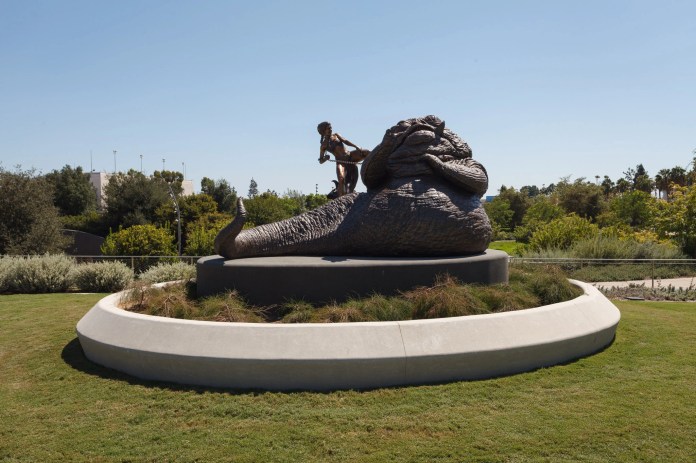


 Author


 / 250to250
  / @twofiftytotwofifty


 Culture and Society
 PUBLISHED, March 27, 2026







 by
by 




 Ernest Hemingway, ca. 1939. Photograph by Lloyd Arnold