Read MoreConstitution Day programming is sponsored by Fredonia’s American Democracy Project, Department of Communication, and Ethnic & Gender Studies program, …
Read MoreSen. Richard Blumenthal, Democrat of Connecticut; Rep. John James, Republican of Michigan; David Becker, CBS News election security analyst; Afghan …
Read MoreWhile Democrats officially nominated their candidates in Lansing Saturday, Republicans condemned what they call a socialist bent in the opposition …
Read MoreMichigan’s Democratic US senate candidate Abdul El-Sayed apologized to the state’s Jewish Democratic … US midterm elections 2026 · Democrats · news.
Officials speculated that the bear and her cubs may have entered the tank because they were thirsty. The high temperature in La Verne Saturday was 98 degrees.
The Illusion of Restoration: Judge Moss’s Ruling, the Dissolution of the CPB, and the Unchecked Dismantling of America’s Non-Commercial Commons
By DrWeb | DrWeb’s Domain | August 30, 2026, with AI research help via Gemini.
Category: DWD Editorial / Media Infrastructure / Constitutional Law / Information Architecture
SECTION I: The Pyrrhic Victory in Court
In the immediate wake of March 31, 2026, a dangerously complacent narrative solidified across legacy news aggregators and casual social commentary: The courts saved public broadcasting. When U.S. District Judge Randolph D. Moss handed down his comprehensive 62-page memorandum opinion in National Public Radio, Inc. et al. v. Trump et al. (Civil Action No. 1:25-cv-01674), media advocates celebrated what appeared to be an unambiguous First Amendment triumph. Judge Moss made short work of Executive Order 14290 (“Ending Taxpayer Subsidization of Biased Media”), dismantling its transparent viewpoint discrimination with razor-sharp judicial prose: “It is difficult to conceive of clearer evidence that a government action is targeted at viewpoints that the president does not like and seeks to squelch.”
The court’s logic was unassailable. Citing foundational precedents from Perry v. Sindermann to Agency for International Development v. Alliance for Open Society International, Inc., Judge Moss declared Section 3(a) of the executive order unlawful and permanently enjoined federal agencies from enforcing a blanket blacklist against National Public Radio, the Public Broadcasting Service, or their local affiliates. On paper, the executive branch was formally prohibited from utilizing discretionary federal grant mechanisms—from Department of Education early-childhood literacy allocations to National Endowment for the Arts (NEA) cultural grants and Federal Emergency Management Agency (FEMA) emergency warning system stipends—as punitive cudgels to retaliate against disfavored journalistic coverage.
Yet, to mistake this legal victory for institutional survival is to misunderstand the brutal mechanics of federal appropriations and the structural architecture of American public broadcasting. Judge Moss’s injunction stopped an unconstitutional executive overreach, but it could not—and by design of Article I, never will—resuscitate an entity that Congress chose to financially execute eight months earlier.
The catastrophic reality that remains stubbornly obscured from public consciousness is that public broadcasting’s core federal foundation was not saved. It was extinguished.
The Rescissions Act of 2025 (Pub. L. No. 119-28), enacted on July 24, 2025, legally clawed back $1.1 billion in forward-funded appropriations allocated for Fiscal Years 2026 and 2027. Stripped of its statutory operational cash flow, the Corporation for Public Broadcasting (CPB)—the Congressionally chartered entity established under Lyndon B. Johnson to serve as a non-political buffer between state power and independent media—voted to wind down operations and dissolve. As Judge Moss explicitly and somberly noted on page 14 of his own ruling: “CPB no longer exists, and no Court order declaring the Executive Order unlawful as applied to the CPB can afford NPR, PBS, or their member stations any meaningful relief.”
What the public celebrated as a rescue was merely an autopsy report with a protective order attached. While national syndicators secured minor settlements to keep the physical satellite transponders of the Public Radio Satellite System (PRSS) alive, the foundational financial circulatory system that nourished over 1,500 local community stations was allowed to bleed out.
SECTION II: The 1967 Mandate and the Architecture of Independence
To understand the depth of the current crisis, one must revisit the information architecture designed by the 90th Congress. When the Public Broadcasting Act of 1967 (47 U.S.C. § 396) was drafted, its chief architects—guided by the seminal findings of the Carnegie Commission on Educational Television—were acutely aware of a fundamental democratic vulnerability: How does a democratic government fund independent, non-commercial broadcast journalism without converting it into state-controlled propaganda?
The statutory answer was brilliant, deliberate, and structurally insulated:
The Non-Governmental Buffer: Congress created the Corporation for Public Broadcasting not as a federal agency, but as a private, non-profit D.C. corporation governed by a bipartisan board with fixed, staggered terms.
The Anti-Interference Firewall (§ 398): Section 398 of the Act explicitly forbade any federal department, agency, officer, or employee from exercising “any direction, supervision, or control over educational television or radio broadcasting.”
Two-Year Forward Funding: In 1975, recognizing that annual budget wrangling invited political hostage-taking, Congress adopted a two-year advance appropriation cycle. This ensured that lawmakers voting on CPB budgets were funding operations two fiscal years into the future, insulating day-to-day newsrooms from immediate retaliatory budget slashes over controversial reporting.
Crucially, the CPB was never designed to produce content itself. Under 47 U.S.C. § 396(k), the vast majority of CPB’s congressional appropriation was statutorily mandated to bypass Washington-based network headquarters entirely and flow directly to individual, locally licensed stations in the form of Community Service Grants (CSGs).
Judge’s ruling and public media dissolution. AI image by WP AI.
Statutory Layer (1967 Design)
Intended Democratic Function
2025–2026 Dismantling Mechanism
Two-Year Advance Funding
Insulated newsrooms from retaliatory political budget cycles.
Smashed via retroactive clawbacks in the Rescissions Act of 2025.
CPB Independent Buffer
Prevented direct executive or political control over distribution.
Dissolution triggered after total statutory defunding.
Direct CSG Station Grants
Subsidized local rural and tribal newsrooms; funded national dues.
Zeroed out overnight; eliminated baseline operational subsidies.
Non-Commercial Commons
Protected civic discourse from commercial rating algorithms.
Forced local stations into emergency paywalls, commercialization, or shutdown.
This decentralized flow created a resilient, bottom-up federation. A public radio station in rural Wyoming or an indigenous-operated television channel in northern Alaska received baseline operating capital from the federal grant pool. The local station then used a portion of those funds to purchase syndicated national programming (such as Morning Edition, PBS NewsHour, or Frontline) from NPR and PBS. The federal government did not directly fund national network news desks; local American communities chose to pool their federal resources to purchase them.
By attacking the CPB through legislative rescission while targeting the networks via executive decree, the political assault bypassed the First Amendment protections established in FCC v. League of Women Voters of California (1984). Instead of unconstitutionally censoring the speech directly, adversaries choked the economic pipes that sustained the physical infrastructure.
SECTION III: The Local News Desert & The Rural Blackout
The mainstream corporate press often covered the CPB battle through the narrow lens of Beltway personality clashes, focusing on elite national news desks in Washington and New York. This framing completely inverted the geographic and socio-economic reality of the devastation.
Flagship urban stations like WNYC in New York, KQED in San Francisco, or WGBH in Boston operate in wealthy donor markets with deep philanthropic endowments; federal CSG money represented only 5% to 12% of their annual operating budgets. For these metro giants, the loss of federal funding was an austerity crisis that demanded staff buyouts, consolidated beats, and tightened belts. But for the hundreds of rural, tribal, and small-market stations scattered across the American heartland, the dissolution of the CPB was an existential extinction event.
In rural Appalachia, the Mississippi Delta, the Great Plains, and Indian Country, CPB Community Service Grants routinely accounted for 40% to 65% of a station’s total operational budget. These stations serve communities where:
Local corporate underwriting is non-existent due to depleted local business economies.
Broadband access remains sparse, unreliable, or prohibitively expensive.
Commercial broadcast television and daily print newspapers have long since abandoned the beat, creating sprawling informational news deserts.
When the CPB dissolved, the domino effect was instantaneous. Over the past twelve months, dozens of rural repeater towers have gone dark. Tribal public radio networks—which provided life-saving health bulletins, Native language preservation broadcasts, and local weather crisis alerts across expansive reservations—were forced to lay off sole station engineers and localized news staff. In many counties across the American West, the local public radio frequency was not merely a source of national news analysis; it was the only functional, 24-hour civic broadcast link integrated into FEMA’s Emergency Alert System (EAS).
Furthermore, because these rural stations could no longer pay their annual affiliate dues to NPR or PBS, the national syndicators experienced an immediate secondary liquidity shock. The erasure of the small-station subsidy starved the national newsrooms of subscription revenue, forcing the very centralization and reduction of regional bureaus that critics disingenuously claimed to oppose.
SECTION IV: Anticipatory Obedience and Media Autonomy
The structural dismantling of the CPB cannot be evaluated in a vacuum. It represents a crowning case study in the dynamics of anticipatory obedience—a psychological and institutional surrender wherein legacy organizations preemptively dilute their coverage, soften their adversarial edge, and sacrifice institutional norms in a desperate, futile attempt to placate authoritarian power.
Long before Executive Order 14290 was penned, the seeds of structural vulnerability were sown by media executives who attempted to navigate bad-faith attacks with defensive retreat. For years, non-commercial media leadership responded to orchestrated allegations of “systemic bias” not by doubling down on rigorous, fearless investigative journalism, but by indulging in false equivalencies, bureaucratizing newsrooms, and apologizing for basic factual reporting.
This dynamic accelerated across the commercial and non-commercial press alike throughout 2024 and 2025:
Major corporate newspaper publishers spiked long-planned presidential endorsements to protect billionaire owners’ secondary aerospace and logistics government contracts.
Broadcast network news divisions settled dubious defamation threats out of court to avoid regulatory retribution during FCC license renewals.
Public media boards implemented suffocating, multi-tiered editorial review protocols that delayed urgent investigative exposés on corporate grift and executive branch abuses until the news cycle had passed.
The tragic lesson of 2026 is that anticipatory obedience never purchases safety; it merely signals weakness. When the administration issued EO 14290, it did not target public broadcasting because the networks were radically combative; it targeted them because public media had been politically isolated, structurally starved, and institutionally defenseless. The subsequent First Amendment victory in Judge Moss’s courtroom proved that the law was on the side of press freedom, but the prior years of institutional timidity ensured that when the blow landed, public media had already lost the broad, militant public mobilization necessary to halt Congress’s rescission knife.
SECTION V: Beyond Federal Subsidies: The Bridge Fund and Grassroots Information Architecture
If the American public media experiment is to survive the collapse of the 1967 statutory model, it must completely abandon the nostalgic fantasy that a future Congress will magically re-fund the CPB on historic terms. The old paradigm—reliant on federal appropriations filtered through centralized gatekeepers—is dead. The future requires constructing a robust, decentralized, and adversarial Information Architecture built on radical transparency, civic ownership, and direct public utility.
We are already witnessing the embryonic stages of this transformation. Across the country, surviving journalists and local communities are constructing alternative pathways to sustain the Fourth Estate:
1. The Emergence of Civic Endowment Consortia
Independent philanthropic coalitions, municipal media trusts, and grassroots “Bridge Funds” are stepping into the void left by CPB grants. Rather than funding Washington bureaucracy, these consortia are directing capital directly into local reporting trusts, guaranteeing multi-year operational underwriting for regional reporters who cover school boards, statehouses, water rights, and municipal courts.
2. Open Protocols & Decentralized Syndication
The proprietary distribution bottlenecks of the 20th century are giving way to federated open-source media networks. By bypassing closed corporate platforms and leveraging open standards, local newsrooms are sharing raw audio feeds, investigative databases, and verified reporting across independent digital nodes, ensuring that a single corporate takedown or federal injunction cannot sever the public’s access to reliable reporting.
3. The Reader-Supported Sovereign Commons
The survival of deep-dive investigative journalism depends entirely on a direct, unmediated pact between the citizen-journalist and the reader. The collapse of the CPB proves that when an information system relies on the grace of state power or the algorithmic whims of advertising monopolies, its demise is merely a matter of time. Non-commercial media must be funded as a vital public utility—not by state coercion, but by an engaged public that recognizes high-integrity information as the primary prerequisite for democratic self-governance.
The judicial victory of March 31 was a constitutional baseline, not a triumph. It demonstrated that executive censorship remains illegal under the supreme law of the land. But the work of rebuilding the public information commons—brick by brick, server by server, newsroom by newsroom—remains in our hands.
MULTIMEDIA EVIDENCE & PRIMARY DOCUMENTATION
Memorandum Opinion & Order:National Public Radio, Inc. et al. v. Donald J. Trump et al., No. 1:25-cv-01674 (D.D.C. Mar. 31, 2026), ECF No. 81 (Judge Randolph D. Moss presiding). Available via Justia Law D.D.C. Docket Archive.
Executive Order 14290: “Ending Taxpayer Subsidization of Biased Media,” 90 Fed. Reg. 19415 (Issued May 1, 2025). Full primary text and litigation pleadings archived via the Civil Rights Litigation Clearinghouse.
FCC v. League of Women Voters of California, 468 U.S. 364 (1984). Full Supreme Court opinion and syllabus on public broadcasting editorial freedom available via Justia U.S. Supreme Court Center and Oyez.
Perry v. Sindermann, 408 U.S. 593 (1972). Landmark precedent establishing the unconstitutional conditions doctrine regarding government benefits and free speech, accessible at Justia U.S. Supreme Court Center.
Agency for International Development v. Alliance for Open Society International, Inc., 570 U.S. 205 (2013). Supreme Court decision barring the leverage of federal funding conditions to suppress speech, available via Justia U.S. Supreme Court Center.
Accuracy in Media, Inc. v. FCC, 521 F.2d 288 (D.C. Cir. 1975). Landmark D.C. Circuit ruling restricting agency interference in CPB programming decisions, available via OpenJurist.
Reporters Committee for Freedom of the Press (RCFP). (2025). Amicus Curiae Brief in Support of Plaintiffs-Appellees in National Public Radio, Inc. v. Trump. Complete brief and analysis available at RCFP Legal Filings Archive and direct PDF Repository.
Congressional Research Service (CRS).Federal Funding for the Corporation for Public Broadcasting (CPB) (Report No. R43983 / R47120). Official legislative analysis hosted via EveryCRSReport and CRS Reports (Congress.gov).
Starr, Paul. (2004). The Creation of the Media: Political Origins of Modern Communications. Basic Books. Overview and publishing details available via Basic Books / Hachette.
McChesney, Robert W., & Nichols, John. (2011). The Death and Life of American Journalism: The Media Revolution that Will Begin the World Again. Nation Books. Profile and indexing at Nation Books / Hachette.
Pickard, Victor. (2019). Democracy Without Journalism? Confronting the Misinformation Society. Oxford University Press. Academic catalog link available via Oxford Academic.
Snyder, Timothy. (2017). On Tyranny: Twenty Lessons from the Twentieth Century (Chapter 1: “Do Not Obey in Advance”). Information and excerpts via Penguin Random House.
Witherspoon, John, & Kovitz, Roselle. (1987). The History of Public Broadcasting. Current Publishing. Full digital text archived via the Internet Archive.
Crews are continuing to battle two wildfires in Monterey County that have collectively burned more than 33,000 acres and forced more than 600 people to evacuate.
The views expressed by contributors are their own and not the view of The Hill
‘Medicare for All’ means Medicare for none
by Merrill Matthews, opinion contributor – 08/25/26 8:00 AM ET
Article video…
It may be one of the most deceptive public policy marketing schemes in modern history. First, pick the most popular health insurance program in the country, which is Medicare. Then call your health insurance reform proposal “Medicare for All,” even though the intent is to eliminate the Medicare program as we know it, so that no one would have that coverage anymore.
Sen. Bernie Sanders (I-Vt.) has long pushed to end the nation’s current mix of private health insurance (that is, employer-based and individually purchased) and government-provided health insurance (Medicare and Medicaid) and replace it with a new government-run program. Taxpayers would pay higher taxes — though no one would pay premiums — and the government would pay all medical bills.
Under most government-run health care systems, as in the United Kingdom, the government determines what services and medicines are available, who can have them and when. Bureaucrats rather than doctors decide whether patients are allowed to have access to those services and medicines.
That is what Sanders and 71 percent of Democrats mean by Medicare for All. But that’s not Medicare.
Sanders knows he’s being deceptive. His Senate website says, “Medicare is the most popular health care program in America.” Then he claims that under Medicare for All, “every resident of the U.S. will receive health insurance through an expanded Medicare program.” That is a blatantly false statement.
Medicare has multiple parts. Part A covers hospital bills, Part B covers doctors’ bills, Part C is now Medicare Advantage and Part D covers prescription drugs. Medicare for All has none of that.
Importantly, Medicare Advantage relies on private sector health insurance similar to employer plans. Seniors have a choice between traditional Medicare and Medicare Advantage. Currently, 55 percent of eligible seniors choose Medicare Advantage. Medicare for All excludes private sector coverage, including Medicare Advantage.
Remember President Obama’s promise for the Affordable Care Act? “If you like your health plan, you can keep it,” is what he said. That won him [the] Politifact2013 “Lie of the Year.” But Sanders won’t make that claim, because he intends to ensure no one has their current health plan, including people currently on Medicare.
There are the big donors to American elections, and then there are the biggest donors — the ones that can turn around candidates’ fortunes and sometimes even write history.
These are the billionaires who tower over Senate and House races. The corporations digging deep to increase their profits. The dark-money groups that want to keep their sources of cash secret forever.
The 20 biggest donors so far in the midterm elections — some of whom are grouped together because of close familial or business relationships — have combined to shovel a staggering $1.2 billion into federal races this cycle, according to a New York Times analysis of the latest contribution data available.
The lineup shows the rising power of the tech industry and is dominated by Republican-leaning donors, reflecting how the party has steadily built an advantage in midterm money. That edge could keep the party competitive despite a political environment that favors Democrats.
Read MoreBill educational benefits to the American Civil Liberties Union (ACLU). … Detroit Board of Education. Later he served as lead counsel on the …
Read MoreAmong the dozens of collections in the public library’s Digital Library is a collection of amateur photographs in the 1880s from the Cincinnati Camera …
Read MoreYet, there were still signs of potential disharmony at the convention, 66 days before the midterm election. Some prominent Democrats haven’t …
Read More“While it’s true that the National Park Service is part of the executive branch of the federal government and is an agency within the U.S. Department …
Read MoreA central theme of country music is “Don’t forget your roots.” It’s because she loved us. Unconditionally. Extravagantly. Imagination Library alone …
Read MoreSeveral members of the Proud Boys showed up at a Democratic Socialists of America gathering on Saturday at the Forsyth County Public Library in …
Read MorePublic Library Association (PLA). Roster. No roster found. Previous Year / Next Year. Displaying active committee roster as of 08/30/2026. Last …
Read MoreDemocratic US Senate candidate Hallie Shoffner was shown to have a slight lead in the recent Talk Business & Politics-Hendrix College poll against …
Read More21801 Slider Rd. Moss Point, MS 39562 (228) 588-6263. George Broadus, Branch Manager. Kathleen McIlwain Public Library of Gautier 2100 Library Lane
Read MoreShould Iowa turn back to Democrats after supporting Trump in all three of his elections, and not electing a Democratic senator since 2008, it …
Read MoreIt happened in the area of Hollywood Boulevard and 26th Avenue just before 3:30 a.m., not far from the Hollywood Branch Library. Local 10 News cameras …
Read MoreLaura Beveridge is a Stern-Bryan Fellow covering national politics and campaigns during the 2026 midterm elections. She was previously a junior …
Read More… American education. Roughly 80% of teachers and administrators surveyed … New Hampshire’s Department of Education has since convened a School …
Read MoreThis baby boomer vs. Gen X Senate race emerges as key test of generational change in U.S. politics and what age is too old for Congress. By. Leah …
Read More… generative AI infrastructure. Topics. AI, AI, caterpillar, Enterprise … The startup community will gather to answer a pivotal question: How …
Read MoreThere need to be democratic free elections in Venezuela. … And so I’m going to spend my time between now and election day fighting for the midterms.
Read MoreThe Public Library Services Consultant partners with internal OCLC teams to help member libraries achieve their strategic, operational, and community- …
On Aug. 30, 1992, astronomers spotted an object orbiting the sun beyond Pluto for the very first time. It was the first Kuiper Belt object ever detected.
Before then, Plutowas believed to be the most distant planetary body of our solar system. No one had seen anything orbiting farther out because these so-called Trans-Neptunian objects were far too faint to detect with the technology they had at the time.
With new digital imaging techniques, astronomers were able to spot a new and tiny world orbiting 4 billion miles beyond Neptune. Officially designated 1992 QB1, this 100-mile-wide (160 kilometers) object was thousands of times fainter than Pluto. Now astronomers have confirmed more than 2,000 objects orbiting out there in what is now known as the Kuiper Belt.
Why it mattered
This image shows a European Southern Observatory view of 1992 QB1, the first Kuiper Belt Object, discovered on Aug. 30, 1992. (Image credit: European Southern Observatory)
Our solar system was a much smaller place before the discovery of 1992 QB-1. We had nine planets, from Mercury to Pluto, and that was the end.
But when astronomers found 1992 QB-1, it led to a much larger solar system than anyone could have dreamed.
The Kuiper Belt, named after the Dutch astronomer Gerard Kuiper who first proposed its existence, is a doughnut-shaped region that begins at the orbit of Neptune, about 2.8 billion miles (4.6 billion miles) from the sun. If you use the distance between the Earth and sun, which is 93 million miles (1 astronomical unit or 1 AU), as a guide, the Kuiper Belt begins about 30 AU from the sun and extends out to 1,000 AU. It’s one of the largest structures in the solar system.
This graphic shows the scale of the Kuiper Belt and its place in our solar system, which itself is surrounded by a vast Oort cloud of icy comets and other objects. (Image credit: ESA)
While 1992 QB-1 was the first confirmed Kuiper Belt object after Kuiper theorized the region’s existence, the dwarf planet Pluto — which is also beyond Neptune — was found first in 1930.
Back then, Pluto was classified as a full planet, but the discovery of 1992 QB-1, as well as Kuiper Belt objects even larger than Pluto found later, raised questions about Pluto’s status. An object called Eris, which is larger than Pluto, ultimately led astonomers to downgrade Pluto to a dwarf planet in 2006.
Today, Kuiper Belt objects aren’t just objects in photos, they are places humanity has explored with spacecraft. In 2015, NASA’s New Horizons spacecraft flew by Pluto, a first in history. That probe went on to fly by the Kuiper Belt object Arrokoth on Jan. 1, 2019.
Speaking of finding unseen objects in space, on this day in space (in 2026, it JUST happened), NASA’s Roman Space Telescope launchedatop a SpaceX Falcon Heavy rocket to observe more of the universe than ever before. Here’s why that matters.
Read MoreHow will changes at the U.S. Department of Education affect schoolchildren this year, what’s happening with screentime limits in classrooms, …
CAPE CANAVERAL, Fla. — A new era of astronomy is about to begin after NASA’s newest flagship observatory leaped from the terrestrial bounds of Earth into the vastness of space this morning.
NASA’s Nancy Grace Roman Space Telescope launched today (Aug. 30) on a SpaceX Falcon Heavy rocket from the Kennedy Space Center here in Florida. Liftoff occurred at 7:26 a.m. EDT (1126 GMT) at Launch Complex-39A (LC-39A).
Roman is NASA’s newest orbital observatory designed to add to the wealth of research and discoveries we’ve received from the Hubble Space Telescope and James Webb Space Telescope. “The scope is extraordinary,” Roman senior scientist Julie McEnery said during live commentary. “We will do a survey of our own Milky Way galaxy and find 20 billion stars. That would make it the largest catalog of astronomical objects that’s ever been produced.”
A SpaceX Falcon Heavy rocket carrying NASA’s Roman Space Telescope crosses the sun during launch from Pad 39A of NASA’s Kennedy Space Center, Florida on Aug. 30, 2026.Space.com / Josh Dinner A SpaceX Falcon Heavy rocket launches with NASA’S Nancy Grace Roman Space Telescope onboard from Launch Complex 39 on Aug. 30, 2026, at NASA’s Kennedy Space Center in Florida.Space.com / Josh Dinner A SpaceX Falcon Heavy rocket launches with NASA’S Nancy Grace Roman Space Telescope onboard from Launch Complex 39 on Aug. 30, 2026, at NASA’s Kennedy Space Center in Florida.NASA/Joel Kowsky
While Hubble and the JWST are built to get close looks at distant phenomena in the universe, Roman will study the bigger picture of our cosmos. Its main instrument, known as the Wide Field Instrument (WFI), will take extremely wide images of the universe, capturing ultra-high definition views across broad swaths of the sky. It’s also equipped with the first active coronagraph to be used in space, which will revolutionize exoplanet studies.
The Roman Space Telescope is named after NASA’s first chief astronomer Nancy Grace Roman, the first woman in an executive leadership role at the space agency. It was Roman who advocated for a telescope in space, leading to the Hubble Space Telescope. Roman, who died in 2018, earned the nickname “Mother of Hubble” as a result.
“It was Nancy in the old days, before the internet and before Google and email and all that stuff, who really helped to sell the Hubble Space Telescope, organize the astronomers, who eventually convinced Congress to fund it,” Ed Weiler, Roman’s successor as Hubble’s chief scientist, told the Voice of America in 2011.
At liftoff, Falcon Heavy blazed off the pad at LC-39A, roaring with the thunder of 21 Merlin 1D engines on the business end of the SpaceX triple-booster launch vehicle. About 2.5 minutes into flight, the rocket’s two side boosters cut off their engines for a nominal separation and began trajectory burns to return for a landing back here on the Space Coast.
The rocket’s core booster then continued onward to deliver Falcon Heavy’s second stage equipped with Roman into space. Main engine cut off (MECO) and separation of Falcon Heavy’s main stage took place about four minutes after liftoff, with fairing separation about 15 seconds later.
Falcon Heavy’s side boosters, meanwhile, executed boostback burns for landings at SpaceX’s Launch Complex-40 and Landing Zone-2 at Cape Canaveral Space Force Base, a few miles downrange from LC-39A.
A view of on e of the two SpaceX Falcon Heavy side booster as it lands at Cape Canveral Space Force Station following the Roman Space Telescope launch. (Image credit: NASA)
Roman’s delivery to space caps more than a decade and $4 billion of development for the space telescope, which was made possible, in part, by incorporating elements of an unused spy satellite.
With its coronagraph and WFI, the telescope is designed to make groundbreaking strides in the fields of dark matter and dark energy, exoplanet discoveries, and will be capable of capturing views 100 times wider than those of its Hubble predecessor.
“The smallest Roman images will be a billion pixels,” Dominic Benford, progam scientist for the Roman Space Telescope, said during live commentary. “When we take a billion-pixel image, there isn’t a screen on Earth large enough to display all the pixels.”
NASA’s Roman Space Telescope flies free from its SpaceX Falcon Heavy rocket after a successful launch on Aug. 30, 2026. The large dish visible on the spacecraft is its high-gain antenna, which will beam its trillion-pixel photos back to Earth. (Image credit: NASA)
The coronagraph works by blocking out the light of distant stars in such a way that scientists can examine minute details around those stars — meaning they can map out exoplanets orbiting in the systems. Once active, Roman’s Wide Field Instrument (WFI) will capture more than a terabyte of data daily; its largest survey will take over a year to complete and is expected to fill more than half a million 4K TVs.
How big will the largest Roman image be?
“A trillion pixels,” Benford said.
You can actually adopt one of those Roman Space Telescope pixels yourself with NASA’s new “Adopt a Pixel” program, which the agency announced during the Roman launch.
Roman’s Falcon Heavy launch vehicle released the telescope to fly on its own a short 31 minutes after liftoff. NASA cheered the success, and even got a bit of a nod from celebrities in the form of a record message from singer Jewel.
“As you may know, I make artwork using astrophysical data, and there would be no data more fascinating than dark energy and dark matter,” Jewel said in a recorded video. “And so, it is with this great wish of great success and Godspeed that I wish the Nancy Grace Roman Space Telescope so excited.
Now, the telescope is headed to sun-Earth Lagrange point 2 (L2), a relatively stationary orbital location beyond the orbit of the moon that allows the spacecraft to remain persistently on Earth’s night side, with the sun on the opposite side of the planet. The locale places the sun to Roman’s backside and points its sensitive instruments away from the intrusion of light reflected off the Earth and moon.
Roman’s journey to L2 will take about 90 days. The first 40 or so of those days will be spent turning on the telescope’s instruments and performing status checks as the spacecraft slowly configures itself for operation. Science commissioning will begin after about 45 days, its completion corresponding with when Roman arrives at L2.
“I very much hope, and in fact, expect that the most exciting science of Roman will be a surprise — something we couldn’t predict and that will set the stage for the next, deeper set of questions for future missions to progress,” McEnery told reporters a day before launch.
The telescope’s first images are expected in the beginning months of 2027.
The U.S. Open, the final tournament of the tennis season, is getting underway. The world’s best players are heading to the U.S.T.A. Billie Jean King National Tennis Center in Queens, N.Y., to battle it out for the chance to play a championship match at Arthur Ashe Stadium, the largest tennis arena in the world.
The players come freighted with great expectations, previous victories and defeats, aches and pains, personal dramas and professional rivalries, all of which they will carry with them out on the court when they play. Tennis is a game that exposes a lot about its players, which is one of the things that makes it so beloved around the world.
In this episode of the “Sunday Daily,” the host Natalie Kitroeff talks with Matthew Futterman, a senior tennis writer for The Athletic and the author of “The Cruelest Game: Chasing Greatness in Professional Tennis,” about this year’s crop of players. They’ll dig into the biggest rivalries and dramas brewing in the tournament ahead.
On Today’s Episode:
Matthew Futterman, a senior tennis writer for The Athletic, and the author of “The Cruelest Game: Chasing Greatness in Professional Tennis.”
Read More… seek value beyond price, considering durability and repairability. Generative AI adoption is strongest in travel, beauty, and fashion sectors.
Dr. Adam Kalkstein is suing over his removal from the military academy.
Students at West Point. Drew Angerer/Getty Images
A science professor says he was fired from the U.S. Military Academy at West Point, New York, for refusing to ignore the human causes of climate change, and is now suing the institution in federal court.
Dr. Adam Kalkstein, a professor of geography, told The New York Times that the dean of the West Point academic board, Brigadier General Shane Reeves, in a meeting last year ordered him to remove everything about human contributions to climate change, as President Trump sets the agenda as commander in chief. Kalkstein told Reeves that such a change would be immoral, and possibly illegal. When Reeves suggested Kalkstein resign, Kalkstein declined, after which the dean stormed out of the room.
“We’re only telling cadets part of the story. We’re lying to them, deceiving them. It would be like trying to teach the law without being able to even mention the Constitution,” Kalkstein reportedly said during the meeting, according to Stars and Stripes.
Six months later, Kalkstein, a tenured professor, was told his contract wouldn’t be renewed, and on Monday, he sued the institution in the Southern District of New York, alleging that his First Amendment rights were violated. The lawsuit states that the institution’s order would require Kalkstein “to omit a massive, fundamental, essential component of the court and to defy science.”
According to the Times, Kalkstein is a conservative Republican who believes military cadets need to know the truth about climate change for national security reasons rather than social justice. He wrote a letter to Defense Secretary Pete Hegseth arguing that knowing the causes of climate change was important for competing over resources in the Arctic and understanding why sea ice was melting.
Hegseth, along with the rest of the Trump administration, is trying to purge “wokeness” from government and military institutions, including any acknowledgment of climate change. Early in his tenure last year, Hegseth boasted on X that “The @DeptofDefense does not do climate change crap. We do training and warfighting.”
That’s a major departure from previous administrations. In 2021, the Pentagon concluded in a report that “increasing temperatures; changing precipitation patterns; and more frequent, intense, and unpredictable extreme weather conditions caused by climate change are exacerbating existing risks.”
Those risks still exist, but the Trump administration is flat-out ignoring the science for financial and culture-war reasons. Professors like Kalkstein, and the knowledge of America’s future military officers, are among the casualties.
Read More One Instagram user commented, “The scary thing is the people banning books have probably not read any of them.” Another user wrote, “I have yet to …
After weeks of intense negotiation, state lawmakers on Friday reached a compromise on legislation to regulate energy use by California’s growing data center industry, action triggered by community anger over the facilities and fears of high utility bills in some communities.
Read More… Democrat, who is Jewish, and Representative Debbie Dingell, a Michigan Democrat. … More on the 2026 Midterm Elections. Fund-Raising in Texas: Many …
Read MoreStability AI built its name around Stable Diffusion, the open image-generation ecosystem that helped bring generative AI into creative workflows.
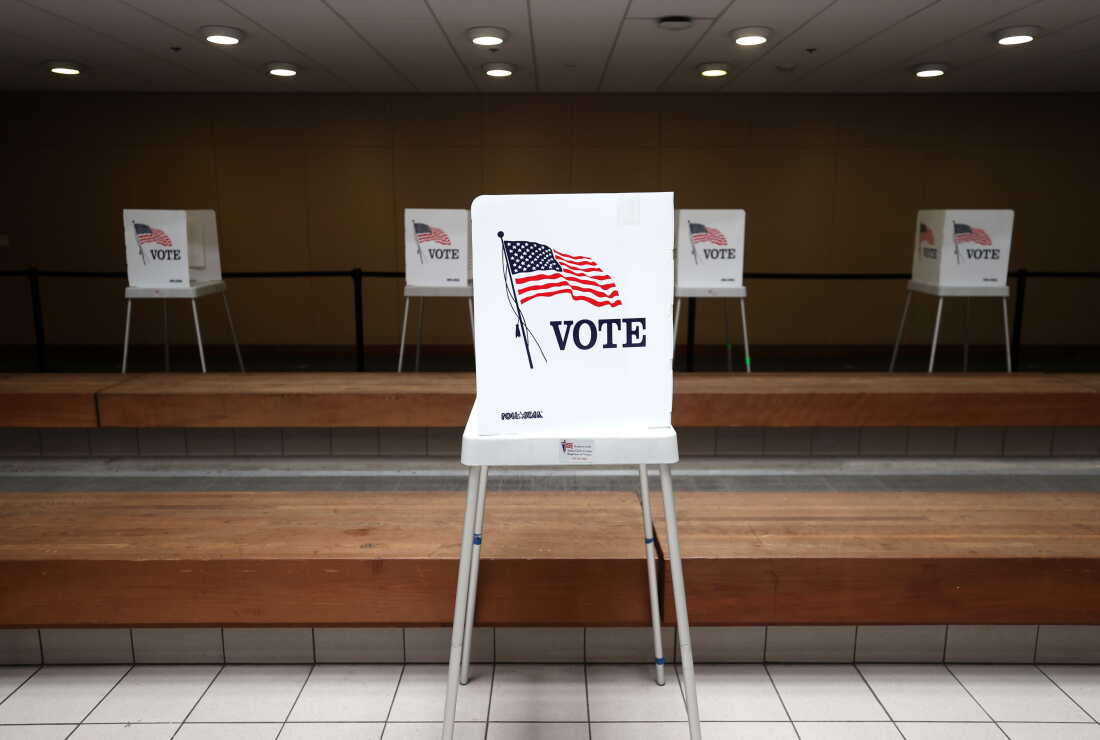
A view of voting booths at the Santa Clara County registrar of voters office in San Jose, Calif.A view of voting booths at the Santa Clara County registrar of voters office in San Jose, Calif. Justin Sullivan/Getty Images
Congressional Democrats are preparing for a new kind of midterm challenge: the risk that President Trump will attempt to undermine November’s elections by claiming fraud or interfering in the voting process.
At the center of their effort is a task force of at least 11 senators, as well as staff and a constellation of outside experts and groups convened by top congressional Democrats to protect against what Senate Minority Leader Chuck Schumer, D-N.Y., describes as “direct threats posed by President Trump and MAGA Republicans.”
“The goal of our task force is to ensure that every vote counts, and every American can participate in our democracy without coercion, intimidation or threats from Donald Trump or anyone else,” Schumer said in April while announcing the initiative.
Members have already played a central role in challenging preelection maneuvers by the administration — including efforts to obtain state voter rolls and limit mail-in voting — even as they collectively prepare for an array of scenarios they fear could unfold over the coming 10 weeks. Senate task force staff have a list of roughly 100 possible threats, including the prospect of a national election emergency declaration from the White House and the presence of federal troops and law enforcement at polling locations.
This account of that effort is based on interviews with more than a dozen people involved in those preparations, including Democratic lawmakers, their staff, election litigators and experts in academia and at nonpartisan good governance organizations.
Those conversations reveal a Democratic establishment intent on avoiding what multiple people described as a “failure of imagination” that prevented lawmakers from anticipating the Jan. 6 attack on the U.S. Capitol, but also Democratic lawmakers limited by both a lack of Republican buy-in and a shortage of legislative maneuvers to address the risks they see.
Even as task force members acknowledged there is no magic “protect democracy” button tucked away in a Capitol cloakroom, they each emphasized the power of legislators as messengers and organizers, able to prepare the public and their state and local counterparts to act when necessary to ensure a legitimate election.
Trump and the playbook his critics see
It remains to be seen how the president may choose to wade into the midterm voting process in the coming months, but since returning to office, Trump has focused deep attention on the way U.S. elections are administered.
“We have very important elections coming up,” he said in a July address from the East Room of the White House. “We want those elections to be honest.”
Trump used the speech to call on Congress to pass the SAVE America Act, a package of changes to election law that would, among other measures, require voters to show proof of citizenship when registering to vote and a photo ID before they can cast a ballot.
“How easy is that to do, unless you want to cheat? The only reason you wouldn’t do it is you want to cheat because your policies are so bad, and your candidates are so pathetic that you can’t get away or can’t get elected any other way,” he said.
Read More… American’s civil rights with strong resolve. … Secretary for Civil Rights at the United States Department of Education under two administrations.
Read MoreIt has been “extraordinarily important” to the progressive victories across the 2026 primaries, she said. Arab American votes became ‘up for grabs’.