

Analyst Notes: Answering your questions about data centers and water
How to think about these questions when there’s little data available.
Published Oct 21, 2026, By Trygve M.
Hi, I’m Trygve, and I co-authored our recent deep dive on electricity prices and AI data centers. We got some great questions and feedback on it — you all are a bunch of curious critters, and I love that. It’s seldom that a piece invites so much critical engagement and curiosity. That’s a credit to you, reader, and I appreciate you digging in with us on this complex topic.
For this edition of Analyst Notes, we’re going to do something a bit different than we have before — answer your questions.
Many of you are curious about data centers and electricity prices and have big questions ranging from policy, economics, the electric grid, and how that all influences consumer costs; to the impacts of data centers on communities, like how they affect jobs, air quality, or housing values.
But overwhelmingly, you wanted to know about data centers and water. I think the question on everyone’s mind boils down to this: is there enough? With data centers popping up across the country and demanding water, does that leave enough available for other water users?
Let’s get into it.
How much data is there about data centers and water?
Not much…
Okay, so why write this piece if there’s no data?
I said not much data, not no data! The federal government gives us a bit, and local government offers some insights on individual projects, but none of it is centralized nor helpfully aggregated or disaggregated in the government data landscape.
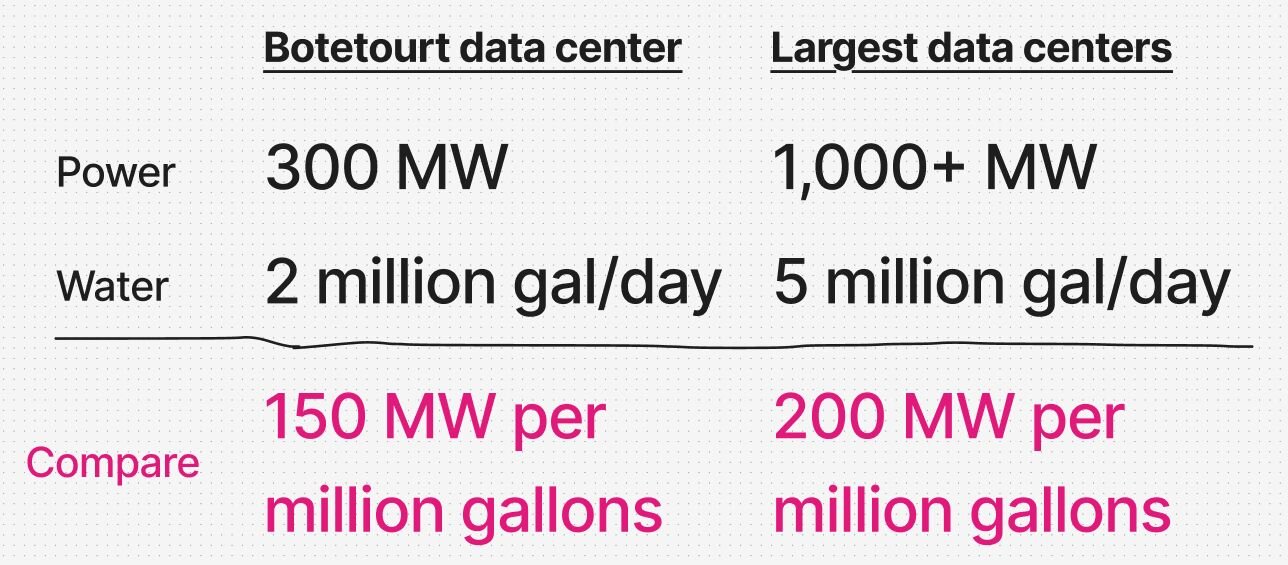
Given this, what I’d like to do in this piece is give you a way to think about these questions. Of course, I’ll sprinkle in available data, identify the kinds of data that would be nice to have, and point out good questions to ask as you develop your understanding of what data center water use might mean for where you live. That local context is really important.
Why don’t we have great federal data on data centers and water use?
I don’t know. I can speculate that at least part of it has to do with the necessary data being proprietary and/or paywalled for competitive reasons as the involved companies race to build more/better. Other factors might include the industry developing faster than any government system designed to track its requirements and impacts, and water getting regulated primarily at the state rather than federal level.
The relative lack of data for this important piece of the economy feels odd when you consider how robust the federal data collection programs are for other important sectors, whether that’s agriculture (visit the USDA’s Economic Research Service), fisheries (say hello to [NOAA]’s fisheries landings database), or home construction (check out the monthly release on new residential construction by the Census Bureau and the Department of Housing and Urban Development).
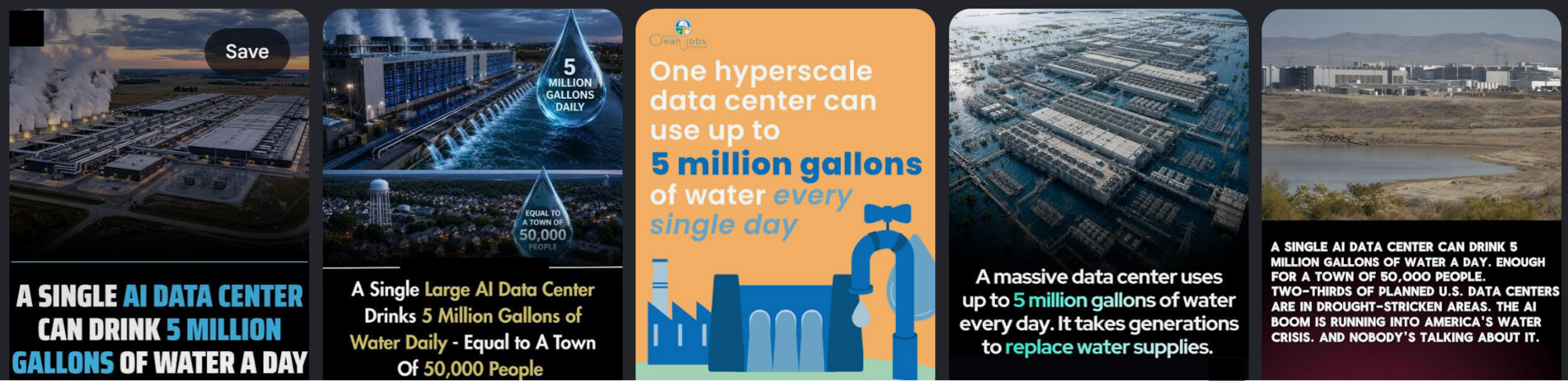
Why is everyone wondering about data centers and water use?
Here’s a snippet of a sentence from a major outlet that I came across recently that makes plain some of my hesitation:
“… data centers, which typically require a large amount of water to operate …”
This is pretty representative of how media sources talk about data centers. I share this not because the description is wrong, but because it’s not specific enough to really shape our understanding of the issue. Consider:
- Describing a “typical” data center is a challenge. They come in a variety of sizes and cool their equipment in different ways. How they use water depends on those details.
- Saying a “large” amount of water poses more questions than it answers. Water use is definitely measurable (my water utility is very firm on this point), but it’s not clear to me how often water use data is shared publicly and/or placed into its appropriate context. Again with the data constraints.
- Local context is important. There are no data centers (that I know of, at least … and federal data is no help here) in Forks, Washington — one of the wettest places in the US — but if there were, its water use would feel different from an identical data center located in a drier and more populous area.
Back to why people care about this issue. To state the incredibly obvious: people, animals, plants, and businesses all need steady access to water. Making and delivering water to where it’s used (we aren’t all drinking directly from streams, after all) comes with costs, and maybe you live in a place where water is scarce.
Let’s start thinking about our core question — is there enough? — by exploring something foundational.
How does a data center use water?
A data center may use water to cool the heat-generating computing equipment inside. That’s a liquid-cooled system. Air-cooled systems also exist, as do hybrid systems and other cooling technologies. What gets built depends on the facility size, location, cost, and other factors.
Sticking to liquid-cooled systems, there are broadly two types: closed-loop and open-loop.
- A closed-loop system fills with water, which absorbs heat from the computing equipment. Then, the water passes through chillers which cool it down so it can be used again. Aside from top-offs for leaks or maintenance, a true closed-loop system requires little additional water once it’s operational because it’s not exposed to the air. They tend to be more water efficient and more energy intensive.
- An open-loop system also uses water to absorb heat from the computing equipment, but it cools the warm water by exposing it to the air. This is an efficient cooling method, but requires a continuous water supply to replace what’s lost to evaporation. They tend to be more energy efficient and more water intensive.
If this is hard to visualize, here’s a simplified schematic of an open-loop cooling setup.
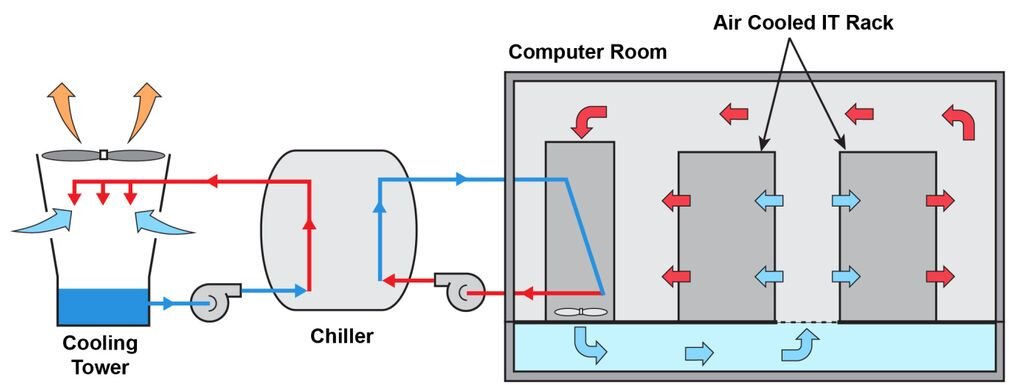
Source: Department of Energy
(Any closed-loop schematics I found made my head spin, so I won’t show them here. The Louisiana Department of Conservation and Energy has a helpful one-pager comparing open-loop and closed-loop systems.)
There are different ways of deploying these loops, but I’m not an engineer. What’s important to keep in mind is this: closed loop cooling requires water periodically, while open loop requires it consistently.
Data centers also use a small amount of what’s known as domestic water –– for toilets, drinking fountains, that sort of thing. Domestic water use happens in all buildings. It isn’t unique to data centers and will be a fraction of the water used by a liquid-cooled system, but it’s there.
All of the above is called “direct water use.” If a data center includes any on-site water treatment or power plants that use water, that would also count.2
To understand how “thirsty” a given data center is, we would need to know how it cools the equipment inside. And federal data doesn’t provide answers at the data center level or in the aggregate.
SEE ALSO: https://www.youtube.com/results?search_query=data+centers+2026+water+use&sp=EgIIBQ%253D%253D
Read more: Analyst Notes: Answering your questions about data centers and water – USAFactsContinue/Read Original Article: Analyst Notes: Answering your questions about data centers and water | USAFacts
Discover more from DrWeb's Domain
Subscribe to get the latest posts sent to your email.

