
Is the Dictionary Done For?
The print edition of Merriam-Webster was once a touchstone of authority and stability. Then the internet brought about a revolution.
By Louis Menand, December 22, 2025

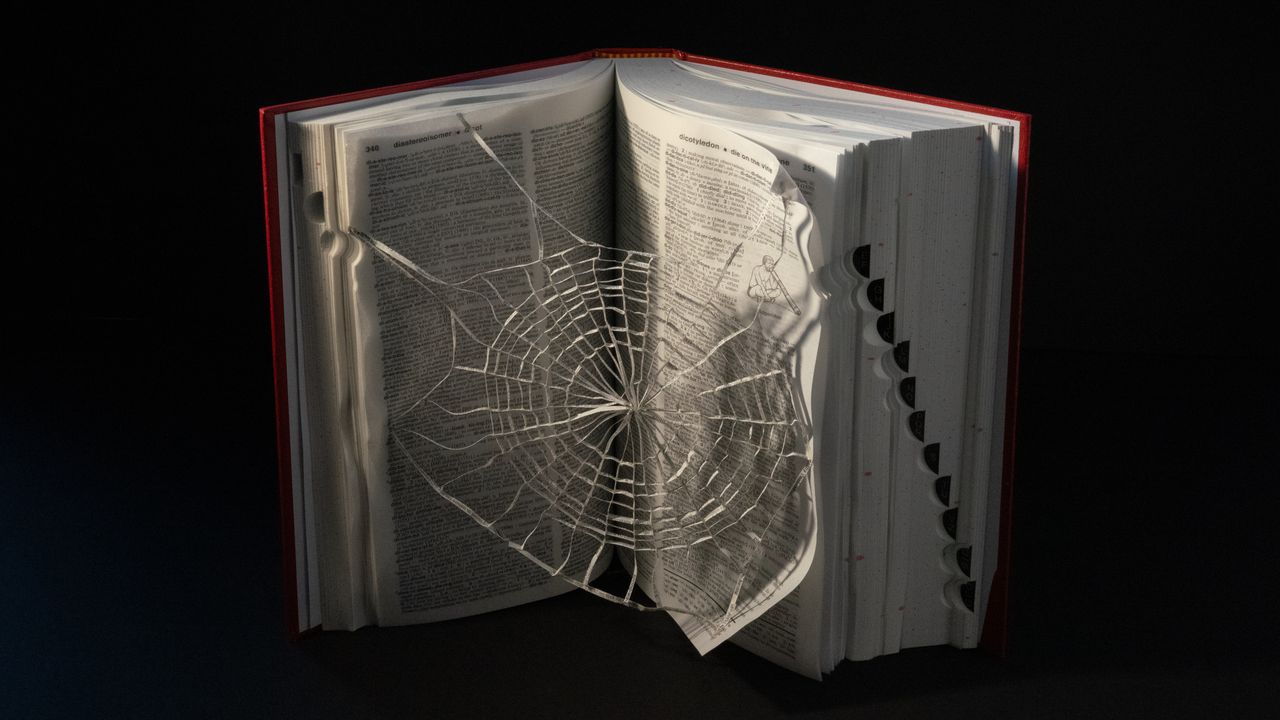
Wars over words are inevitably culture wars, and debates over the dictionary have raged for as long as it has existed. Photo illustration by Stephen Doyle
Once, every middle-class home had a piano and a dictionary. The purpose of the piano was to be able to listen to music before phonographs were available and affordable. Later on, it was to torture young persons by insisting that they learn to do something few people do well. The purpose of the dictionary was to settle intra-family disputes over the spelling of words like “camaraderie” and “sesquipedalian,” or over the correct pronunciation of “puttee.” (Dad wasn’t always right!) Also, it was sometimes useful for doing homework or playing Scrabble.
This was the state of the world not that long ago. In the late nineteen-eighties, Merriam-Webster’s Collegiate Dictionary was on the Times best-seller list for a hundred and fifty-five consecutive weeks. Fifty-seven million copies were sold, a number believed to be second only, in this country, to sales of the Bible. (The No. 1 print dictionary in the world is the Chinese-language Xinhua Dictionary; more than five hundred million copies have sold since it was introduced, in 1953.)
There was good money in the word business. Then came the internet and, with it, ready-to-hand answers to all questions lexical. If you are writing on a computer, it’s almost impossible to misspell a word anymore. It’s hard even to misplace a comma, although students do manage it. And, if you run across an unfamiliar word, you can type it into your browser and get a list of websites with information about it, often way more than you want or need. Like the rest of the analog world, legacy dictionaries have had to adapt or perish. Stefan Fatsis’s “Unabridged: The Thrill of (and Threat to) the Modern Dictionary” (Atlantic Monthly Press) is a good-natured and sympathetic account of what seems to be a losing struggle.
The Best Books of 2025, Discover the year’s essential reads in fiction and nonfiction.
Fatsis is a reporter whose work has appeared in a number of venues, including Slate and NPR, and who has mainly covered sports. For one of his books, he embedded with professional football teams—“participatory journalism,” a reportorial genre made popular by George Plimpton. For “Unabridged,” Fatsis embedded in the offices of Merriam-Webster, which are in Springfield, Massachusetts (home to the Naismith Basketball Hall of Fame, which I’ll bet he visited). There, he played amateur lexicographer, digging up new candidates for inclusion and trying his hand at definitions, which, as he demonstrates, is more challenging than it looks. (He found that asking ChatGPT to do it had poor results.)
As Fatsis tells the story of his lexicographical Bildung, he makes genial and informed digressions into controversies in the dictionary racket, some possibly overfamiliar, like how to label ethnic slurs and whether to include “fuck,” others more current, like the crusade to come up with a gender-neutral third-person-singular pronoun (after many failed launches, we appear to be stuck on “they,” which seems kind of lame) and whether or not large language models can create a dictionary (so far, not). He has a section on our contemporary speech wars, showing that many of the most radioactive words—“woke,” “safe space,” “microaggression,” “anti-racism”—are much older than we might assume.
He also introduces us to terms likely to be new to many readers: “sportocrat,” “on fleek,” “vajazzle,” and the German word Backpfeifengesicht, which is defined as “a face that deserves to be slapped or punched.” Martin Shkreli, the pharma bro, was his illustration, until he came across a tweet from Ted Cruz’s college roommate. “When I met Ted in 1988,” it said, “I had no word describe him, but only because I didn’t speak German.”
Continue/Read Original Article Here: Is the Dictionary Done For? | The New Yorker
Discover more from DrWeb's Domain
Subscribe to get the latest posts sent to your email.