at Chapel Hill.
Culture of fear in places of learning. Faculty at NC colleges report anxiety over threats to academic freedom
By Kate Denning | Carolina Public Press, Published December 25, 2025 at 1:00 PM EST
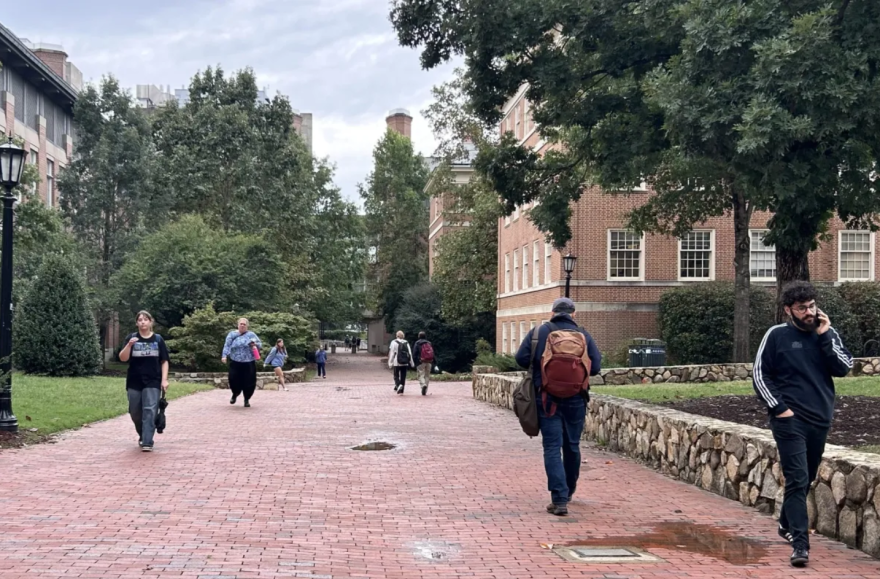
At a recent Faculty Assembly meeting, a body of delegates from each of the 17 UNC System institutions, Wade Maki, chair of the assembly and UNC-Greensboro professor, asked its members to raise their hand if they had colleagues who were afraid of losing their job because of something they said in the classroom. Every delegate raised their hand, acknowledging concerns about academic freedom.
He asked them again to raise their hand if they had colleagues who were afraid of losing their job because of something they posted on their private social media accounts. Again, every delegate raised their hand.
[Subscribe for FREE to Carolina Public Press’ Daily, Weekend and Election 2026 newsletters.]
“I can’t think of anything that better expresses the climate that we are in,” Maki said.
North Carolina has narrowly avoided being in the spotlight alongside the slew of universities to fire faculty over speech both in and out of the classroom. But just because it hasn’t happened yet doesn’t mean that academics feel entirely safe from the national phenomenon. Some say the anticipation is creating a culture of fear and self-censorship among faculty in the classroom and when interacting with the media.
‘Aggression’ toward academic freedom
Todd Berliner is the president of the recently revived American Association of University Professors UNC-Wilmington chapter. He and the eight others on the executive committee resurrected the chapter because of the “unprecedented aggression toward faculty and toward academic freedom that has erupted” in the last year, though it’s really been happening for nearly a decade, he told Carolina Public Press.
What were once commonly shared values in academia like shared governance and academic freedom have become politicized and challenged, Berliner said.
Several high-profile firings occurred this year due to professors speaking on issues related to gender identity — one at Texas A&M after a gender and sexuality lesson in a literature class and another at the University of Oklahoma after a psychology professor gave a student a failing grade on an assignment that cited the Bible to disagree with the notion that there are more than two genders. Both raised concerns about the state of academic freedom in higher education.
In September, an associate professor — a rank that typically indicates academics have obtained tenure at their institutions — at a small private North Carolina college declined an interview request from CPP because the person did “not feel it is safe to even report on academic/scientific expertise, as that is now often attacked, and professors are now being reprimanded/fired for taking such a stance.”
Instances like these indicate a newly aggressive climate toward the mission of academia and the open exchange of ideas, Berliner said.
“When faculty feel threatened and when this kind of aggression is directed toward faculty, we can’t do our best work, and we need to be able to think freely and expose ourselves and our students to whatever ideas are pertinent to the issues of the day and to history in order to gain understanding,” he said.
Aside from disagreements over course material, public statements on current events and other outside political activity have also resulted in retribution for academics. As many as 40 faculty members were fired this year over comments related to the assassination of firebrand conservative activist Charlie Kirk, the national branch of the American Association of University Professors told The Guardian in October.
Continue/Read Original Article Here: Culture of fear in places of learning. Faculty at NC colleges report anxiety over threats to academic freedom | WFAE 90.7 – Charlotte’s NPR News Source
Discover more from DrWeb's Domain
Subscribe to get the latest posts sent to your email.