

I grew up in an area of Southern California known for the beach, the ocean, the coastline, but my family lived far from the water, high in the hills of Laguna. In our car we wound up, up past parks and horse trails until we reached the end of a cul-de-sac, where our gardenia-studded yard overlooked the Ortega Highway. Nearly everyone I knew from school lived walking distance from the ocean, but my parents had chosen this place, inland, high up on the land. Every day involved this climb in a car, our house so far from the bottom that walking down was a fool’s errand, hiking back up in the heat a death wish.
When I was in my twenties, my parents planned their move back to France. All my mother wanted was to live in a small apartment within walking distance of town. After twenty-five years of driving up and down hills to run errands for her family, finally she would make her way on foot every day to buy fresh fruit, flowers, bread. I loved picturing her in this life.
Instead, my parents moved into a house too big for them, far, far up in the hills of Vence. They moved across the ocean to this other continent, to an area known for its turquoise coastline, its stretch of sea, its rocky shores, but my parents are inland, high up on the land, a small triangle of the Mediterranean vaguely visible from their gardenia-studded yard. They have to drive down endlessly winding curves for more than ten minutes every time they want to see friends, eat at a restaurant, buy a baguette. My mother never walks anywhere.
When I visit, we make our way down and back up the hill, down and back up, twice a day, four times a day, to go to the beach, to dine in town. I get violently nauseous on these drives, and often the nausea lingers as we eat our meal, tingeing whatever is in my mouth with a distracting dizziness. If my mother is driving, I can stomach it. But when my father drives, he races around each curve, braking harshly, then speeds back up again, bend after bend, turn after turn, while I grip the door handle, close my eyes, and breathe, willing myself not to throw up, not to voice the roiling rage I feel toward him, for keeping my mother trapped in a car, for insisting on living in this place far from everything, high up in the hills, where every time I visit I’m thrown into a constant state of vertigo and revolt.
My father does not want to show me the way….He does not understand why I would want to climb back up to the summit of his past. He does not understand that my future waits there.
My father says that after so many years in a house with a big backyard and privacy, he could never live on top of other people in an apartment building. He could never enjoy a patio knowing the neighbors could see him. This though my father spends most of his time inside, watching TV on a leather recliner, while the rest of us bask in our sunburns and the sounds of cicadas. This though my mother’s only wish is to live walking distance from town. My father is stubborn. He gets his way. He will live in the hills. He will die on this hill.
Last summer, I went to my father’s childhood home for the first time, outside of Beirut. In a country known for its sea, its coastline, my father’s family lived inland, high up on the land, in the hills of a place called Mechref. The word means “elevated,” “overlooking,” implying a location with a view of the surrounding landscape; it can also mean a lookout point, a place of keeping watch, or, alternatively, a place of shelter and refuge. We’d been in the car all day, driven to southern Lebanon so that I could see the Roman cemetery in Tyre described at the start of a book I’d recently translated. My father, my mother, and my partner had all tried to prevent this drive, fearful of Israel’s bombings nearby. But while we were in the south, Israel bombed the north, in an area we’d visited just the day before to see a different set of ruins. On our way back to Beirut, my father eagerly instructed the driver on how to reach his former home. We passed a checkpoint, crossed the threshold of a hill, and began our ascent. A familiar nausea began to simmer in my stomach, reaching toward my throat. Turn after turn, churn after churn. We sat in pools of our sweat and I gripped the door handle as my father regaled us with stories of his childhood. I’d never heard him speak so much about the past. He wanted to take us to the community club where he and his friends used to go for lemonade and a swim. But it was closed, and seemingly long abandoned. Half the houses we passed appeared uninhabited and dilapidated, overgrown shrubs and vines scaling outer walls and blocking driveways. We didn’t see a soul.
This place was a paradise, he said. A community of mostly expats, mostly Christians, where my father’s Lebanese Muslim family ended up because my grandfather knew the founder and admired his vision of a self-sufficient utopia, “New Mechref,” where the electrical lines would be buried underground. They were the fourth or fifth family to arrive out of fifty, and one of only two that were Muslim. He and his younger brothers would ride their motorcycles along the dirt paths, winding through the hills, racing at high speed. Once, a circus came to the area and promptly went out of business. My grandfather brought home one of the circus’s monkeys, which rode around in his car saluting passersby and had a room to itself until one day it attacked the youngest son and my grandmother forced him to give up his pet. I’m told my grandparents threw wild parties, loved life. I’m also told my grandmother had crippling physical and mental health issues, that she felt closest to her religion when most unwell.
When the Civil War began, the U.S. and U.K. citizens living in Mechref were evacuated in a convoy of fifty cars. Down, down they all went as they fled the country that had erupted into violent conflict that would last another fifteen years. One by one, the tight-knit community dwindled to just a few Lebanese households, including my father’s, left in this paradise perched on the hills. Soon the village below theirs, Damour, was invaded by Muslim forces, and the local Phalange militiamen guarding their Christian area informed my father’s family that they wouldn’t be able to protect them for much longer, that my father and his brothers were at risk of being kidnapped. It was time to flee. This was the beginning of an end for my father’s family. My grandfather traveled to Dubai to establish a new life for them there.
Meanwhile, as Phalange soldiers guarded their house, my twenty-year-old father went around selling electronics from my grandfather’s warehouse for cash, cash that my grandmother hid on her person when they left. My father drove his mother in a red Fiat—his two younger brothers in another car behind them— down the hills of Mechref, along the empty streets of Beirut, through checkpoint after checkpoint until they reached their cousins’ house (“your great-aunt Aida died yesterday, by the way,” he tells me when I ask again for the details of their escape) and finally the airport. Soon after, in a house visible through the windows of their own, their neighbor and the founder of this paradise was gunned down, along with more than twenty of his family members, staff, and bodyguards. Another neighbor heard the gunshots, took the man’s sons to the hospital, and they survived; one, still on crutches, went to live for a few weeks in Seattle with my father, who had gone there to continue his studies while the rest of his family started their new life in Dubai.
It took them two days to make their way out of those hills—those hills that had seemed high up and removed enough to be a refuge, with a vantage point that allowed them to keep an eye on the violence below (“Beirut had gone berserk” my father tells me). I ask how they were able to get through those checkpoints, why the Phalange militiamen were willing to help them. My mother assumes that my father paid them off; my father insists they paid no one. He grew up with those men in those hills, went to school with them, was in the boy scouts with them—they protected him because of their shared childhood. I ask a question I’ve never thought to ask before, whether he would have gone back to Lebanon if not for the war, and he surprises me by saying yes, that he’d always planned to take over his father’s business importing foreign electronics and appliances after college. Instead, he would go from Seattle to France to Bahrain to Munich to California and back to France, leaving Lebanon behind for good.
My father had not been back to his childhood home since that day in 1975. The summer he brought me there was in 2025. Fifty years later. Even so, when we reached the top of the hill, he knew exactly where to find his house. It didn’t look like anyone was living there, or had lived there recently. The small, almost heart-shaped pool was drained of water. There were no cars in the driveway. The gate was rusted. The gardenias were gone. There was no sound or movement. We stepped out of the car and stood before the gate and I saw something spectacular—the Mediterranean loomed so big I could only describe it as “fat.” An enormous swath of sea opposite the little balcony attached to his childhood bedroom. I’d never seen so much of it at once as from the top of that hill; I was in awe. The closest thing I could think of was the view of the Pacific Ocean from the house where his parents ended up in Southern California after their years in Dubai, Italy, and Seattle. It glints vividly in my memory because of a photo I have of my brother as a child standing next to my grandmother in her backyard, a miniature broom in his hand to match her full-sized one, the ocean winking behind them.
In her essay “The Matter of Setting,” published in the Lebanon-based journal Rusted Radishes, Lauren Alwan defines settings as static, things we can recall and recreate, versus places, which are inevitably “changed by time, by disaster, by the change that takes place inside us.” She tells the story of her Syrian grandfather, who left Damascus for Brooklyn to avoid being conscripted into the Ottoman Army, and retired forty years later “in Altadena, in a house reminiscent of the home he left with fruit trees and mountains in the near distance, and a patio off the garden like the courtyard houses in Damascus…, a setting he could claim as his own.” It brings me comfort to know that my Lebanese grandparents lived out the end of their lives in a house with the same view as the home they’d left behind, a recalled and recreated setting on the other side of the world.
Over and over and over my father has found this house, this hill, these winding roads of Lebanon, in America, in France. Every day he relives his youth.
My mother asked what happened to this house when they fled. My father had no answer. Technically they still own it, they never sold it. But probably many families have lived in it since, and a law was passed to protect squatters living in homes abandoned during the war. My mother urged him to find out, suggested that maybe we could come back and fix it up. He dismissed the idea with a wave of the hand as we turned our backs to the sea and walked to the car.
As we made our way back down, I winced at the curves and breathed deeply, willing myself to take in every last detail of this place I feared I would never see again, this perch my father was forced to flee fifty years ago. My father, who never talks about his past, about Lebanon. Who seems unfazed by the separation between him and his homeland, between his homeland and me, who refused to teach me his language or bring me to his country, only consenting to come when I’d been invited by a university in Beirut and informed him that I would be going whether he joined me or not.
My ancestry is a hill. I can’t see through it. I can’t hold it in my hand. It’s something I must surmount. Something that stands between. I know part of me is waiting on the other side, but I can’t find the path to the top to see what lies beyond. My father does not want to show me the way. He has set his sights on other lands and languages. He does not understand why I would want to climb back up to the summit of his past. He does not understand that my future waits there.
There are two letters in Arabic that more or less correspond to the English h: ه) haa) a soft h as in hello, or house, or hill; and ح) Haa), a hard h made by constricting the middle of the throat, as if fogging up a mirror, a pharyngeal fricative with no equivalent in English. I can’t pronounce this letter. My father didn’t teach me Arabic growing up; my throat was not taught to move those muscles and now I don’t know where to locate that elusive sound so present in the language, including at the start of the word for love, حُ بّ) Hubb). That Haa is a hill I may never hike up. It is one of the obstacles standing between me and me.
Another is that the English word love was rarely uttered, with no fricative to blame, in the place where I grew up, more of a house than a home. Spotless, constantly vacuumed, no trace of activity left anywhere. No magnets or homework assignments on the fridge, no art projects on display. We wore our shoes all day and all night. The wall-to-wall carpeting muffled our footsteps, concealing us from one another. The only sign of life was the stench of my father’s cigars, or the acidic tang of his espressos. And there was so much open, boundless space, so much air-conditioned air hovering in the hallways. There were rooms we never stepped foot in except to take posed family photos, and a formal dining room that remained set as if for a dinner party that very night, waiting for a cast of ghosts that would appear as soon as we went to bed, to feast as we slept.
We mortals sat at that table once a year, on Christmas. I can still reach out and touch the endless space between me and my family, invisible but insurmountable. Every night, after staring for hours at separate screens in separate rooms, we convened in the living room to stare at the same screen while we ate our dinners, with at least three feet between us in our separate chairs. Three feet that felt like thousands of miles, like the distance it takes to cross the Mediterranean Sea, the Atlantic Ocean, and all the way to the Pacific. One rupture morphed into another, one heartache passed down to another. All roads leading to that same word caught in the throat and staring up the same hill.
My Arabic teacher, a Lebanese woman I meet with virtually once a week, tells me that when she swims in the Minnesota lakes, she misses the salt of the Mediterranean in her mouth. She makes small sounds like a kitten lapping at milk as she imagines sifting through Minnesota lake water for the salinity of the sea. Her memory is visceral, alive, bodily. It’s hard to imagine my father having such a thought, so disconnected does he seem from the young boy whose balcony overlooked all that brine (“For some reason I wasn’t afraid,” he tells me, implausibly, as he describes his younger self driving his mother down the hills of Mechref, through checkpoint after checkpoint, past faction after faction). I spend most days yearning for the Mediterranean, as if I’d lived beside it for many years and long to return, though I’ve lived in the United States nearly all my life.
This reality does not align with the memories held in my body, or with what the sea contains of me. Perhaps because, in the words of Övül Ö. Durmusoǧlu in “Hope the Voyage Is a Long One,” “[t]he sea forms a core in the soul. Everyone born or ancestrally connected to the Mediterranean knows that is a kind of imprint that doesn’t ebb away no matter how far one travels.” The sea inside me longs to find its way back to that vastness. For as long as I can remember, I’ve taken a trip to the Mediterranean each summer, and as soon as I’m submerged, the sea pours into my ear stories of my past and future self. The rest of the year, it calls out to me like a familiar friend on the other side of a hill.
That summer day in the backseat of the car, as we descended the hills of Mechref, my partner turned to me and whispered: “Don’t you see? It’s the same hill.” And it was only then that I did see. Over and over and over, my father, incapable of sharing his past, my father, who has never indulged my desire to know my ancestry, who has seemingly cut Lebanon out of himself—over and over and over my father has found this house, this hill, these winding roads of Lebanon, in America, in France. Every day he relives his youth as he makes his ascent to higher ground, transporting us to that place lodged in a lost past, temporarily effacing the distance, a palimpsest of hills and childhoods superimposed over one another. At every stage of his life, my father has sought out that abandoned hill, set himself atop it.
______________________________
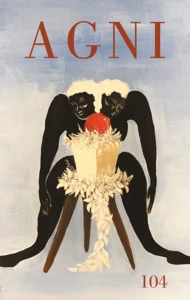
“My Father Is a Hill” by Emma Ramadan appears in the latest issue of AGNI. The new issue of AGNI includes Proximity: An AGNI Portfolio of Writing and Art by Women of Color.
Discover more from DrWeb's Domain
Subscribe to get the latest posts sent to your email.

