

Lee Holleman’s first impression of the campus left her flat. It looked undernourished, somehow: a sense of architectural scrawniness. “The University of Tennessee was overrun with students from Hoboken…[and] New Jersey,” she recalled. “They had no complaints about Knoxville and I had a million. They seemed to adapt extremely fast while I…struggle[d].” She had traveled from Wynne, Arkansas, to major in the liberal arts. “I couldn’t believe it when I first arrived [in Knoxville] to discover…a place more like Arkansas than Arkansas was…Arkansas [had] changed but this place [was] stubbornly not giving an inch mentally or emotionally.”
Meanwhile, the man she’d soon meet and marry was also struggling with his homecoming to Knoxville. On October 2, 1957, The Knoxville News-Sentinel reported, “C. J. McCarthy Jr. accidentally shot.” The facts, as portrayed in the News-Sentinel and The Knoxville Journal, were wildly inconsistent, one reporting that he underwent leg surgery, the other that he’d shot himself with a .22-caliber rifle during target practice and that the wound was not serious: The bullet lodged just below the surface of the skin. His mother said he wasn’t carrying a rifle at all at the time. He was “returning [a] pistol to its holster and the trigger accidentally caught on the holster causing the weapon to discharge,” Gladys said—sounding strangely official. Whether drinking was a factor in the incident, no one was saying.
The answer lay not in modern industrialism, they said, but in Southern agrarian traditions, family farming, which imparted the wisdom of self-sacrifice, a spiritual focus, and a commitment to community.
After his discharge from the air force, Cormac McCarthy had hitchhiked around the country for a few months. In the fall of 1957, he was back in Tennessee. He re-enrolled in the university because the GI Bill provided support and he didn’t want to work. “[I] wandered from one department to the next taking what courses I thought would please me, like a drunk in a supermarket,” he said. He signed up to study physics and engineering, but he also took Expository Writing: Modern Essays and Composition and Writing of Fiction from an instructor named Robert Woodham Daniel. Daniel also sat on the advisory board for the student literary publication the Phoenix.
McCarthy had little patience for literary theory (though later he’d become fascinated with Ludwig Wittgenstein’s philosophical investigations of language and language’s relationship to the unconscious). Rather than theory, he was after pragmatic components of writing, but in classrooms he naturally absorbed scraps of academic ideology. In the 1970s, he’d tell a student of psychiatrist Robert Coles, “An intellectual is a person who feels that his learning—and it may be pitifully little—entitles him to status. People who really do know are inevitably returned to the common ground of man.” His insistence that the goal of knowledge was to understand the “common ground of man” shows how thoroughly the thinking of the Southern Agrarians entered him on his brief return to school.
The Agrarians were a group of prose writers, poets, and critics, among them Allen Tate, John Crowe Ransom, and Robert Penn Warren (whom McCarthy would come to know), largely associated with Vanderbilt University. They proclaimed that literature’s primary purpose was to engage the question “Whom and what shall our souls believe?” The answer lay not in modern industrialism, they said, but in Southern agrarian traditions, family farming, which imparted the wisdom of self-sacrifice, a spiritual focus, and a commitment to community.
The group called itself the Fugitives in the 1920s before adopting the Agrarians label. In their utopian reconstruction of a mythic past, the Agrarians’ polemics failed to mention the South’s legacies of slavery and rebellion. The men stated their vision most boldly in the 1930 manifesto I’ll Take My Stand: The South and the Agrarian Tradition. They called for a “violent” break from the modernist present: “[A]n agrarian society…[values] a form of labor that is pursued with intelligence and leisure, and that becomes the model [for other pursuits]…[T]he culture of the soil is the best and most sensitive of vocations.”
McCarthy believed “there’s no reason to…blot the page with weird little marks….I mean if you write properly you shouldn’t have to punctuate.”
The Agrarians were still deeply influential in the academy, especially in the South, when McCarthy re-enrolled at the University of Tennessee, but they had refined their approach. Their aesthetics had become an essential foundation for what came to be New Criticism. New Critics insisted that a text’s value lay solely in its language. Literature was organic, like the soil: Adding anything to try to enrich it—theory, history, biographical knowledge—was to ruin it. Only its formal properties mattered, but it was taught at the time as a “branch of history,” Tate lamented. Students were learning dates and terminology instead of poetry.
Of more immediate interest to McCarthy were arguments about what his favorite Southern writers—Faulkner, Erskine Caldwell, Eudora Welty, Flannery O’Connor—were up to. Among literary critics, “Southern gothic” had become a common term—somewhat derisive—seeking to account for the prevalence of dreary, decadent settings and disfigured characters in Southern fiction. In the nineteenth century, many Romantic novels, among them Wuthering Heights and Frankenstein, as well as the stories of Edgar Allan Poe, dwelled on the grotesque and the fantastical in order to expose the social rot beneath the glorious facades of manor houses, castles, and well-ordered municipalities. Similarly, after the traumas of the Civil War and Reconstruction, some Southern writers emphasized aberrant behavior to undercut the aristocratic whitewash of gentility and custom.
Novelist Ellen Glasgow had coined the term Southern gothic in her 1935 essay “Heroes and Monsters” for The Saturday Review of Literature. She both praised and faintly damned the “fantastic nightmares of William Faulkner.” His writing, she said, caught the South’s ongoing social turmoil. But, she warned, “the literature that crawls too long in the mire will lose at last the power of standing erect. On the farther side of deterioration lies the death of a culture.” She pleaded with contemporary Southern writers to “deal as honestly with living tissues as…[with] decay”: “[O]ur age” has many more hues than “the colors of putrescence.”
In his classes, Professor Daniel covered the Agrarians and the pros and cons of the gothic, but he was much more passionate about literary structure and the craft of writing. His interests suited McCarthy, and McCarthy’s skills helped him in turn. Daniel hired the young man. The professor was editing a textbook, The Written Word: Forms of Writing (it would appear in 1960). “[P]art of the text book was English essays from the 18th century. And [Daniel] handed me a bunch of these,” McCarthy recalled. “He said, ‘re-punctuate these things.’ And I was getting paid to do this…[S]o I took them home, and it was just, you know, [the writers] wrote so well and they punctuated so poorly. And every few lines…it would be a semi-colon and it was just terrible.”
McCarthy believed “there’s no reason to…blot the page with weird little marks….I mean if you write properly you shouldn’t have to punctuate.”
He remembered that one of the essays was by or about “[Jonathan] Swift or someone.” He removed most of the commas, brought it to Daniel, and the professor said, “This is very good. This is just what is needed.”
Swift’s “A Modest Proposal” appeared in The Written Word. Wes Morgan determined that “21-percent” fewer “weird little marks” graced the anthology’s version of the essay than Swift’s original 1729 pamphlet. McCarthy had streamlined Swift for the modern world.
He continued the reading regimen he’d begun in Alaska. And he started to think “I could probably [write novels] too and probably do it better….[I]f someone has a talent and they sit down and discover that talent, there is a sense of power and a sense of mystery about it. There’s a feeling that you’re on the verge of creating something that has some significance.”
He began to consider, seriously, the idea of being a writer—“I don’t know why….[P]eople [ just] like to do things they’re good at,” he said.
In general, he had a “sense of…the world” that left him “very exercised”: This gave him subject matter. He knew he wanted to tackle issues “that [were] troubling to the human soul,” not “what Bob said to Alice in the drawing room one evening. I mean, I [didn’t] understand Proust or Henry James or any of these people that don’t write about matters of life and death. To me, that’s not literature.”
“I didn’t have too many doubts about my abilities,” he added. He’d known since he was eight years old that he could write. “The only thing that worried me was—what is it Melville says? ‘O time, patience, cash!’ Mainly the cash. You’ve got to figure out how to eat while you’re doing this.”
McCarthy’s fresh devotion to reading and writing was like a cypress stump in the middle of a stream, impeding the easy flow of his social life.
During breaks between school terms, or in the summers, he rarely stuck around Knoxville. He found the family stifling. Knoxville’s racism, always overt, struck him more forcefully than ever.
One day, as he was walking in downtown Knoxville, a Black man passed him singing The Clovers’ “One Mint Julep.” In that instant, he knew the world was going to change. “It clicked in me,” he said. “These old, old cultures that had long been demonized—they had so much magic in their music, it transcended everything.” Forget politics or social movements. This amazing energy, the vitality, simply could not be repressed.
Once, on a school break, he escaped Knoxville, hitchhiking to Georgia. He took a ferry to go hunting on an island off the coast. On the way over, he asked the ferryman if mosquitoes were a problem here. “Oh yeah. Big problem,” the ferryman answered.
“How big?”
“Mister, the mosquitoes get so big here, they can stand flat-footed and fuck a moose.” Dennis remembered his brother writing this scene into a story he later threw away.
At home, McCarthy enjoyed his friends from the old days. He remained loyal to them all. He hit the bars with J-Bone and Junior, Conrad Payne, and the Clancy brothers. Even without the threat of a run-in with Tarzan Gwinn, it was hard to stay out of trouble late at night, and on occasion the trouble got more serious than in the past. The liquor was stronger and consumed in greater quantity. “Junior had the worst temper of all of them,” Walt Clancy said. “Soon as he’d graduated high school, he joined the Marines, and when he got out, he started drinking too much and he fell in with some bad guys.
One night they decided to rob the Magnolia Drugstore, corner of Magnolia and Milligan Street. “What Junior told me…he was in the car, asleep, while the others went in. He was just drunk. But he did some serious jail time.” By now, Bobby Davis and Hoghead Henry were dead from the collision of guns and booze. Byrd Slusser and Donald Bowling would follow within a year. McCarthy hung back whenever a fray dusted up (“he hated like hell to get in fights,” a friend of his recalled), and J-Bone tempered himself a little, “which is why they lived to be old men and the others didn’t,” Clancy said.
McCarthy’s fresh devotion to reading and writing was like a cypress stump in the middle of a stream, impeding the easy flow of his social life. “[T]he fact of being a writer or aspiring to be a writer placed him in a lonely world,” said Richard Marius. McCarthy’s family and the other middle-class citizens of Knoxville had “nothing to offer” his sensibility, so he decided to “fix his attention on the vast and visible underclass,” the society of outcasts—but even there, as an “educated person in an uneducated world,” he didn’t quite belong.
So he’d leave town and return when school started again. In these short spans of time, the changes that occurred in the city or among his friends left him more disoriented than ever. The collapse of the past he’d sensed when he’d shipped out for basic training appeared to be accelerating.
He spent the summer of 1959 hitching to California: his first immersive view of the West, aside from the time he’d spent in Seattle awaiting his discharge. The snow-damped Alaskan tundra remained sharply in his mind as he walked the Southwestern deserts. In his imagination these eruptive landscapes overlaid each other like palimpsests.
He made a trip to San Francisco especially to see the Beat poets’ haunts. Beat writing—its jumpy jazz rhythms light and alliterative, so unlike Faulkner’s sonorous throat clearings—did not jive with McCarthy’s other influences. But he took seriously the work of Kerouac and Ginsberg and the Beat precursor Henry Miller. It was not their styles that struck him, particularly, but their brashness, like the overweening assurance of Frank Lloyd Wright, their attitudes and their views of the world, especially the nihilistic strain in some of the writing. To a fellow Southern novelist, John Fergus Ryan, he’d say of Henry Miller, “I love that old man, he’s largely responsible for me becoming a writer,” by which he meant Miller’s fuck-you confidence permitted him to believe he could make literature, too.
In San Francisco, McCarthy didn’t encounter any of the Beats, but he did meet a strange figure who’d prove to be a lifelong friend, an unforgettable companion, and a sometimes scary pain in the ass.
Kerouac published On the Road the year McCarthy returned to the University of Tennessee. The book made its way around campus, and McCarthy paid attention. In April 1958, he published a letter to the editor in the biweekly news magazine, The Reporter. He was responding to an article in the magazine by the political scientist and novelist Eugene Burdick. Burdick had written a piece entitled “The Innocent Nihilists Adrift in Squaresville.” McCarthy called it “far and away the most comprehensive article on the ‘beat generation’ that I have read.” His response to Burdick’s piece gives us insight into his mental framework just as he was committing to a life of writing.
Burdick had written that the “hipsters,” the authentic Beats, were surrounded now by people “who are merely curious, who want to see the vision but not be in it, who have a contempt for Squaresville but live there, who dig jazz but don’t live it”:
The real hipster “lives it,” he cuts loose from all the square’s restraints and chews into the present, burns with enthusiasm, has a precious spongelike quality of soaking up experiences and a disbelief that they can ever be squeezed out into sensible drops….[T]he hipster is committed, gone, burning.
McCarthy knew he was poised between the poles Burdick described, intensely curious, living in Squaresville (Knoxville, the university), but longing to burn and be gone. Burdick elaborated:
The battle between the generations has always existed. What makes the hipster different is that he knows the battle is hopeless, that he is bound to lose, and that by fighting he merely exhausts himself and gives the squares comfort. This is what the calm, icy imperturbability of juvenile delinquents means when they put their faces under the bright lights for a police line-up. They don’t get hysterical and shout or try to explain. Why explain that their marijuana “tea parties” and kicks in a stolen car and sexual indulgences are little things compared to the barely controlled violence of adults who allowed a world war, cold war, and Korea? They see the adult world as senseless, hypocritical, violent, and essentially beyond redemption.
Burdick seemed to have drawn directly from McCarthy’s experience, the hopelessness of fighting with his father over a world his father had already ruined, the surrender to indulgence and mindless violence because…why not?
The icy touch of war, wherever he looked beyond his beloved woods. The overall quality of the Beats’ work was suspect, but the Beats had proven that a libertarian sensibility like McCarthy’s could unleash a powerful stream of language.
In Suttree, he would acknowledge his debt to the hipsters, alluding to a line in Howl where Ginsberg celebrated “the absolute heart of [poetry], good to eat a thousand years.” Suttree echoes the poet while lamenting the interstate’s destruction of McAnally Flats, pausing to recall the old McAnally, “good to last a thousand years.” In an earlier scene, Suttree hitches a ride with a man driving “an old Hudson” on a rainy night. A 1949 Hudson figures prominently in On the Road. In Kerouac’s sketchbook for the novel, he says he once drove his car through Knoxville. While traveling one night in the South, he stopped for a bedraggled hitchhiker in the rain.
In San Francisco, McCarthy didn’t encounter any of the Beats, but he did meet a strange figure who’d prove to be a lifelong friend, an unforgettable companion, and a sometimes scary pain in the ass.
John Sheddan—“Long John”—was a large, hulking man with feet as big as snowshoes. An on-again, off-again student at the University of Tennessee, he lived with his mother in her Knoxville house. Like McCarthy, in the summer of 1959 he’d gone to San Francisco to meet the “beatnik heavies.” He took great pride in the fact that he and Jack Kerouac both lived with their mothers.
In a 1996 e-mail to McCarthy scholar Marty Priola, Sheddan described his introduction to McCarthy: “I had been roaming the streets of North Beach and haunting the coffee houses, especially the Co-Existence Bagel Shop. I didn’t meet any of the…heavies, but I saw a skinny pale-faced chap in an old fatigue jacket wandering about the streets.”
Dennis Francis, who knew both men, said, “Sheddan was hustling two gay guys who drove a Cadillac convertible that was about eight blocks long. They’d wrecked the convertible in front of the City Lights Bookstore. There was a portable record player in the back seat—this was in the days before tape decks and stuff—and the needle was skipping…anyway, Sheddan looks up and Cormac walks by, wearing a navy pea coat. Cormac was probably looking for a way to try to save a quarter or something. He was such a cheap son of a bitch!”
Sheddan added, “A few weeks later, when I [returned to Knoxville and] walked into the student center at UT, I saw [this chap] again.
__________________________________
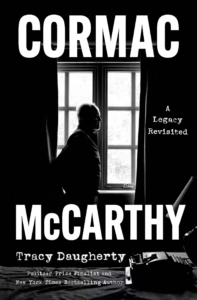
From Cormac McCarthy: A Legacy Revisited by Tracy Daugherty. Copyright © 2026 by the author and reprinted by permission of St. Martin’s Publishing Group.
Discover more from DrWeb's Domain
Subscribe to get the latest posts sent to your email.

